
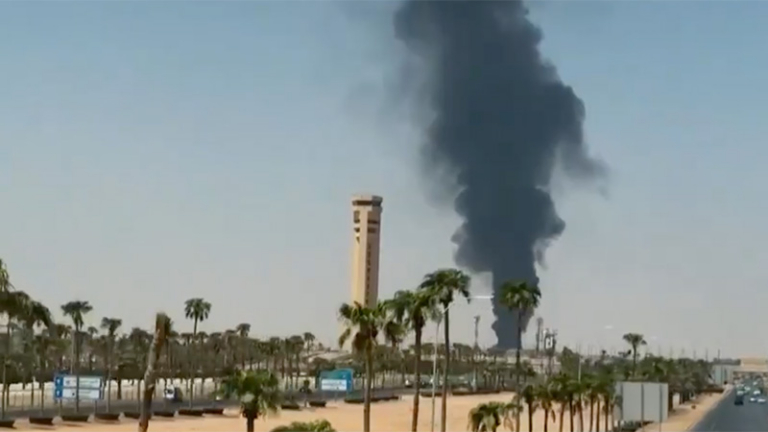
On October 5, 2026, Yemen’s internationally recognized government began an offensive with support from Saudi Arabia to retake the territory taken by Ansar Allah, also known as the Houthis, the previous month. On September 10, the Houthis seized the coastal city of Mokha, rapidly overrunning Yemeni government forces and taking the strategic Bab al-Mandab Strait. The Saudis supported their allies with airstrikes on Houthi positions. The Houthis subsequently targeted economic facilities in the south and west of Saudi Arabia, hitting fuel tanks near Riyadh’s main airport. These attacks came just two months after the Houthis closed Bab al-Mandab to Saudi oil tankers—a route which the Saudis were using as an alternative to the Strait of Hormuz, thus forcing their ships to take an even longer detour to Asia via the Suez Canal.
These events have upended the delicate April 2022 ceasefire between the Houthis and the Saudi-backed Yemeni government and now risk a wider confrontation. The Saudis face a difficult path ahead, as they must convince their allies to join the armed conflict against the Houthis. The United States has refrained from giving direct military support in Yemen, and European allies have offered only limited military assistance. On October 5, 2026, Pakistan and Turkey committed to send troops to Saudi Arabia under the Mecca Joint Defense Agreement signed in August. However, representatives from both Turkey and Pakistan have clarified that their troops will be playing a supportive rather than active combat role against the Houthis.
Saudi Arabia’s current crisis in Yemen has far-reaching implications for the future of the kingdom’s alliances, especially the US-Saudi security partnership, as well as for Saudi Arabia’s position amid broader conflicts across the region. The Houthi strikes have also contributed to Saudi’s broader economic woes. Beyond the risks to its Vision 2030 project, the kingdom faces a growing economic deficit, as well as short- and medium-term decreases in its share of the oil market. Facing such challenges, the Saudis have chosen to confront the Houthis. Will their allies help in this fight?
Options for Confrontation
Since April 2022, the Houthis and Saudi-backed forces of Yemen’s internationally recognized government largely maintained a truce. The truce was seriously tested in July 2026, however, when an Iranian civilian aircraft carrying a high-level Houthi delegation that had attended the funeral of Iran’s former Supreme Leader Ali Khamenei attempted to land in Sanaa International Airport without prior permission from Yemen’s internationally recognized government authorities. Saudi-backed government forces struck the runway and prevented the plane from landing, in a move that effectively reimposed the pre-truce blockade of the national airport. Saudi Arabia rejected the Houthis’ demand to lift the blockade, prompting the movement to declare a naval blockade by targeting Saudi oil tankers and denying them transit through the Bab al-Mandab Strait. Both sides subsequently escalated their attacks: the Saudis struck Houthi-run areas in Yemen, while the Houthis targeted Riyadh and struck Aramco facilities in southern Saudi Arabia.
On October 5, 2026, Saudi-aligned forces in Yemen began a major military offensive to recapture areas around Bab el-Mandab. Riyadh now has few good options for its next move. Continued confrontation with the Houthis until the movement retreats will be costly, with few guarantees of success. Saudi-aligned forces in Yemen have previously struggled to defeat Houthi forces, while also suffering from internal divisions and difficulties in recruitment. If Riyadh instead decides to reach an agreement with the Houthis, the Saudis will then need to coexist with a movement that is aligned with their primary regional adversary, Iran, that could potentially threaten the kingdom from the south. The effective outcome for Riyadh would be a strategic loss in Yemen.
Anti-Houthi forces may be able to retake territory in Yemen and prevent subsequent expansion, but they are unlikely to defeat the Houthis entirely.
In the coming weeks, anti-Houthi forces may be able to retake territory in Yemen and prevent the movement from subsequent expansion. But previous experience suggests that they are unlikely to defeat the Houthis entirely. Saudi Arabia will then likely continue to support the internationally recognized government and look for additional allies in the conflict.
The Search for Allies
On September 11, 2026, Saudi Crown Prince Mohammed bin Salman requested support from US President Donald Trump to fight the Houthis, which Trump refused. Although US CENTCOM Commander Bradley Cooper traveled to Saudi Arabia, he only offered intelligence support that the Saudis had already been receiving. US officials then met with Houthi representatives in Oman to ensure that US ships could safely pass through the Bab al-Mandab Strait. The Saudis were reportedly frustrated by the meeting and the lack of further US assistance at a moment when their security and economy seemed to be targeted.
The Trump administration’s response on Yemen is potentially eroding Saudi leaders’ confidence in US security guarantees in the Gulf, especially as Washington considers reducing its military footprint in the region and moving its bases to areas further away from Iran in locations such as Israel, Jordan, and western Saudi Arabia. But despite growing Saudi frustration with the lack of US support and weakening confidence in Washington’s security guarantees, the US-Saudi relationship has not been fundamentally transformed by the crisis. The July 2026 US-Saudi nuclear deal and Washington’s preliminary approval in September of F-35 aircraft sales to the kingdom show that the US-Saudi partnership remains solid. Yet by refusing to defend Saudi Arabia directly, the US is showing the limits of its security guarantee to the kingdom, which may embolden adversaries who see such limits as a sign of diminished US deterrence that only undermines Saudi’s position in the region.
The Trump administration’s response on Yemen is potentially eroding Saudi leaders’ confidence in US security guarantees in the Gulf.
Riyadh has few options outside of the US. The Mecca agreement is still in its infancy, and it remains to be seen how Pakistan and Turkey’s limited troop deployments will affect the conflict. The Europeans have also agreed to modest defensive support, with France offering troops to protect the oil port of Yanbu. The United Kingdom has also agreed to refuel Saudi aircraft conducting strikes over Yemen. In the meantime, Saudi Arabia is attempting to repair its alliance with the United Arab Emirates (UAE) in Yemen in a bid to obtain further military support against the Houthis.
UAE forces left Yemen in December 2025 after the Saudis accused the Emirates of supporting forces aligned with Southern Transitional Council (STC), which had threatened their southern border. On September 29, 2026, Emirati Vice President Mansour bin Zayed visited Riyadh for discussions about the future role of the STC in Yemen’s internationally recognized government and banning the Saudi-aligned Islah Party, which the STC and UAE are lobbying the US to designate as a terrorist organization. The UAE is also seeking greater support for militia groups that have fought the Houthis in southern Yemen, including the UAE-aligned Southern Giants Brigades led by Abu Zara’a al-Mahrami and the National Resistance led by Tareq Saleh. While such demands may be difficult for Saudi Arabia to accept, it may agree to a compromise in return for the UAE’s military support against the Houthis.
Fear of a Declining Regional Role
Despite their limited options, the kingdom and its allies in Yemen chose to confront the Houthis even before the October 2026 offensive. As early as September 8, Yemen’s internationally recognized government launched a ground offensive toward Sanaa with Saudi air support. On September 25, Saudi Arabia’s Grand Mufti called on the country’s troops to sacrifice their lives in the fight against the Houthis. A day later, the Yemeni government called for a national mobilization against the Houthis.
Riyadh’s approach to the conflict in Yemen reflects the kingdom’s hardening stance against Tehran.
Riyadh’s approach to the conflict in Yemen reflects the kingdom’s hardening stance against Tehran. On September 14, 2026, Saudi Arabia reportedly rejected the Iranian proposal over control of the Strait of Hormuz. The Saudis also appear to be urging the United States to continue its naval blockade on Iran without reinstating the June 2026 Islamabad Memorandum of Understanding, effectively increasing economic pressure on Iran without resorting to direct military action. Such an approach would presumably weaken Iran and deny it outright victory, while sparing Saudi Arabia from retaliatory Iranian strikes against its military and economic infrastructure. Saudi Arabia’s position is understandable, considering it stands to lose much in terms of its regional influence should Iran emerge from the war in control of Hormuz, free of economic sanctions, and retaining regional influence through its allies in Iraq, Lebanon, and Yemen. However, strangling Iran economically may push Tehran towards a wider military escalation that once again targets the Arab Gulf states and harms their already damaged economies. Riyadh would then effectively face conflict on two fronts.
Conclusion
The conflict in Yemen has placed Saudi Arabia in a difficult position. To turn the tide against the Houthis, Saudi Arabia is hoping to further mobilize its allies, particularly the United States, to intervene in Yemen and prevent the wider regional conflict that the kingdom has long sought to avoid. Thus far, however, support from Saudi allies has been limited. But even with greater US assistance, success is not guaranteed. In 2025, a US bombing campaign that lasted more than fifty days and estimated to have cost more than $1 billion was unable to defeat the Houthis militarily.
Riyadh’s military offensive aims to retake Bab al-Mandab from the Houthis before considering any kind of settlement with the movement. To be successful, the operation will require substantial ground forces, while inflicting serious economic costs—especially if the conflict turns into a prolonged war of attrition. Saudi Arabia has no ideal options in this complex regional reality. And every option carries a high price.
The views expressed in this publication are the author’s own and do not necessarily reflect the position of Arab Center Washington DC, its staff, or its Board of Directors.
Featured image credit: Screencap via X