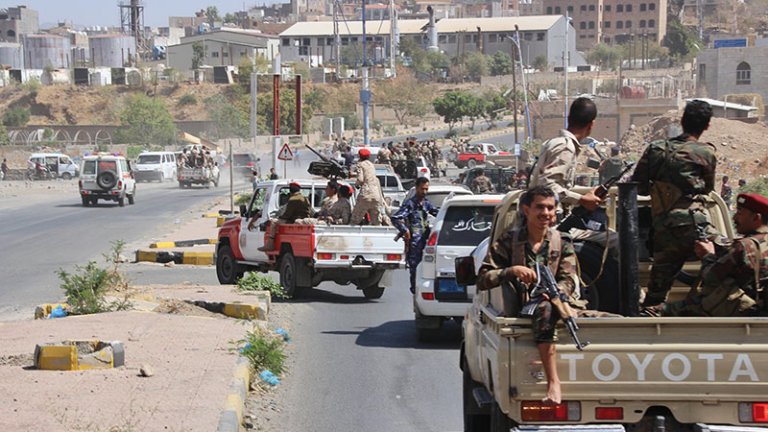
When Ansar Allah—commonly referred to as the Houthis—seized Yemen’s Red Sea coastline and strategic islands in the Bab al-Mandab Strait on September 10, 2026, they appeared to gain the upper hand in Yemen’s long-running conflict. However, in early October Saudi-backed government forces began to retake some of the captured territory and Saudi Arabia launched a punishing assault on Houthi positions from the air. France, Pakistan, and the United States have all sent personnel to help the kingdom counter the Houthi offensive.
Outside the region, some have portrayed the Houthi offensive as another theater within the broader US-Israeli war on Iran. However, this broader regional war is separate from the war in Yemen, which can be traced back to the Houthi takeover of Yemen’s capital Sanaa in September 2014 and the decision by neighboring Saudi Arabia to launch a coalition to oust them in March 2015.
While the Houthis are certainly allied with Iran and benefit from the weapons and support that Tehran has covertly provided them since at least 2009, they have their own agenda: to consolidate their control over Yemen. They would pursue this political objective even if Washington and Tehran somehow agreed to end the war that Trump rashly launched. Still, their recent decision to escalate does reflect the sense of momentum produced by Iran’s success in withstanding American and Israeli attacks. Thus, even as these two conflicts are distinct, the Iran war is both exacerbating and heightening the effects of the violence in Yemen.
The Houthis’ Red Sea Offensive
The catalyst for the latest round of violence came on July 13, 2026, when an Iranian civilian plane—carrying a Houthi delegation that had attended the funeral of Iran’s assassinated Supreme Leader, Ayatollah Ali Khamenei—returned to Yemen. When the plane attempted to land at Sanaa International Airport, the runway was bombed. Yemen’s internationally recognized government—under the leadership of the Presidential Leadership Council (PLC)—took responsibility for the attack, while the Houthis blamed Saudi Arabia, which supports the PLC. As a result of the attack, the plane was forced to land in Houthi-controlled Hodeidah. On July 20, the Houthis announced a blockade on Saudi Arabia, targeting oil exports through the Bab al-Mandab Strait in retaliation for its attacks and ongoing restrictions on Houthi-controlled territory. The Houthis subsequently targeted Saudi petroleum facilities and oil tankers in the Red Sea.
The attack on Sanaa Airport officially ended the truce that had largely held between Saudi Arabia and the Houthis since April 2022.
The attack on Sanaa Airport officially ended the truce that had largely held between Saudi Arabia and the Houthis since April 2022. Even before this incident, however, the Houthis appeared to have already been preparing for a return to conflict, mobilizing their fighters and moving materiel into position. In a June 16, 2026, speech, the Houthi leader Abdul Malik al-Houthi announced that the group was ready for combat and called for official and grassroots action to end what he described as more than 11 years of Saudi aggression and blockade.
The speech shifted the Houthis’ narrative away from their support for Palestinians, which had become central to the group’s domestic legitimacy in the context of Israel’s ongoing assault on Gaza since October 7, 2023. In subsequent months, as the Houthis began striking Israeli ships in the Red Sea in retaliation for their violence against Palestinians, their credibility at home substantially increased, helping paper over their repression and failure to improve the daily lives of Yemenis under their control. The Houthis’ support for Palestine also drove recruitment and raised their international profile. Yet the group also paid for its solidarity with Palestinians, with the United States and Israel hitting Houthi areas with deadly air strikes. In August 2025, Israel assassinated several Houthi cabinet ministers, including the prime minister. Following Netanyahu’s stated commitment to a ceasefire in Gaza in October 2025, the Houthis signaled a pause in their campaign against Israel. Despite Israel’s daily violations of said ceasefire, the Houthis have limited their attacks on Israel, an indication that the group may wish to avoid returning to open conflict with Tel Aviv. Instead, the Houthis shifted focus to Riyadh’s restrictions on their airspace and seaports, as well as Saudi support for the various competing groups that oppose Houthi rule.
The Houthi Resurgence
Over the past four years, the Houthis have improved their military capabilities. Increasingly, they can manufacture weapons inside Yemen, although a network of providers, including Iran, continues to provide the raw materials and other components they need. Analysts have claimed that the Houthis have been bringing in large shipments of military material, equipment, and weapons. There are also reports that they have used Claude, Anthropic’s AI tool, to develop guided weapons. As early as 2017, the Houthis experimented with the use of a drone boat, and in the years since have remained at the cutting edge in terms of their use of emerging technologies to threaten adversaries with far more resources and firepower.
The Houthis’ ability to swiftly seize the Red Sea coast from forces loyal to the PLC was further facilitated by the withdrawal of the United Arab Emirates (UAE) from Yemen in January 2026 under pressure from Saudi Arabia. Until early 2026, the UAE provided significant assistance to Yemen’s southern secessionist movement, led by the Southern Transitional Council (STC). The chairman of the STC, Aidarous al-Zubaidi, was also a member of the PLC. However, in December 2025, STC forces suddenly took large swathes of territory in eastern Yemen, which included areas along the Saudi border in the provinces of Hadramawt and al-Mahra. Saudi Arabia responded quickly, bombing Emirati ships transporting weapons to the STC and insisting that the UAE fully withdraw from Yemen. Under Saudi pressure, the STC leadership announced the dissolution of the group, while al-Zubaidi fled to the UAE. The PLC rescinded al-Zubaidi’s membership of the council along with another STC ally, the former governor of Hadramawt, replacing them with two new figures. Yet Saudi Arabia’s attempt to quash the STC hardly quelled demands for southern independence. Instead, it appeared to alienate separatists who previously supported the PLC in the hopes that by doing so, it would lead to an independent southern Yemen.
The PLC’s initial inability to repel the Houthi advance along the Red Sea coast in the current conflict—even with Saudi backing—was seen as a sign of the ruling government’s overall ineffectiveness.
The PLC, in turn, owes much of its own rise to power to Saudi Arabia. After the Arab Spring protests forced President Ali Abdullah Saleh to step down and end his more than 33-year rule over Yemen in 2012, Abdrabbuh Mansur Hadi led the internationally recognized government that replaced him, initially with Saudi support. What was meant to be a two-year interim position for Hadi, however, turned into ten. His rule finally ended when Saudi Arabia withdrew its backing and transferred authority to the PLC. The PLC initially comprised eight men, four aligned primarily with Saudi Arabia and four with the UAE.
These dynamics created deep internal divisions in the PLC, which has also been accused of corruption and an inability to improve the quality of life for the population under its authority. Some Yemeni critics have called for reforms to make the PLC more accountable and representative of all Yemenis. In response to such criticisms, in January 2025, PLC chairman Rashad al-Alimi announced a crackdown on corruption. Nevertheless, the PLC’s initial inability to repel the Houthi advance along the Red Sea coast in the current conflict—even with Saudi backing—was seen as a sign of the ruling government’s overall ineffectiveness.
Riyadh and the Houthis: What Do They Want?
Over the course of the Houthis’ war with Saudi-backed forces from 2015 until 2022, the group advanced its military capabilities, largely through covert Iranian support. The turning point in this war came in March 2022, when the Houthis hit Saudi Arabia during the Formula One Saudi Arabian Grand Prix in Jeddah. The attack showed the Houthis were capable of not only deterring tourists and investors from coming to Saudi Arabia but also threatening the success of Crown Prince Mohammed bin Salman’s ambitious Vision 2030 plan to transform the kingdom’s economy and society. Only after the attack did Saudi Arabia agree to a two-month United Nations (UN)-brokered truce in April 2022.
By March 2023, Saudis were reportedly eager to find a longer-term agreement to end their costly and ultimately futile involvement in Yemen. Over the next few months, Riyadh engaged in direct talks with the Houthis, mediated by Oman, in pursuit of that goal, resulting in a broader UN-brokered roadmap agreement in December 2023. Under the terms of this agreement, Saudi Arabia would reportedly pay public sector salaries, including in Houthi-held territory, and would ease restrictions on air and seaports. The deal would have also enabled the resumption of oil exports and initiated an inclusive, Yemeni-led political settlement under UN auspices. In effect, the deal would have disempowered the PLC, which depends largely on Saudi support. When the Houthis initiated hostilities against Israel in late 2023—which prompted the US to launch Operation Prosperity Guardian against them in response—the Saudis were notably absent, unwilling to risk a resumption of transborder attacks.
The Houthis’ flight back and forth from Tehran in July 2026 appears to have crossed a red line for the Saudis.
However, the Houthis’ flight back and forth from Tehran in July 2026 appears to have crossed a red line for the Saudis, and Riyadh feared that showing restraint in this case would merely embolden the Houthis further. In the context of the Iran war and the closure of the Strait of Hormuz, Saudi Arabia relied more heavily on exporting oil through the Red Sea. When the Houthis began targeting Saudi oil infrastructure, Mohammed bin Salman likely believed that the US would intervene to deliver Saudi oil to the global market. However, Trump’s refusal to directly aid the Saudis in their conflict with the Houthis appears to show Washington’s reluctance to reopen a sustained Yemen campaign while heavily committed elsewhere in the region.
Riyadh’s Strategic Options
At present, Riyadh faces three options: 1) attempt to reverse Houthi gains militarily through continued partnership with the PLC; 2) shift support to the southern separatists in the STC; or 3) renew negotiations with the Houthis in preparation to withdraw from Yemen. Currently, the Saudis appear to be pursuing the first option. Although the US has declined to resume air strikes on Houthi positions, the United Kingdom is refueling Saudi planes over Yemen. France has also announced that it will send troops to the Saudi city of Yanbu to help secure energy sites. Pakistan began sending troops last year, with between 30,000 and 40,000 reportedly deployed to Saudi Arabia, although not to the front lines in Yemen.
Still, the longer-term viability of the PLC remains in question. The fecklessness of the PLC, in contrast to the relative effectiveness of the STC, has prompted some analysts to suggest that Saudi Arabia should switch its support to groups supporting southern secession. Given Saudi concerns about the implications of an independent southern Yemen for its own security, this option seems unlikely, although with the expulsion of the UAE, Saudi Arabia might try to repair relations with the southerners.
That leaves the possibility of the third option. If the current conflict becomes too costly, or if Saudi Arabia feels that it has improved its bargaining position by adequately damaging the Houthis, Riyadh may return to the negotiating table. Saudi Arabia had previously exhibited willingness to negotiate with the Houthis under the UN-brokered agreements. If they decide to do so again, they may agree to a similar deal, wherein they withdraw support for anti-Houthi forces and allow the Houthis to consolidate control. Yet for many inside Yemen who have fled Houthi rule, this option would be a catastrophe. For example, while the UN has reported that all sides in the conflict have used child soldiers, the Houthis do so in significantly higher numbers. They have also detained hundreds of people, targeting those active in Yemen’s once vibrant civil society. The Houthis’ systematic diversion of humanitarian aid is also well documented by human rights groups. In fact, the Houthis’ practice of kidnapping or attacking UN personnel and aid workers—accusing them of serving as spies for Washington or Tel Aviv—has led several humanitarian organizations to stop operating inside Houthi-controlled territory, to devastating effect for the local population.
Nevertheless, the Houthis have demonstrated themselves to be the most capable security force inside Yemen. Despite attacks on them by the central government in the 2000s, seven years of war with Saudi Arabia and the UAE, and an air campaign by Israel and the United States, the Houthis appear to have grown stronger. The resumption of attacks against them by foreign countries only reinforces their narrative that they are the sole defenders of Yemen’s sovereignty.
If foreign powers continue to pour fuel onto Yemen’s conflict, it will continue to rage.
From 2015 to 2022, Saudi Arabia tried unsuccessfully to oust the Houthis from Yemen at a high human cost, as their crippling blockade on the country contributed to the deaths of tens of thousands of children. As such, the Saudis could decide to make a deal with the Houthis and withdraw from Yemen. By building a relationship with the Houthis, the Saudis could also gradually make them less dependent on Iran. In this scenario, the Houthis, southern separatists, and other local actors would be left to determine the balance of power within Yemen. Without the excuse of a foreign aggressor, the Houthis would have no one to blame for their inability to provide for the Yemeni people. But if foreign powers continue to pour fuel onto Yemen’s conflict, it will continue to rage. Although UN mediation in Yemen needs an overhaul, the UN could plausibly play a productive role in helping to facilitate dialogue among the Yemeni factions to finally end the conflict.
Unfortunately, Saudi Arabia, with international support, has resumed its futile assault on Yemen. Riyadh apparently believes that diplomacy has failed and previous efforts to appease the Houthis have merely caused their ambitions to expand. The Yemeni population, many of whom are already on the edge of survival, are paying the price.
The views expressed in this publication are the author’s own and do not necessarily reflect the position of Arab Center Washington DC, its staff, or its Board of Directors.
Featured image credit: Mohammad Bash via Shutterstock