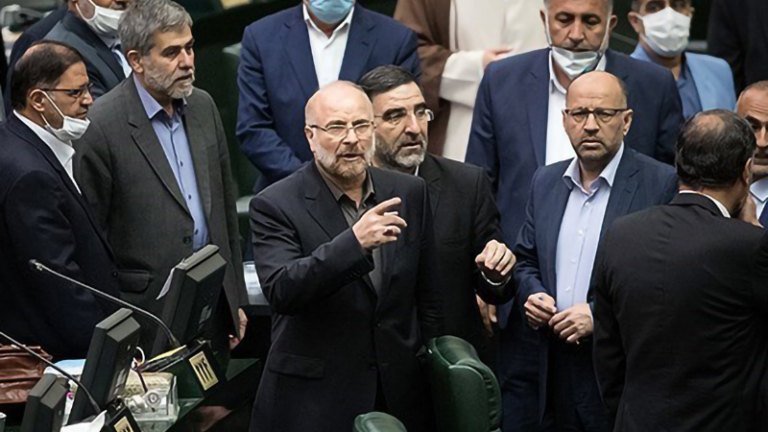
President Donald Trump’s tone on the Iran war has been subdued since the 2026 US midterm elections delivered a “blue wave” of Democratic victories across the House and Senate. In Tehran, officials gleefully suggested that the wave that drowned the Republicans had begun in the Strait of Hormuz.
Mohammad Bagher Ghalibaf, the conservative speaker of the parliament, was quick to post a facetious message on X: “Americans said NO TO WAR, and we endorse this message.” Several Islamic Revolutionary Guard Corps (IRGC)-affiliated outlets and other state media cited a joke by a US-based journalist that instead of fomenting regime change in Tehran, the war had caused regime change in Washington.
Once the celebration passed, however, assessments began to roll in from across the political spectrum. Most appeared in agreement that the Trump administration had been weakened by this electoral defeat. Trump himself admitted that American voters “didn’t like the war” or his messaging going into the elections. In Tehran, debate is focusing on what this moment of political weakness means for the Iran war. Iranian hardliners, pragmatists, and independents are all trying to understand whether Trump is genuinely on his backfoot or on the road to renewed escalation.
The Hardliners: Nothing but Total Victory
For Iran’s more hardline factions, which include the Paydari Front and hawkish IRGC commanders, the only path forward is more force, both on the battlefield and at the negotiation table. From their perspective, Tehran has already won the war, and the US midterm losses are simply the latest in a long list of setbacks for Trump. For these factions, any compromise while Iran holds the upper hand would amount to betrayal. They call instead for total victory, reviving older slogans from the 1980-88 Iran-Iraq War such as “war until victory”—ignoring how the bloody eight-year conflict ended with a negotiated ceasefire.
Hardliners dismiss any meaningful differences between Democrats and Republicans.
Hardliners also dismiss any meaningful differences between Democrats and Republicans. They contend that an imperialist United States will challenge Iran’s sovereignty no matter who governs in Washington. The IRGC-affiliated Tasnim News dismissed Trump’s softer language after the elections, suggesting that both parties pursue similar goals. Supreme Leader Mojtaba Khamenei echoed this skepticism, cautioning that no one should hope that the US’s “hegemonic system might change through partisan or factional shifts,” while adding that making concessions to Washington will not “dissuade it from hostility towards the Iranian nation.”
Pragmatists and Reformists: A Window for Restrained Diplomacy
Iran’s pragmatists and reformists—a broad coalition that stretches from the center of the conservative camp to the more progressive wing of the reform movement—tend to see diplomacy as the best path forward. Despite being sidelined by the hardline establishment, especially after the start of the war, moderate reformists retain a foothold in the executive branch with President Masoud Pezeshkian and maintain a limited public presence through the media. When the war began, many of these figures rallied around the flag and have been unwavering in their defense of Iran’s national sovereignty. Yet they have also been clear about the devastating toll of the war and sanctions on ordinary Iranians and see the midterm results as offering a small window of opportunity for diplomacy. In their view, a politically weakened Trump facing a hostile Congress and a US public tired of high prices may need a deal as much as Tehran does.
On the eve of the US midterms, Pezeshkian indicated that the Supreme Leader had granted his administration limited powers to pursue dialogue. He stressed that Iran would not surrender but would negotiate from a position of strength to bolster the public’s resilience. Foreign Minister Abbas Araghchi took a more threatening approach, declaring in English that Washington could choose peace by accepting Iran’s conditions “on all fronts” in return for reopening the Strait of Hormuz. If not, he warned, the United States would see Iran’s “battle-hardened warriors rain down hell.” His remarks are a reminder that even after the US midterms, Iran’s pragmatists are operating within an increasingly securitized environment.
Independent Skeptics: Beware of a Wounded Foe
Independent analysts and former government officials from across the ideological spectrum have also weighed in, warning of the danger of dealing with a US president who has little to lose. Fayyaz Zahed, an analyst and former media advisor to President Pezeshkian, called the midterms a humiliating defeat for Trump but warned against a reckless Iranian response. Stating that “one must fear the bull because he has strength and horns but no reason,” Zahed warned that a powerful but wounded and unpredictable enemy could still cause significant damage to Iran.
Several analysts also raised the alarm about the deteriorating economic conditions in Iran.
Several analysts also raised the alarm about the deteriorating economic conditions in Iran. In the daily reformist newspaper, Arman Melli, economist Mahmoud Jamsaz warned that the threat to Iran is not only renewed US attacks but also a weakened Iranian economy and a foreign policy that offers the country no way out of the current crisis. Trump’s fickle decision-making and his continued insistence that the war was a “very good decision” have only heightened such concerns.
From a Subdued Trump to Renewed Hostility?
Immediately after the midterms, Trump appeared to soften his stance. On November 8, he told CNN that renewed strikes were “highly unlikely” if talks progressed. Tehran answered with cautious firmness. Hardliners urged resolve on the battlefield and at the bargaining table. The pragmatists argued that negotiating through strength could now pay dividends.
Four days later, on November 12, Trump swung back toward confrontation, reassigning Vice President JD Vance from negotiations with Iran and declaring that the United States did not need a deal. Given that Vance is seen in Tehran as a pragmatic figure in the Trump administration, many inside Iran interpreted the move as a sign of escalation. The reformist daily Shargh suggested that advocates of diplomacy were losing ground in Washington. Ghalibaf’s rhetoric hardened as well. Rejecting a return to “neither war nor peace,” he warned that if Washington made another mistake, his country’s army would expand the geographical scope of the conflict.
On November 13, 2026, the IRGC claimed drone attacks on US military installations in Bahrain, though US Central Command (CENTCOM) alleged that it shot down the drones. Any window for diplomacy after the midterms seems to be closing quickly.
Competing Views in a Security State
Washington is often quick to present Tehran’s competing views as evidence of an unclear chain of command. Trump has repeatedly stated that he does not know who rules Iran after Israeli strikes killed the former Supreme Leader Ayatollah Ali Khamenei on February 28, 2026, and other top officials in the weeks that followed. But Tehran’s competing views on Trump are a reminder that the Iranian government is not a monolith.
Figures across Iran’s political spectrum have expressed triumph and skepticism since the midterms, particularly in light of uncertainty about Trump’s emerging position. The factions in Tehran speaking the language of battle currently sound loudest. The clock, however, may not be on their side for long: Trump has been wounded, but he is not necessarily retreating. Misreading the aftermath of the midterms could still prove costly for Iran’s hardliners.
The views expressed in this publication are the author’s own and do not necessarily reflect the position of Arab Center Washington DC, its staff, or its Board of Directors.
Featured image credit: Tasmin News