Yemen’s Houthis present a conundrum. For more than a decade, the movement has been fighting a protracted conflict with Saudi Arabia, which has often restricted the seaports and airports controlled by the movement. The Houthis have been repeatedly targeted by US and Israeli military strikes, and the movement has been sanctioned by the United States, United Kingdom, and the United Nations Security Council (UNSC), with backing from several Arab states. Beyond that, Washington has designated the movement a foreign terrorist organization, and Saudi Arabia is now advocating that the European Union (EU) follow suit. Given how many powerful forces have lined up against them, it is remarkable that the Houthis have not collapsed. But the movement has done more than simply survive. Since July 2026, it has ramped up its fight with Saudi Arabia, sending missiles and drones into the heart of the kingdom. What then explains the surprising resilience of the Houthis?
One explanation is that the Houthis are simply a proxy force for foreign actors, thriving through external military aid and support from states like Iran. But their entrenchment in Yemen points to a more complex answer that situates the Houthis in a broader ecosystem shaped by both external and internal dynamics. Previous attempts to contain the movement have failed because they do not account for how this ecosystem has enabled the Houthis to dominate northern Yemen and the Red Sea by taking advantage of geopolitical dynamics, building governance structures, and extracting revenue from the local population. Rather than relying on a military campaign, a more viable policy toward the Houthis must therefore address this broader ecosystem.
Regional and Geopolitical Dynamics
Although various factors help explain the Houthis’ resilience, regional dynamics are arguably among the most important. At key moments, the movement has strategically taken advantage of geopolitical rivalries and conflicts to expand beyond its original stronghold in Saadah in northern Yemen.
In the 1990s, Hussein al-Houthi founded the Houthi movement as a rebel group seeking to revive the Zaydi Hashemite Imamate, which had ruled northern Yemen on and off for over a thousand years until it was overthrown by a republican revolution in 1962. In 2004, the movement took up arms against the Yemeni army. After the Yemeni government killed its founder, the movement expanded its armed rebellion and military capabilities, fighting the government in a series of conflicts known as the Saadah Wars that lasted until 2010. Throughout this period, Saudi Arabia also sponsored Sunni Salafi groups to challenge the Houthis, creating a volatile dynamic in the country that Ali Abdullah Saleh, Yemen’s former president who had ruled the country since 1990, exploited to secure his own rule, particularly against Islamist dissidents.
In 2012, after Saleh formally stepped down as president following the Arab uprisings, the Houthis sought to expand their power in the country. Their greatest rival at the time was the Muslim Brotherhood-affiliated Islah Party. Saleh, who sought revenge on Islah for supporting his removal from power, aligned himself with the Houthis. Saudi Arabia and the United Arab Emirates (UAE), which have traditionally opposed the Muslim Brotherhood, accommodated Saleh’s tactical alliance with the Houthis against Islah. However, both Saleh and the Gulf states grossly underestimated the threat posed by the Houthis. Without outside support, Islah could not stop the Houthis’ advancement towards Yemen’s capital of Sanaa, which fell to the movement in 2014. The situation expanded into a regional conflict as a Saudi-led coalition began to intervene militarily against the Houthis in 2015. However, the movement proved sufficiently resilient that the conflict settled into a protracted stalemate. In 2022, the Houthis and Yemen’s internationally recognized government agreed to a UN-brokered truce that reduced hostilities without solving the underlying dispute.
The more the Houthis have demonstrated their solidarity with Gaza, the more their popularity has grown.
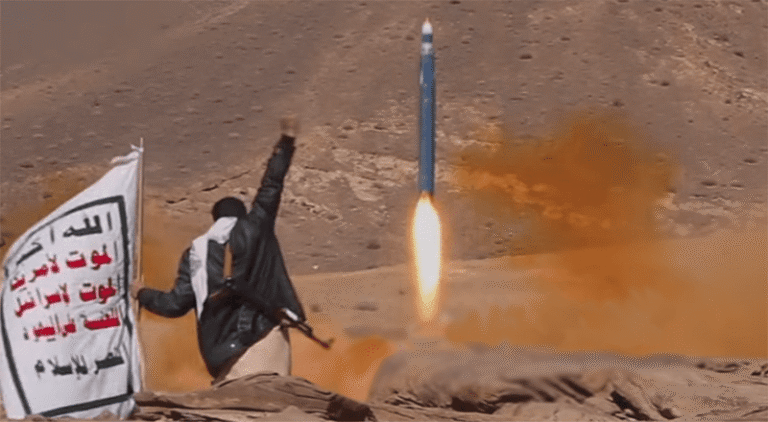
After October 2023, the Houthis once again took advantage of regional geopolitics to expand their domestic influence. By attacking and hijacking ships in the Red Sea and launching missiles and drones into Israel, the Houthis have bolstered their global reputation as one of the few Arab and Muslim forces willing to fight in solidarity with Palestinians in Gaza. The more the Houthis have demonstrated their solidarity with the people of Gaza, the more their popularity has grown inside Yemen, across the region, and on the international stage.
The Houthis’ strategy of solidarity with Gaza has also delivered local benefits. In Yemen, it accelerated the movement’s recruitment efforts, neutralized domestic opposition, and allowed the Houthis to consolidate their growing authority at lower political costs. Solidarity with Palestinians also helped the Houthis divert domestic attention away from the poor humanitarian conditions and the collapse of public services in the areas that they controlled. In other words, Houthi entrenchment may have been regionally enabled, but it has always been locally anchored.
Governance and Political Control
The Houthis do not retain control of northern Yemen through military force alone. Over the years, they have built up institutions that have converted their military gains into a system of governance. The second factor in explaining the Houthis’ resilience is thus their state-building efforts.
Soon after their 2014 takeover of the capital, the Houthis developed a centralized security and administrative apparatus that took control of the state’s various military, security, and telecommunications institutions across northern Yemen. The Houthis specifically formed an internal governance structure known as al-Mushrifin, or the supervisory system. This system operates through a vertically integrated hierarchy that ensures central directives are enforced across state ministries, military branches, local governorates, and community leadership structures in every village, province, and district controlled by the movement. The supervisory system operates directly under the leadership of Abdul Malik al-Houthi, the leader of the Houthis’ armed wing, who is supported by an inner executive council. The system is large enough to have its own institutional logic. It maintains internal discipline through strict ideological mandates, complex security surveillance, and financial incentives that prevent supervisors from working outside the system. By centralizing their decision-making, the Houthis have been able to consolidate power, unify their military command, and increase their capacity to generate revenue. In this respect, the supervisory system can be characterized as a shadow state.
Another strategy that the Houthis have deployed to secure their authority has been to bring Yemen’s northern tribes under their influence. This strategy involves replacing traditional tribal leaders and sheikhs with figures more aligned with the Houthis. Additionally, the movement has exploited the dire economic situation in the country to expand military recruitment from the tribes, create a security pact called the “tribal honor document,” and evoke Zaydi doctrine to ensure that the tribes submit to the central authority of the movement. One of the consequences of this strategy has been the systematic erosion of tribal autonomy.
Finally, the Houthis rely on heavy-handed repression to maintain their rule. According to human rights groups, the populations under their control frequently face arbitrary arrests, forced disappearances, and torture.
Financing and Economic Extraction
The Houthis’ entrenchment in Yemen is also tied to their overall economic strategy. Building an independent financial apparatus has been one of the pillars of the movement’s political and military survival. The Houthis have drained Yemen’s foreign exchange reserves, stopped paying salaries to millions of civil workers, sold fuel at high prices, and imposed new taxes and customs on the private sector. The movement also collects taxes and other sources of revenue from already impoverished citizens at levels previously unseen in modern Yemeni history. In 2023, the Houthis reportedly generated around $3.7 billion from these various sources of revenue.
Over the years, the movement has also heavily relied on international aid to meet its financial needs.
Over the years, the movement has also relied on international aid to meet its financial needs. Since 2016, Yemen has received roughly $20 million in UN-led humanitarian funding. Since most of Yemen’s population resides in areas controlled by the Houthis, most of this humanitarian aid has been distributed to communities under their rule. The Houthis have been accused of diverting some of this funding to support their military efforts. A 2018 report found that the Houthis had redirected food baskets and medical supplies to frontline Houthi fighters or sold them on the black market to fund military recruitment. The same report claimed that the Houthis had denied food aid to those who were not loyal to the movement. Houthi security agencies have also reportedly restricted independent UN monitoring and auditing of distribution lists. For a few years, the Houthis also operated the Supreme Council for the Management and Coordination of Humanitarian Affairs and International Cooperation (SCMCHA), an institution they created to ostensibly monitor and control international humanitarian assistance but has been accused of channeling funding to further their own objectives. The World Food Program has repeatedly criticized the Houthis’ aid manipulation and their attacks on aid workers, periodically halting aid to Yemen in response.
One further source of income for the Houthis has come from collecting fees from ships seeking safe passage along Yemen’s Red Sea coast. In 2024, a UN panel of experts estimated that the Houthis could generate close to $180 million per month from shipping fees, though a precise figure has not been independently verified.
The Weakness of the Internationally Recognized Government
The Houthis benefit from the enduring weaknesses of Yemen’s internationally recognized government (IRG). Unlike the Houthis’ strong system of vertical governance, IRG rule is unstable and fragmented. Since its inception in April 2022, the Presidential Leadership Council (PLC) has served as the executive body of the IRG, with which it is largely interchangeable. The PLC suffers from institutional paralysis, factionalism, and systematic corruption. It also struggles with competing political agendas among its members, the absence of consensus-building mechanisms, and infighting between PLC Chairman Rashad al-Alimi and the Southern Transitional Council (STC), a tension that only ended when the STC was officially dissolved in January 2026.
Unlike the Houthis’ strong system of vertical governance, IRG rule is unstable and fragmented.
At various moments, the PLC has operated out of Riyadh due to security and political constraints, which further undermines its local credibility and strength in Yemen. Since July 2026, renewed fighting between Houthi forces and the PLC, particularly in Taiz and the Bab al-Mandab Strait, has severely tested the PLC’s political and military power. The internal fractiousness of the executive body, along with its heavy reliance on external Gulf backers, has hampered its ability to maintain stability and present a unified political front against Houthi offensives.
Toward A Viable Policy
The Houthis have not only survived recent crises but continue to expand their power. Analysts often pay considerable attention to the Houthis’ military relations with Iran, Hezbollah, al-Shabab, and other external actors. What they often ignore, however, is the movement’s ability to effectively navigate broader geopolitical, political, and economic dynamics. The internationally recognized government of Yemen and other international actors need to understand that in order to support a durable, just, and comprehensive peace deal in Yemen, they must address how the Houthi movement governs, exploits crises, and creates opportunities.
The failure to end the conflict with the Houthis has come at a heavy cost for civilians in Yemen, who have suffered through years of war with no end in sight. Yemen remains one of the world’s worst humanitarian crises. The crisis has become so serious that Yemenis have begun protesting Houthi policies that have further impoverished them through a social media campaign called “I am hungry” and by writing oppositional messages on Yemeni currency notes. In 2019, the UNDP estimated that Yemen’s conflict since 2015 had set the country back nearly two decades in terms of its economic development, and that by 2021 it had missed out on $126 billion in growth. To save Yemen, the international community should adopt a multi-pronged strategy to facilitate renewed negotiations and work with local and regional actors on achieving a meaningful political settlement.
The views expressed in this publication are the author’s own and do not necessarily reflect the position of Arab Center Washington DC, its staff, or its Board of Directors.
Featured image credit: Ansar Allah Spokesperson on X

