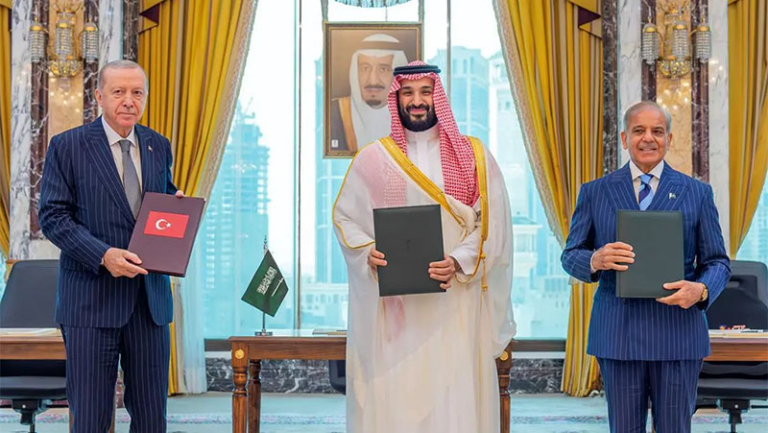
On August 7, 2026, Saudi Crown Prince Mohammed bin Salman, Turkish President Recep Tayyip Erdoğan, and Pakistani Prime Minister Shehbaz Sharif signed the Mecca Joint Defense Agreement, allowing Turkey to join the September 2025 Saudi-Pakistan collective defense deal. The agreement commits signatories to treating an armed attack on any one of the three as an attack on all, and to deepening their defense cooperation more generally.
Despite the headlines, the Mecca agreement is unlikely to produce a real military response if an attack happens. Not only has the text of the accord not been made publicly available, but the agreement does not establish a joint command, standing forces, or any specified trigger mechanism. While some analysts have concluded that the language carries political weight without operational content, the other component of the agreement—defense cooperation—might be more transformative.
Practical cooperation in defense manufacturing, joint exercises, and intelligence sharing may have the potential to produce limited political coordination between the three countries, which over time could be more important than the commitment to mutual defense. Of course, the Mecca agreement does not replace the US security umbrella over Saudi Arabia. The partners that Riyadh has brought in are already Washington’s allies, not adversaries. It is for this reason that Washington has shown no concern. Indeed, President Donald Trump praised the agreement, welcoming how the countries “will finally be able to defend themselves in a more meaningful way,” undoubtedly hoping for the arrangement to eventually take on some of the burdens the United States currently shoulders in the region. From this perspective, the Mecca accord could deliver much more for Riyadh in terms of industrial and diplomatic capacity than it does in collective defense.
What Riyadh Wants from Diversification
Since the US-Israeli war on Iran began in late February 2026, Saudi Arabia has been subjected to sustained and varied attack. Iranian missiles and drones, as well as Iraqi armed groups aligned with Tehran, have struck the kingdom directly. From Yemen, the Houthis have resumed strikes on airports, energy infrastructure, and Saudi-linked tankers in the approaches to Bab al-Mandab. The Jazan refinery has been shut since 27 July, when a combined missile and drone assault damaged its gasification complex and tank farm.
Even with these additional layers, the kingdom was still vulnerable to attack—a situation that is unlikely to change by adding Turkey into the equation.
Declining trust in the US umbrella has led to the refrain of “diversifying security partnerships” becoming commonplace in recent Saudi commentary. Non-US partnerships existed before the war, but the recent conflict has made them more visible. British Sky Sabre units and Royal Artillery personnel have been operating in the kingdom since spring 2026, for example, part of a wider British deployment across Bahrain, Kuwait, and Saudi Arabia. A Greek Patriot battery has been stationed near Yanbu since 2021 and has repeatedly intercepted missiles and drones aimed at Red Sea refineries, including an engagement confirmed by Greek security sources in July. Since the September 2025 Saudi–Pakistani Strategic Mutual Defense Agreement (SMDA), Islamabad has deployed to Saudi Arabia some 8,000 troops, a squadron of JF-17 fighters, and a Chinese-supplied HQ-9 air-defense system, with the equipment operated by Pakistani personnel and financed by Riyadh, as reported in May.
All of this diversification effectively took place inside the broader system of US alliances: the additional partners were all allies or close partners of Washington. Riyadh did not turn to Beijing or Moscow for security. Yet even with these additional layers, the kingdom was still vulnerable to attack—a situation that is unlikely to change by adding Turkey into the equation.
Who Will Defend Saudi Arabia?
Ankara has little incentive to confront either Iran or its Yemeni and Iraqi partners. Turkey’s Foreign Minister Hakan Fidan specifically stated, in fact, that the agreement identifies no common adversary and is not directed at Iran. He also said that preparations had been under way for well over two years, a formulation designed to separate the pact from the current war. In practice, Turkish–Iranian relations remain a working mixture of rivalry and cooperation.
Pakistan’s constraints are structural and longstanding. It shares a roughly 900 kilometer border with Iran, has a substantial Shia population whose presence extends into the officer corps, and experienced significant domestic unrest after the killing of Iran’s supreme leader in February 2026. Islamabad has also served as an important mediator between Washington and Tehran, a role incompatible with belligerency. One Gulf-focused assessment described the Saudi–Pakistani relationship as transactional, with assistance limited and delivered in phases. Riyadh showed little appetite for supporting Islamabad in its confrontation with Afghanistan since October 2025; Islamabad has correspondingly little appetite for absorbing Saudi conflicts. Islamabad may provide forces for the defense of Saudi territory and will not participate in offensive action against Iran or the Houthis.
The agreement has not yet been tested. Within 48 hours of its signing, a Houthi drone struck the Jazan refinery on August 9, apparently as retaliation for Saudi incursions over Saada and Hajjah. The Saudi Energy Ministry reported a fire that was extinguished without casualties. Although neither Ankara nor Islamabad seemed prepared to take part in any Saudi response, the drone attacks are the kind of low-level strikes least likely to trigger a collective-defense clause. The real test is yet to come.
Political and Industrial Value
If the Mecca agreement has real value, its importance is not military but political and industrial. Fidan himself identified defense-industrial cooperation as one of the main topics discussed in Mecca. Reports suggest that the pact will deepen existing arrangements, such as the co-production of the Akinci unmanned combat aerial vehicle platform between Turkey’s Baykar and Saudi Arabian Military Industries, which began in 2023. Negotiations over Saudi participation in Turkey’s Kaan fighter jet program had already reached an advanced stage in February 2026, and Erdoğan publicly raised the prospect of joint investment. For Riyadh, this offers a plausible route toward the localization targets of more than 50 percent of its military spending on equipment and services by 2030, slow though the process is likely to be.
If the Mecca agreement has real value, its importance is not military but political and industrial.
Similarly, the pact creates an opening for Pakistan to have greater access to Saudi capital and Turkish military technology. Already, since Islamabad and Riyadh signed the SMDA in September 2025, Pakistan was able to secure a $3 billion cash infusion from Saudi Arabia to secure its foreign exchange reserves in April 2026. The agreement also gives Pakistan higher standing in the region, boosting its diplomatic capital and making it appear indispensable to both Riyadh and Washington.
Turkey gains market access for its defense industry together with a broader regional footprint, extending its security commitments beyond those it already had with Libya, Qatar, and Syria. Riyadh gains new arms suppliers and technology transfers in the field of military industry. Despite their defense partnership, Saudi Arabia and Turkey are unlikely to forgo their regional competition for influence in countries such as Syria and Lebanon. They continue to approach such issues differently and do not necessarily share the same priorities.
The Shifting Role of the United States
Despite the Mecca agreement, nothing suggests that Saudi Arabia intends to unwind its security relationship with the United States or to abandon the objective of a formal defense treaty to guarantee its security. In November 2025, Riyadh and Washington signed a Strategic Defense Agreement accompanied by the White House granting Saudi Arabia a major non-NATO ally designation, approval of future F-35 deliveries, and a large armor package, while the kingdom agreed to increase its investments in the United States to one trillion dollars. That agreement still fell short of the congressionally ratified, NATO-style treaty that the kingdom had originally sought.
Saudi planners have followed Washington’s ongoing debates about military repositioning and potentially reducing its footprint in the Gulf, which has prompted them to include alternatives in their contingency planning.
Saudi Arabia is now building additional layers while retaining its core alliance with the United States. Saudi planners have followed Washington’s ongoing debates about military repositioning and potentially reducing its footprint in the Gulf, which has prompted them to include alternatives in their contingency planning. Although US military power is indispensable, the relationship neither protects Saudi Arabia from attack nor guarantees that Washington will act according to Saudi priorities.
Washington’s response to the accord has been warm. The Trump administration has preferred that US allies assume more of the burden of regional defense, which perhaps explains why it has not objected to the agreement. Yet Washington’s expectation that its partners will help contain Iran may be mistaken. Ankara’s strategic attention is directed toward Syria, where its objectives clash with those of Israel. Turkish planners increasingly treat the deteriorating relationship with Israel as their principal regional problem. What Washington reads as Iran-focused burden-sharing may look to Ankara, at least, as insurance against a very different adversary.
Do International Actors See the Accord as a New Military Bloc?
Iran’s response to the agreement was largely muted. Foreign Minister Abbas Araghchi notably welcomed the agreement, urging Muslim states to stand together and rely only on themselves. Parliamentary voices were more dismissive. Ebrahim Rezaei of the National Security and Foreign Policy Committee said that no paper agreement with Ankara and Islamabad would secure the kingdom any more effectively than its long one-sided dependence on Washington and advised Riyadh to change its policies so as not to need protection from others. Several Iranian analysts concluded that in an actual nkara and Islamabad would occupy the space between inaction and intervention, offering political support, intelligence, and logistics without entering the war.
Beijing did not formally respond, but Chinese state media reacted to the pact with ambivalence, observing that the agreement signaled shifting regional power dynamics and exposed the vulnerabilities of a US-dependent security strategy. Beijing clearly wants to weaken the US monopoly on regional security without inheriting the burden of Washington’s role. Saudi Arabia’s diversified security strategy creates opportunities for China in terms of training, weapons sales, and military diplomacy. Pakistani-operated Chinese systems are already embedded in Saudi air defenses. Yet the Turkish defense industry competes directly with Chinese exports, and any hardening of the Mecca pact in the event of a confrontation with Iran would strain Beijing’s efforts to keep out of Washington’s way in the region.
Israel responded to the Mecca accord with silence, even though the deal fuels its existing tensions with Turkey. Since February 2026, Israeli politicians have warned about an emerging “Sunni axis,” with Naftali Bennett describing Turkey as the new Iran. In the run-up to Israel’s October elections, Israeli politicians could well use the agreement for domestic scaremongering. But Israel’s real concern is the future. If Turkish industrial capacity, Saudi capital, and Pakistani military capabilities ever combine into an operational force, Israeli airpower could soon see its freedom of movement narrow across the region. But Israeli analysts doubt this would happen anytime soon.
Egypt’s absence from the Mecca agreement has drawn attention. Cairo may be reluctant to join a regional security alliance for its own reasons, but unconfirmed reports suggest that Riyadh was unenthusiastic about inviting Egypt. Riyadh doubts Cairo’s readiness to play any important security or military role in support of the kingdom.
Despite these varying interpretations of the Mecca accord, planners in none of these capitals treat the agreement as an operational military structure today.
Conclusion
The Mecca Joint Defense Agreement does not replace the United States as the kingdom’s primary security guarantor, and Saudi decision-makers have not tried to make it do so. US weaponry, intelligence, and integrated air defense systems remain structurally embedded in Saudi capabilities, and no currently available alternative even approaches that role.
The Mecca agreement is best read as a sign of anxiety. Behind it lies a considered judgment that dependence on a single guarantor is no longer prudent—and that additional layers of security are worth acquiring even where their operational value remains uncertain. The three signatories define their threats differently, no joint command or published text exists, and the pact seemingly does not cover drone strikes—one of the most frequent threats to Saudi Arabia since the beginning of the war with Iran.
Nevertheless, the prospect of defense cooperation and future political coordination lends some value to the agreement. Saudi Arabia has not gained a partner to fight Iran or the Houthis, but a new option for military cooperation, joint training, and the transfer of expertise into a defense sector that the kingdom seeks to strengthen. Saudis know there is no ready substitute for Washington as their security guarantor. But signing the Mecca agreement is a decision prompted by ongoing uncertainties about regional security in the Gulf for the post-Iran war era.
The views expressed in this publication are the author’s own and do not necessarily reflect the position of Arab Center Washington DC, its staff, or its Board of Directors.
Featured image credit: SPA