
Egypt has several good reasons for wanting the conflict between the Houthis and Saudi Arabia to end. After losing billions of dollars in Suez Canal tolls during the 2023-2025 Israeli war on Gaza—when Yemen’s Iranian-backed Houthi rebels targeted ships in the Red Sea ostensibly heading to Israel—Egypt had hoped to recoup some of its lost revenue following the October 2025 ceasefire. Although tolls have slightly rebounded, ten months after the ceasefire, renewed fighting between the Houthis and Yemeni government forces, as well as Houthi attacks on Saudi oil infrastructure and shipping, have again adversely affected ship traffic in the Red Sea.
It might then come as little surprise that, on October 26, 2026, the Egyptian parliament approved Riyadh’s request for military help to quell further Houthi attacks. But military involvement in Yemen’s conflict carries huge risks for Cairo. Egyptians have bad memories of their military intervention in the Yemeni civil war in the 1960s and do not want to revisit that quagmire. The Houthis have demonstrated an ability to strike targets hundreds of miles away, and Egypt has no desire for its own infrastructure to be added to the target list. For these reasons, Egypt still prefers a diplomatic solution to the crisis and maintains contacts with Tehran and the various groups fighting in Yemen. Nevertheless, pressure from Saudi Arabia, one of Egypt’s main economic benefactors, seems to have been effective in Cairo’s decision to provide military assistance to the kingdom.
Deliberations Over the Saudi Request
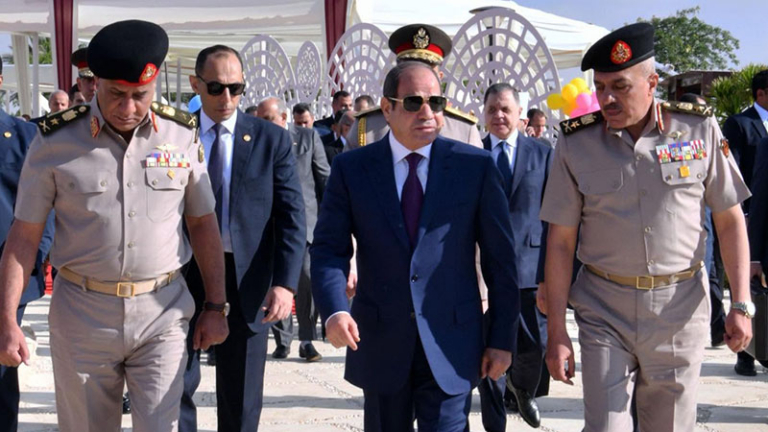
On September 15, 2026, Saudi Crown Prince Mohammed bin Salman flew to Cairo to meet with Egyptian President Abdel Fattah el-Sisi reportedly to find ways to strengthen relations between the two allies across areas of shared regional and international concern. There was some speculation that the Saudis were there to request Egyptian military support in response to the recent Houthi attacks on the kingdom. The absence of a public announcement after the talks suggested that military assistance from Cairo would not be forthcoming. However, the Houthi attacks on Riyadh airport on October 10, 2026, which killed at least 13 civilians, along with the group’s strikes on the state-run Aramco oil company, seem to have spurred the Saudis to request such assistance again.
The Houthi attacks on Riyadh airport seem to have spurred the Saudis to request such assistance again.
On October 13, Egyptian Foreign Minister Badr Abdelatty claimed that his country would respond positively to any Saudi request for help and might even join the Mecca Joint Defense Agreement signed by Turkey, Pakistan, and Saudi Arabia—though that move seems unlikely, as Egypt has been averse to forming formal alliances in the past. Nevertheless, on October 18, Sisi said he would request that parliament authorize the Egyptian military to come to the aid of Saudi Arabia. The same day, Abdelatty posted on X that he had discussed regional matters with Saudi Foreign Minister Prince Faisal bin Farhan, emphasizing the importance of de-escalation, which appears to be Cairo’s preferred path.
Domestic Economic Concerns for Egypt
Economics have played a significant role in Cairo’s decision to provide military support to Saudi Arabia. Sisi earlier claimed that Egypt lost approximately $10 billion during Israel’s 2023-2025 war on Gaza. Because the Red Sea connects with the Suez Canal—an important shipping route for vessels transiting between Asia and the Mediterranean—Houthi strikes on ships in this waterway have directly affected the Egyptian economy. In the fiscal year ending in July 2023 (before the outbreak of the Israeli war on Gaza), Egypt earned $10.25 billion in revenue from canal tolls. This figure dropped dramatically over the next two years, reaching around $4 billion in fiscal year (FY) 2024/2025 and $4.67 billion in FY2025/2026.
To be sure, Egypt receives foreign exchange from other sources, namely tourism and worker remittances, which have shown steady growth. The former brought in $15.3 billion in 2024, and the latter shows impressive growth. Remittances from Egyptians working abroad reached a record high of $33.9 billion in the first eight months of 2026. Although these sources of foreign exchange earnings exceed toll revenues from the Suez Canal, remittances generally accrue to households rather than to the state.
Nevertheless, Egypt’s financial needs are enormous. In FY2025/2026, the country’s total external debt reached $164.8 billion, up 5.2 percent from a year earlier, while the Central Bank of Egypt projected that external debt-servicing obligations in 2026 would amount to $29.2 billion, including $23.8 billion in principal repayments and $5.4 billion in interest payments. These payments are a huge burden on the Egyptian economy. Interest payments alone were projected to consume half of all government expenditure in FY2025/2026. The country’s high debt burden has led to a sharp decrease in social spending in real terms. For example, healthcare and education spending has declined as a percentage of GDP for the past few years—all the more alarming in a country with an estimated population of 118 million people. Inflation has dropped from an average of 34 percent in 2023 to around 13.9 percent in 2026. However, stubbornly high prices for food and other commodities continue to put economic stress on the population. The current IMF loan program is expected to end in December 2026, and the government has stated that it has no plans to extend it. Any drop in foreign exchange earnings is therefore worrying.
Initial Hope for a Boost in Tolls but Worries Return
Following the October 2025 ceasefire in Gaza, Egypt was optimistic that it could recoup some of its revenue losses resulting from the conflict. In the last five months of 2025, tolls increased by 17.5 percent compared to the same period in 2024, and Osama Rabie, chairman of the Suez Canal Authority, predicted in December 2025 that revenues could increase to some $8 billion in FY2026/2027. On February 8, 2026, Rabie announced that revenues from the Suez Canal had reached $449 million since the beginning of the year, up from $368 million for the same period in 2025.
Cairo has reason to be worried about the Houthi attacks from northern Yemen
Initially, Egypt benefitted from the US-Israeli war on Iran, which began in late February 2026, as Iran began to strike oil facilities, tankers, and other vessels in the Gulf, effectively halting maritime traffic through the Strait of Hormuz. In response, Saudi Arabia began to export more oil via the East-West pipeline to its Red Sea port of Yanbu, with ships then transporting Saudi oil to Europe through the Suez Canal. In July 2026, Egypt earned $505 million in canal revenues—its highest monthly intake since December 2023. The same month, 526 oil tankers transited the canal—up from 485 in June. However, Egypt’s FY2025/2026 Suez Canal revenue is low compared with its $10.25 billion in canal revenues in FY2022/2023, before the Israeli war on Gaza. The Suez Canal Authority has since revised its predictions, now suggesting that the canal’s revenue intake for FY2026/2027 will be around $6 billion. Even that figure, however, is optimistic given the renewal of Houthi strikes in and around the Red Sea.
Cairo has reason to be worried about the Houthi attacks from northern Yemen, which began targeting Saudi ships and oil infrastructure on July 13, 2026, and escalated to the point that Riyadh suspended crude oil exports from Yanbu for more than two weeks in September. The Houthis claimed that they were responding to Saudi policies of restricting air and sea access to Houthi-controlled territory. However, they are probably also responsive to demands from Iran, which wants to maintain pressure on Saudi Arabia. In September 2026, Houthi forces moved south along the western coast of Yemen to take territory from the internationally recognized and Saudi-backed Yemeni government, threatening the Bab al-Mandab Strait—a vital choke point connecting the Arabian Sea to the Red Sea. Although the Houthis claimed that they were only targeting Saudi ships or ships transporting oil from Saudi ports, any violence in this region reduces vessel traffic generally and through Egypt’s Suez Canal.
No Good Options for Cairo
Egypt’s options to end this conflict are limited. For largely historical reasons, Egypt has been reluctant to send ground forces into Yemen and become bogged down in the country once again. Egyptians have lingering memories of their country’s military intervention in the Yemeni civil war from 1962 to 1967, during which it deployed between 55,000 and 70,000 Egyptian soldiers who found themselves trapped in a quagmire that some described as “Nasser’s Vietnam.” Tellingly, when Saudi Arabia assembled a large coalition of Sunni Muslim states in March 2015 to oppose the Houthis’ takeover of Sanaa and much of northern Yemen, Egypt participated only by sending limited air and naval assets off the Yemeni coast to shell Houthi-controlled territory. At the time, Egyptian officials denied press reports claiming that they had dispatched ground troops. Today, Egypt is still technically part of the anti-Houthi coalition, though after its brief participation in the 2015 campaign, it has avoided any further military involvement in Yemen.
If Egypt does decide to send a significant military force to Yemen, it may risk becoming the target of Houthi attacks. Given that the Houthis were able to strike Israel repeatedly from northern Yemen during the 2023-2025 war, they can feasibly do the same to Egypt. Given the fragile state of the Egyptian economy, the country cannot afford attacks on its lucrative tourism industry or other threats that might discourage foreign investors.
Seeking a Diplomatic Solution
While condemning Iranian attacks on the Gulf states, Cairo sees Tehran as a less direct threat to its own interests than do GCC capitals. Indeed, Egypt views Iran as a balancer to Israel’s regional hegemony. Egypt does not favor the collapse of the Iranian regime, which, in its view, could create a power vacuum in the region. Cairo therefore seeks a diplomatic solution to the US-Israeli war on Iran and has occasionally tried to mediate between Washington and Tehran. Egypt seems to want a return to the status quo ante and hopes that its outreach to Iran—including reported backchannel contacts with Iran’s Islamic Revolutionary Guard Corps—will also pressure the Houthis to stop their attacks on ships in the Red Sea.
Given the economic stakes, it would not be surprising if Cairo had been considering reaching an accommodation with the Houthis.
Although Egypt maintains diplomatic ties to the internationally recognized Yemeni government, Cairo also maintains channels with the Houthis, reportedly aiming to protect Egyptian and international ships in the Red Sea and Suez Canal from Houthi strikes. Egypt appears sensitive to Saudi concerns about its communications with the Houthis. In September 2026, when word leaked about a possible Egyptian-Houthi proposal to ensure safe passage through the Bab al-Mandab Strait, the Suez Canal Authority chairman claimed to have immediately rejected such a proposal, saying that Egypt would not give implicit recognition to an “international unrecognized party.” Nonetheless, given the economic stakes, it would not be surprising if Cairo had been considering reaching an accommodation with the Houthis. As Abdelatty noted on September 11, 2026, Cairo prefers “full de-escalation” in the Red Sea. But hopes that diplomacy offers a path forward may be optimistic at this point.
Possible Egyptian Military Response
While direct intervention in Yemen would likely incur a military response from the Houthis, Cairo may pursue a less risky strategy, such as strengthening its naval and air assets in the Red Sea. This approach would show Saudi Arabia that Egypt is helping to defend the kingdom without its direct military involvement in Yemen. Egypt could also deploy air assets within Saudi Arabia to protect Aramco’s oil infrastructure. Although such a deployment would be largely symbolic, it may satisfy critics in Saudi Arabia who believe their country’s economic support to Egypt has not been adequately acknowledged. The defensive deployment of military assets would also not foreclose possible Egyptian diplomatic initiatives in the future.
The views expressed in this publication are the author’s own and do not necessarily reflect the position of Arab Center Washington DC, its staff, or its Board of Directors.
Featured image credit: Egyptian Presidency via Facebook