Pakistani Prime Minister Shehbaz Sharif signed the “Islamabad Memorandum of Understanding between the United States of America and the Islamic Republic of Iran” as a mediator on June 18, 2026, a day after US President Donald Trump and Iranian President Masoud Pezeshkian had agreed to the deal. The document is meant to bring the 2026 Iran war to an end, a war that had opened on February 28 with joint US and Israeli strikes and spread quickly across the region. Among its provisions, the two countries agreed to cease military operations, respect territorial integrity, and continue negotiations to reach a final agreement. Iran committed to reopen the Strait of Hormuz and the United States agreed to lift its naval blockade. In announcing the deal, Pakistani President Asif Ali Zardari acknowledged the contributions of regional states, including Qatar, which helped to broker the talks, as well as countries such as Egypt, Saudi Arabia, and Turkey, which supported the process more informally.
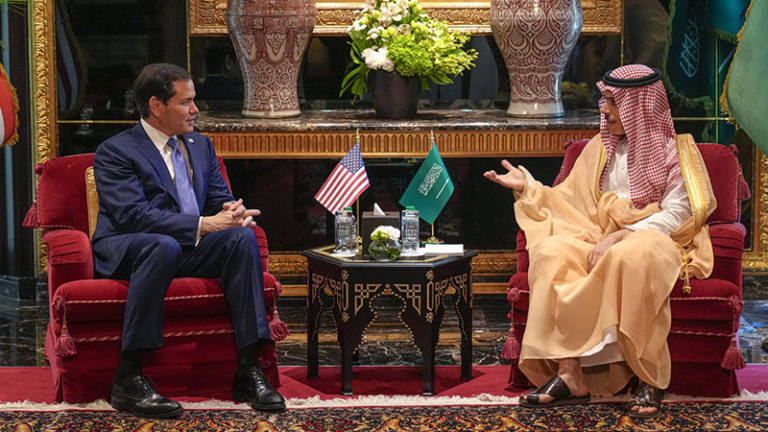
Saudi Arabia’s contribution was quiet. At a conference in Vienna on the day of signing, Foreign Minister Prince Faisal bin Farhan Al Saud called the understanding “incredibly important” and a possible turning point toward calming the region. He then cautioned that the details would matter, particularly regarding long-term verification, and stressed that there would need to be a regional security dialogue to prevent future conflict. This public encouragement mixed with private reservation runs through Riyadh’s position as a whole.
The reason for the reservation is not hard to state. An end to the fighting helps the Saudi economy. It reopens Hormuz, returns Saudi crude to its markets, and lets the kingdom resume the diversification drive that the war and the flight of foreign capital had stalled. The same agreement, though, could help Iran regain its regional influence. This would allow Iran to control the entrance to the Gulf, recover as sanctions are lifted and money returns, and rebuild its reach across the Arab world. Riyadh has cause to fear how this would affect the regional balance and its own influence, especially if the terms of the final deal negotiated over the next 60 days leave the nuclear question and Iran’s regional conduct unaddressed.
Reading Iran After the War
The war affected Saudi Arabia and further complicated its economic diversification plans, which were already facing setbacks. Iranian missiles and drones hit sites inside the kingdom, among them military facilities and energy installations. The Saudi Ministry of Defense announced it had intercepted ballistic missiles fired at Prince Sultan Air Base and shot down drones headed toward the Shaybah oil field, and the Ras Tanura refinery went into a partial shutdown after an early drone strike. Later strikes on Prince Sultan Air Base injured at least ten American service members and destroyed aircraft on the ground, among them a valuable E-3 Sentry surveillance plane.
Despite these attacks, Saudi Arabia never declared war in response. According to US officials, the Saudis and Emiratis separately conducted retaliatory strikes on Iran, though neither capital confirmed these reports. Throughout the war, Saudi Arabia did not cut its line of communication to Tehran. Prince Faisal and his Iranian counterpart, Abbas Araghchi, spoke by telephone repeatedly, and the kingdom did not abandon the normalization deal brokered by China in 2023, though it did expel five Iranian diplomats.
Riyadh’s reading of the war seems to have shifted over its course. In the opening weeks, Gulf capitals reportedly urged Washington not to halt operations too soon, wary of being left across the water from an Iran still able to strike them. Once the costs continued to mount, the message changed. Leaks suggested the Gulf was now pressing Trump not to restart the war, a turn that matched their growing alarm at what a prolonged fight was doing to their economies.
None of the scenarios facing Saudi Arabia are ideal.
None of the scenarios facing Saudi Arabia are ideal. A continued war would bleed the Gulf economies, threatening Saudi standing in the region and imperiling access to the Gulf. Calls have come from Gulf analysts to build routes around Hormuz, but that could take years. Saudi Arabia has fallen back on its Red Sea outlet, the East-West (Petroline) line from the Abqaiq oilfield to the city of Yanbu, which during the crisis ran close to its ceiling of roughly seven million barrels a day. Even at full capacity, the pipeline cannot carry what Hormuz moves. The Red Sea route is also slower to reach the buyers Saudi Arabia values most: China, India, Japan and South Korea take the bulk of Saudi crude, on the order of 75 percent of it, and routing oil out through Yanbu and the Bab el-Mandab Strait adds days to the voyage while exposing cargoes to Houthi fire along the way.
Hormuz is only one piece of the picture. The larger question is Iran’s regional reach, which the past two years had cut down sharply. The Assad regime’s fall in December 2024, and the battering of Hezbollah, left Tehran weaker in its neighborhood than at any point in the previous two decades. Relief from sanctions could reverse part of that. An Iran with revenue again is better placed to fund its partners in Iraq, Lebanon, and Yemen, and if the final agreement says nothing about regional networks, Saudi Arabia stands to lose, having already absorbed fire from Iran-aligned militias in Iraq during this war and from the Houthis in Yemen for years before it.
That risk is why the Saudi foreign minister has indicated the need for the nuclear talks to also address broader security concerns. Prince Faisal also rejected any scheme of tolls or fees for ships passing through Hormuz, arguing that the strait worked without trouble before the war and needs no new arrangement. The point is aimed at Iran, which has hinted it might levy maritime fees on those transiting the strait, presented as lawful under the Law of the Sea. The United States wants passage kept toll-free for the long term, and the deal’s European backers called an unrestricted reopening indispensable to the global economy.
Saudi and Gulf objections to the framework run long, and if the final text does not address these concerns, it will cause real difficulty, particularly if Hezbollah comes out stronger in Lebanon and Iran becomes more entrenched in Iraq. An outcome of that kind would close much of the opening Saudi Arabia gained after the 2024 Lebanon war and Assad’s collapse, rehabilitating Iran’s position in the Levant and across the region. How far the kingdom can move Washington is another matter. With Trump willing to brush off Israeli lobbying, observers of the nuclear talks see Riyadh’s leverage over the outcome as slight.
Washington After the War
A second set of problems sits in the relationship with the United States. The war exposed how little protection the large US bases in the Gulf actually offered. Iranian strikes hit at least a dozen American installations and forced the United States to rethink how it bases troops in the region. The strikes have caused billions of dollars in damage, with one assessment calling many of the bases “all but uninhabitable,” and running the repair bill for the US Fifth Fleet headquarters in Bahrain alone to two hundred million dollars.
The trouble, from Saudi Arabia’s vantage point, is not that the Gulf wants the bases gone. The Gulf states still want the Americans present, as a security anchor and as a way to keep President Trump well disposed toward them. The trouble is the argument now running inside the United States over whether such large, exposed installations are worth keeping when they draw missile and drone fire and turn into a liability in wartime. The Pentagon’s 2027 budget request left out money to repair the damaged bases, and its acting comptroller floated the idea that host countries might help pay, while admitting he could not say what the future posture would be. For Gulf governments this revives the unease that followed the 2015 nuclear accord: a fear that Washington means to draw down its presence and leave Iran room to expand.
The war exposed how little protection the large US bases in the Gulf actually offered.
A financial worry sits atop the security one. In a June 15, 2026, interview, Vice President JD Vance suggested that the Gulf would be pressed to fund Iran’s reconstruction. The memorandum commits Washington to a plan that gives Iran access to a fund worth at least three hundred billion dollars for rebuilding and development, with the details to be settled within sixty days. Vance said a “Gulf Coast Coalition”—meaning the Gulf Cooperation Council—would pay for it if Iran kept to the deal. Trump denied that any American money was involved and officials recast the vehicle as private investment rather than reparations. An Iranian source put Tehran’s opening demand at four hundred billion dollars, calling the result a “Reconstruction and Development Fund” that kept the bill vague while preserving American face. For Saudi Arabia, paying to rebuild a rival at a moment when its own finances are tight is unwelcome. Gulf analysts have already signaled that selling such a contribution at home, after months of Iranian attacks, will be hard.
Beneath all of it lies the difficulty of not knowing what Trump will decide next, on the bases, on the fund, or on the shape of the final deal. The kingdom’s room for maneuver in a region this changed is narrow, which is much of why it and its neighbors have kept their lines to Tehran open and gone looking for some workable arrangement to get through the present phase.
Pressure to Normalize with Israel
There is also a renewed American push for Saudi-Israeli normalization. Trump has said openly that the two should establish ties once the war with Iran is over, and Senator Lindsey Graham (R-SC), who earlier in the war had leaned on Gulf states to join the fighting and warned that “consequences will follow” if they stayed out, has made normalization a priority since the first strikes on Iran. Part of what drives the campaign is the wish to give Israel something to show for a war that fell short of what it set out to achieve against Iran.
Saudi Arabia is in no hurry to oblige. It has no urgent reason to normalize now, and the moment hardly invites it with the Gaza file still unresolved. The kingdom has criticized Hamas for holding on to its weapons, but it has refused to let Israel dictate the terms. Speaking for the Arab Group at the Security Council on 18 June, the Saudi representative rejected using humanitarian aid to exert political pressure and called it the collective punishment of civilians. Saudi Arabia has also held to its core condition of a credible path to a Palestinian state, the line Crown Prince Mohammed bin Salman set out in 2024. That demand collides with Israeli politics, where Prime Minister Benjamin Netanyahu has restated his opposition to a Palestinian state to keep his coalition intact.
The pressure may still grow. Netanyahu wants an achievement to point to after the war, and his backers in Washington see normalization as the prize that would both justify the conflict’s cost and land a blow on Tehran. Holding to its conditions without provoking pushback will be a delicate exercise for Saudi Arabia.
Conclusion
The Islamabad Memorandum leaves Saudi Arabia with a hard set of choices and no clean way through them. A war that hurt its economy, struck its territory, and shook confidence in Vision 2030 has ended, for now, in a ceasefire that brings relief without much comfort, and analysts warn the economic strain may yet deepen. Saudi Arabia wants the war over, and at the same time fears a settlement that puts Iran’s economy back on its feet, frees it to fund its allies, gives it sway over Hormuz, and lets it back into a Levant where its grip had just loosened. So the kingdom pushes where it can, for broader regional security dialogues, against tolls in the strait, and through the quiet diplomacy it has kept up throughout, hoping to leave the final deal with the smallest loss it can manage. It does so with little leverage over a president it cannot easily read, and while fending off competing demands over US bases, reconstruction money, and Israel. Sixty days of extended ceasefire is what the memorandum buys; it settles nothing underneath. Saudi Arabia would be prudent to assume that continued war in the region remains a real possibility.
The views expressed in this publication are the author’s own and do not necessarily reflect the position of Arab Center Washington DC, its staff, or its Board of Directors.
Featured image credit: US DoS via Flickr