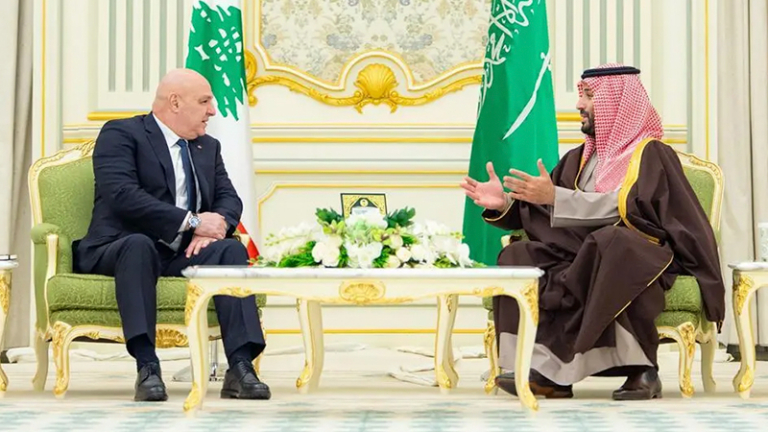
Saudi Crown Prince and Prime Minister Mohammed bin Salman (MBS)’s recent reaffirmation of support for Lebanese President Joseph Aoun underscores an increasingly important feature of Riyadh’s regional strategy. During a July 20, 2026, telephone conversation with Aoun, MBS reiterated Saudi support for Lebanon’s sovereignty, independence, and territorial dignity, and emphasized Riyadh’s readiness to assist the country’s recovery. The call came as Aoun traveled to Washington, where he urged US President Donald Trump to secure a complete Israeli withdrawal from South Lebanon while advancing a plan to bring all armed groups under the authority of the Lebanese state.
These developments illustrate Saudi Arabia’s growing emphasis on restoring state sovereignty as the key to regional stability in the Arab world. Riyadh’s vision of regional order is one wherein independent states exercise authority over their own affairs without being vulnerable to outside interference. As the Kingdom pursues Vision 2030—Saudi Arabia’s ambitious agenda for economic diversification, modernization, and global integration, the success of which depends on a regional environment conducive to foreign direct investment, tourism, international business, and long-term economic confidence—this strategic outlook becomes more important.
As officials in Riyadh see it, increased geopolitical instability raises perceptions of regional risk, discourages investment, complicates economic integration, and diverts attention and resources toward security crises. Consequently, the Saudi leadership views developments in Lebanon not as a distant or isolated challenge but as part of a broader contest over the future balance between external influence, military power, and state authority in the Middle East. Through the prism of the Mediterranean-Gulf security nexus, Saudi policymakers understand that conflicts in the Levant can reverberate throughout the wider region, shaping investor perceptions, regional alignments, and the broader security environment upon which the Kingdom’s domestic transformation depends.
Saudi Arabia rejects both Iranian tutelage and the possibility of Lebanon moving from an Iranian to an Israeli sphere of influence.
Against this backdrop, Saudi Arabia views both Iran and Israel as destabilizing forces whose hostilities risk further undermining the sovereignty of Arab states. While Riyadh has long regarded Hezbollah as a principal instrument of malign Iranian influence in Lebanon, it is also increasingly concerned that Israeli efforts to reshape the country’s political and security landscape through military force could replace one form of external domination with another. In short, Saudi Arabia rejects both Iranian tutelage and the possibility of Lebanon moving from an Iranian to an Israeli sphere of influence. Saudi Arabia’s policy toward Lebanon is best understood not simply as an effort to counter Hezbollah or Iran, but as part of a broader strategy to preserve a regional balance in which strong state institutions, rather than foreign powers or armed non-state actors, determine the political and security future of Arab states.
In the eyes of Saudi policymakers, Israeli attempts to eliminate Hezbollah through force risk fragmenting the Lebanese state and intensifying sectarian tensions, which could produce precisely the instability that Riyadh seeks to prevent. The Kingdom’s objective is to ensure that Lebanon’s state institutions, not foreign occupying powers or non-state actors, ultimately determine the country’s security decisions.
Saudi Arabia’s Evolving Lebanon Policy
Saudi Arabia has long been one of Lebanon’s most influential external actors. Before the outbreak of Lebanon’s civil war in 1975, the small Mediterranean country served as the Middle East’s leading financial hub, attracting substantial Gulf investment. Riyadh expanded its influence through loans, direct financial assistance, and investments in sectors including banking, tourism, and real estate, as well as by cultivating ties with political and commercial elites from Lebanon’s Sunni communities, including former Prime Minister Rafic Hariri and his son Saad during the post-civil war reconstruction. After the 2006 Israel-Hezbollah war, Saudi Arabia and Qatar played key roles in financing reconstruction efforts across the country. From 2011 to 2023, Saudi Arabia pursued sustained pressure on Hezbollah and, by extension, the Lebanese state, seeking to limit Iranian influence.
By the end of the 2010s, however, Saudi officials increasingly viewed Lebanon as a “lost cause.” Riyadh had invested billions of dollars in Lebanon, yet Lebanese leaders continually failed to resolve the issue of Hezbollah’s weapons in ways that Saudi officials found even close to acceptable. Hezbollah’s growing political and military dominance, combined with institutional paralysis and Beirut’s economic mismanagement, convinced Riyadh that its ability to shape Lebanese politics had significantly eroded. The decline of Saad Hariri’s political position and the fragmentation of Sunni representation weakened Saudi Arabia’s influence. The holding of Hariri against his will in Riyadh, from where he announced his resignation in November 2017, exposed the limits of the Kingdom’s clout in Beirut while underscoring the extent to which Riyadh was challenged to meaningfully counter Iran’s influence in Lebanon and across the region. With much frustration, Saudi Arabia concluded that it was no longer wise to spend large sums supporting a political system in which the government did not monopolize the use of force. Although the restoration of Saudi–Iranian diplomatic relations in March 2023 via the Beijing Agreement did not fundamentally alter Riyadh’s view of Hezbollah as a nefarious Iranian-backed actor, it encouraged a more pragmatic assessment of how best to approach Lebanon’s realities.
In the 2020s, Iran and its Axis of Resistance suffered a series of setbacks—including Hezbollah’s major losses during the 2023-24 war with Israel, direct Israeli strikes against Iran in October 2024, and the fall of the Assad regime in Syria in December 2024. Saudi Arabia and other Gulf Cooperation Council (GCC) members saw this reversal as an opportunity to reengage with Lebanon, particularly within the context of the Aoun-Salam government’s formation in February 2025. Riyadh’s support for Lebanon’s new political leadership reflected this reassessment.
Lebanese officials recognize that renewed Gulf assistance requires constructive relations with Riyadh.
Although the Kingdom has not returned to the level of economic influence in Lebanon seen in earlier decades, Saudi Arabia remains an important external actor in Lebanese affairs. Lebanese officials recognize that renewed Gulf assistance requires constructive relations with Riyadh, given that Lebanon’s economy cannot easily recover without improved ties with Saudi Arabia and other GCC states. The lifting of the five-year ban on Lebanese fruit exports to Saudi Arabia in June 2026 represented an important signal of such renewed engagement. As MBS explained, “positive steps taken by the Lebanese state” contributed to Riyadh’s decision.
The changing strategic context has encouraged a shift in Riyadh’s strategy. Rather than attempting to recreate the patronage networks of previous decades, Saudi Arabia during the MBS period has increasingly emphasized state institutions as the mechanism through which Lebanese sovereignty can be restored. This approach reflects a broader reassessment. Riyadh believes Hezbollah’s military autonomy remains incompatible with a sovereign Lebanese state, but it also recognizes that attempts to disarm the group through external military pressure could further weaken Lebanese institutions, intensify sectarian tensions, and create conditions for renewed foreign intervention.
The Regional Pursuit of State Sovereignty
Saudi Arabia’s concern for state sovereignty increasingly overlaps with that of Turkey. Ankara has its own rivalry with Israel and does not want either Israel or Iran to establish dominant positions in Syria or Lebanon. Both Riyadh and Ankara have therefore emphasized political stability, state sovereignty, and limits on external intervention, even though their interests and approaches remain distinct in many areas. Their convergence reflects a shared preference for a regional balance in which no single actor can dictate political outcomes across the Levant.
These dynamics also help explain Saudi Arabia’s emphasis on strengthening Syrian–Lebanese relations. Riyadh views Syria and Lebanon as interconnected rather than separate policy files. As a major supporter of Syria’s post-Assad transition, Saudi Arabia believes that stability, coordination, and economic recovery across the two countries are necessary to prevent renewed exploitation by either Iran or Israel. A stable relationship between Beirut and Damascus, in Riyadh’s view, can reduce the vulnerabilities that have historically allowed foreign powers to expand their influence.
Saudi Arabia has therefore encouraged greater coordination between Beirut and Damascus while opposing approaches that could transform Syria into an instrument against Lebanon’s Shia population. Riyadh’s preferred strategy emphasizes political dialogue, institutional strengthening, and security cooperation rather than sectarian confrontation. This position also overlaps with Turkey’s approach, as both countries have sought to avoid scenarios in which regional rivalries deepen Lebanon’s internal divisions.
Saudi Arabia’s position on Hezbollah and Israel is ultimately shaped by this broader strategic calculation. Riyadh opposes Hezbollah’s continued possession of an independent military capability because it believes the group undermines the Lebanese state’s authority and allows Iran to maintain a destabilizing role in the Levant. At the same time, Saudi Arabia is concerned that an Israeli campaign aimed at permanently eliminating Hezbollah could produce instability, weaken Lebanese institutions, and create conditions for another form of external domination.
Lebanon in a New Regional Order
The Kingdom’s preferred outcome for Lebanon is therefore not simply the defeat of one non-Lebanese actor by another. Riyadh seeks an outcome in which Israel withdraws from Lebanese territory, Iranian weapons networks are curtailed, and the Lebanese state becomes the sole authority responsible for national security decisions. Saudi Arabia’s challenge is to reduce Iranian influence without allowing the process of doing so to consolidate Israeli hegemony and bring Lebanon into Tel Aviv’s sphere of influence.
The Kingdom’s preferred outcome not simply the defeat of one non-Lebanese actor by another.
However, the Saudi leadership must contend with the possibility of a deeply troubling scenario in which a long-term Israeli military presence becomes entrenched in South Lebanon while Hezbollah retains a significant portion of its military capabilities. Such a situation would leave Lebanon trapped between an increasingly permanent Israeli occupation and the continued power of an Iranian surrogate group, rather than moving toward genuine state sovereignty. If the Lebanese Armed Forces were increasingly perceived as facilitating or policing an enduring Israeli security arrangement—which could draw unwelcome comparisons to the role of the Palestinian Authority in the occupied West Bank—Hezbollah and Iran would be in a strong position to reinforce their narrative that the Islamic Republic and the Axis of Resistance are alone in genuinely confronting Israeli expansionism. Such an outcome might strengthen Hezbollah’s popular support inside Lebanon while further complicating efforts to consolidate the Lebanese state’s monopoly over the use of force. The Trilateral Framework Agreement, signed by Lebanon, Israel, and the United States on June 26, 2026, could, if implemented in a manner that institutionalizes an indefinite Israeli presence without fully addressing Hezbollah’s military status, inadvertently move Lebanon closer to this impasse that Riyadh finds highly undesirable.
For Riyadh, Lebanon’s future is ultimately tied to the broader question of whether states in the Middle East can strengthen their own institutions and sovereignty amid competition among larger external powers. Saudi Arabia’s Lebanon policy reflects an attempt to navigate between these competing pressures while preserving a regional environment compatible with its economic ambitions, security interests, and vision of a more stable and peaceful order in the Arab world.
Preventing a New Regional Hegemony
Lebanon represents a microcosm of Saudi Arabia’s broader concerns about the emerging regional order in the Middle East. Riyadh does not view the weakening of Iranian influence as an end in itself. Rather, the Kingdom seeks a regional balance in which Arab states regain greater authority over their own security affairs without becoming dependent on another external power. The Hezbollah-Israel conflict has intensified this concern because the US-Israeli effort to disarm Hezbollah could produce outcomes that weaken Lebanese sovereignty and undermine Saudi Arabia’s national interests.
Saudi Arabia has become increasingly concerned that Israeli military operations across the region could contribute to a new security environment in which Israel enjoys unprecedented freedom of action. From Riyadh’s perspective, weakening Iranian-backed actors through military force may address one source of instability only to create new problems if Arab states become dependent on Israeli military power for security arrangements. The Kingdom’s concern is that efforts to eliminate Iranian influence could unintentionally undermine the sovereignty of the very states that Saudi Arabia seeks to strengthen.
This concern has shaped Riyadh’s approach to Lebanon. Saudi Arabia does not want Iran to regain a dominant position in the Levant, but it also does not believe that Iranian decline should result in Lebanon becoming a de facto Israeli protectorate. Such an outcome would leave Lebanon caught between competing external powers rather than governed by its own institutions. From the Saudi perspective, the goal must be for the Lebanese state eventually to regain authority over decisions involving war and peace.
Against this backdrop, Saudi Arabia has increasingly sought greater coordination with regional partners that share concerns about instability and unilateral power projection. An informal geopolitical bloc—sometimes referred to as the “Islamic Quad”—involving Egypt, Pakistan, Saudi Arabia, and Turkey, with close cooperation from Jordan and Qatar, reflects a broader desire among several regional powers to de-escalate conflicts, promote greater dialogue, and prevent any single actor from dominating the Middle East.
The views expressed in this publication are the author’s own and do not necessarily reflect the position of Arab Center Washington DC, its staff, or its Board of Directors.