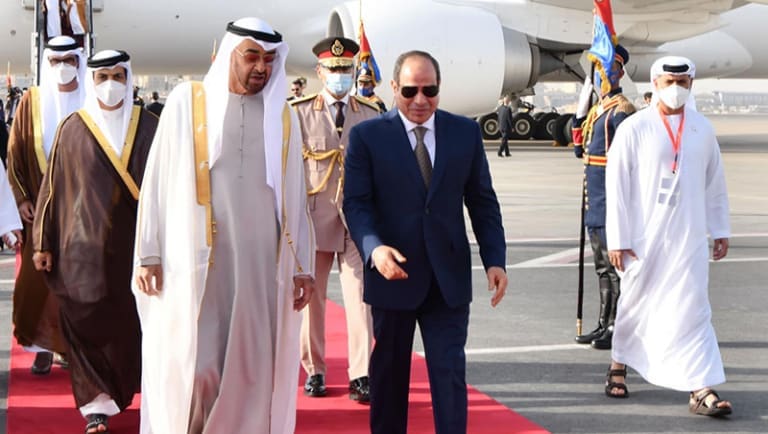
The US-Israeli war on Iran has put Egypt in a predicament. Since the 2013 coup that brought him to power, Egyptian President Abdel-Fattah el-Sisi has enjoyed a mutually beneficial relationship with Gulf leaders who deeply appreciated his crackdown on the Muslim Brotherhood after the 2011 Arab Spring protests. Sisi has been a cornerstone of the new regional political order that connects Egypt to the United States and the Gulf states. Cairo is also heavily indebted to many of the Gulf states that Iran has targeted in its response to the 2026 war: Gulf Cooperation Council (GCC) members have poured tens of billions of dollars in grants, Central Bank deposits, and investments to help Egypt weather serious economic troubles over the years. Yet skeptics in the Gulf are now asking whether Cairo really has the GCC’s interests at heart, given Egypt’s failure to provide military support in their ongoing confrontation with Iran.
Admittedly, Egypt was quick to condemn Tehran’s missile and drone strikes on the Gulf. Sisi called Iran’s actions criminal during his visits to Saudi Arabia, Bahrain, Qatar, and the United Arab Emirates (UAE). While formally asserting its neutrality in the conflict, Cairo—along with Pakistan and Turkey—helped devise a diplomatic path that led to the two-week US-Iran ceasefire that effectively ended (for now) Iranian attacks on the GCC. On April 18, 2026, Sisi’s foreign minister, Badr Abdelatty, announced that Egypt was working with Pakistan, Turkey, and Saudi Arabia to reach a broad security deal that would end the conflict altogether.
Nevertheless, Gulf intellectuals and social media influencers criticized Egypt’s reticence to act more directly in support of the GCC. Often using unflattering language about the country, they reminded Egyptians of the Gulf’s open checkbook offered since Sisi came to power.
Gulf intellectuals criticized Egypt’s reticence to act more directly in support of the GCC.
Egyptian journalists and media commentators responded to these criticisms with vitriol, prompting state media bodies to warn that such verbal attacks on “fellow Arab states” are criminalized in Egypt. Given the controlled media space in both Egypt and the Gulf, the negative comments must be considered reflections of positions that, for diplomatic reasons, Cairo and some Gulf capitals cannot voice publicly.
Gulf critics of Egypt overlook that, since at least the 1990-1991 Gulf War, Washington has been the primary security guarantor in the region. Although several GCC states have hosted US military bases for decades, Gulf leaders have never been able to make that military partnership ironclad. Gulf leaders have been able to secure from Washington a steady supply of modern weaponry, which costs them many billions of dollars annually. But with the notable exception of President Donald Trump’s September 2025 Executive Order on Qatar, the United States has not provided them with mutual defense agreements or defense guarantees.
US military assets in the Gulf primarily serve to project its influence in a strategic region in line with the country’s long-term national interests. US military assets in Saudi Arabia and the UAE, for example, were not, in those countries’ view, rapidly enough deployed to protect the kingdom’s Abqaiq oil facilities following the Iranian-attributed 2019 attack or to Abu Dhabi after a similar 2022 strike. The recent conflagration with Iran suggests that US military assets in Gulf Arab countries are strictly intended to defend US bases there, not the host countries.
Egypt’s leadership seems to combine economic caution with political anxiety when it comes to making decisions over whether to send military support to the Gulf. Egypt suffers from high inflation (above 15 percent in March 2026), lower economic growth in 2026 (4.2 percent) caused in part by a serious decline in Suez Canal revenue, a very high debt-to-GDP ratio (around 83 percent), and an ever declining value of the national currency (55 Egyptian pounds to the US dollar). Involving the armed forces in external affairs is a luxury that the Egyptian economy cannot afford.
Sisi and his lieutenants are also worried about their immediate neighborhood. First, although Gaza has been temporarily displaced from television screens by the US-Israel war on Iran, Israel’s war on the Strip continues, killing Palestinians on a daily basis and threatening to force the survivors to flee into Egypt to escape the violence. Second, Sudan’s civil war—which in April 2026 entered its fourth year—might spill over into Egypt as the stalemate between the warring parties risks the de facto partition of Africa’s third-largest country. Nor can Egypt ignore the divisions in Libya, where Cairo over the years played a pivotal role. Egypt also remains on the lookout for what might happen with its ongoing and dangerous dispute with Ethiopia over the Nile waters, a dispute Egyptians consider a grave threat to their national security. Egypt also faces serious concerns along the Red Sea littoral and the Gulf of Aden, including Yemen’s Houthis, the security of the Bab al-Mandab waterway, and Somaliland’s secession. The uncertainties of Egypt’s strategic neighborhood mean that its leadership is wary of unwarranted engagement in defending GCC states against Iranian attacks.
Egypt’s leadership is wary of unwarranted engagement in defending GCC states against Iranian attacks.
Today’s tensions between Egypt and the Gulf states have arisen from the combination of unrealistic expectations in the Gulf and expediency from Egypt’s leaders. GCC residents might have thought that Egypt’s armed forces could be used as guns for hire, to repay earlier financial assistance. But in modern statecraft, state institutions cannot be expected to serve as foreign policy instruments for other countries. Conversely, Egyptian decision-makers perhaps believed that Gulf money was given freely, with no strings attached. Both perspectives have failed the tests of time and circumstance.
Whether at least some course correction may be required in relations between Egypt and the Gulf states in the future is anyone’s guess. Public opinion in the Gulf should come to terms with the fact they will not be paid back for extending a helping hand to Egypt. Neither should Egyptians or their leaders think that they can always rely on outside financial assistance to navigate choppy economic waters. But one thing is certain: the end of the US-Israel war on Iran will require a serious rebalancing of Egypt-Gulf relations to safeguard their common interests while respecting the free exercise of modern statecraft and its requirements.
The views expressed in this publication are the author’s own and do not necessarily reflect the position of Arab Center Washington DC, its staff, or its Board of Directors.
Featured image credit: Egyptian Presidency/FB