The US-Iranian ceasefire of April 8, 2026, may not withstand President Donald Trump’s June 11, 2026 threat to seize Iran’s Kharg Island and to take control of the country’s oil and gas markets. His words no doubt were welcomed by those political leaders, pundits, and policy analysts in Washington and Tel Aviv who have urged him to “finish the job” with Iran. These hawks know that a US-Israeli air war will never deliver the “unconditional surrender” that Trump has demanded from Iran. That outcome would require a full military invasion that destroys the regime and its entire coercive apparatus. Only a total US military victory, the hawks believe, will eliminate Iran’s domestic nuclear enrichment and ballistic missile programs. But what this “finish-the-job” crowd rarely acknowledges is that their entire strategy rests on the whims of a president whose volatility makes him an unreliable instrument of their regional transformation project.
“Finish-the-Job” Arguments
Early in the 2026 US-Israeli military operations against Iran, the pro-war camp worried that Trump’s determination to finish the job might waver. Atlantic Council President Frederick Kempe, for example, argued that the United States must not “end its military campaign early” but should demonstrate “military resolve” and strategic patience. Kempe’s recommendation built on his argument that over the years, Iran’s proxy conflicts in the region and cyberattacks and energy infrastructure strikes on the Gulf countries had shifted the “balance of power irretrievably in Iran’s direction” and that US military action was needed in response.
The Israeli pro-war camp has echoed many of the same themes. In April 2026, retired Major General Amos Yadlin and Aver Golov, a former Israeli National Security Council official, argued in Foreign Affairs that the objective should not merely be to “finish the job” but to “enmesh” the “defense bases” and “combined might” of Israel and the United States to “shape a New Middle East.” Their vision of Iran is based on events during the immediate aftermath of the 1979 revolution, when the Islamic Republic “declared war on the United States (which it calls the Great Satan)” and stormed the US Embassy in Tehran. “Tehran has since killed, directly or indirectly, thousands of American troops,” they wrote. They present Iran’s regime as committed to harming the United States and as evil by its very nature, and therefore as an unviable negotiating partner. Of course, if a history of enmity were truly the determining factor in international relations, no conflict would ever be resolved through diplomacy.
If a history of enmity were truly the determining factor in international relations, no conflict would ever be resolved through diplomacy.
The goal of the 2026 US-Israel war, Yadlin and Golov asserted, is to force Iran into “dismantling its nuclear program, fully disbanding its proxy network, ceasing…support for terrorist organizations, generally abandoning its efforts to export its revolutionary ideology and explicitly recognizing Israel’s existence.” For Iran’s rulers, this long list of concessions would require nothing less than their political obliteration. While Yadlin and Golov acknowledge that regime change is not a formal US-Israeli war objective, they argue that it should become one in the “postwar campaign.”
Pro-War Arguments Meet Reality
Pro-war arguments are contradicted by the facts. To be sure, over the last year Iran’s regional clout has suffered a series of blows from the United States and Israel. Yet Trump has had no idea how to translate the tactical military gains into a viable diplomatic strategy. His quest for Tehran’s surrender prompted the emergence of a new generation of ultra-hardliners, led by a new Supreme Leader, Mujtaba Khamenei, who appears determined to avenge the US-Israeli killing of his father. Iran’s effective closure of the Strait of Hormuz and its targeting of gas, oil, and desalination plants in the Gulf countries have shown that it would rather threaten the entire Gulf region than capitulate to the United States and Israel. The rise of these new hardline leaders underscores the perils created by the very policy of total victory championed by the pro-war camp.
While the Israeli pro-war camp might hope that the war will produce a new regional order in which Arab governments see Israel as a trusted partner, Israel’s ongoing military onslaughts in Gaza, the West Bank, and Lebanon make this virtually impossible. The basis for any real strategic trust between Israel and Arab states is now weaker than ever, despite the hope of some Arab leaders that they can rely on Trump to advance a coherent US strategy for Iran or the wider Middle East. But Trump’s volatility means that he is no foundation for a stable regional order.
The US pro-war camp, which includes many Republican leaders and conservative pundits, opposes any interim US-Iran agreement of the kind that Trump is reportedly considering. But Iran also has its own counterparts to the “finish-the-job” crowd, some of whom have tried to discredit the prospect of a deal. Iran’s lead negotiator, Speaker of Parliament Mohammad Bagher Ghalibaf, sought to deflect this pressure by arguing that Tehran will get concessions from the United States “not through dialogue but with missiles.” US Secretary of War Pete Hegseth echoed the same logic when he declared that the Trump administration was ready to “negotiate with bombs.” The idea is perilous, as any effort to bomb Iran into capitulation could prompt Tehran to attack the Gulf states even harder than it has so far with possibly devastating results. A war of “mutually assured devastation” could become very real unless Trump suddenly backs down from such a threat.
The Uncertainty of Trump
Apart from the formidable odds against a complete military victory, the final obstacle to the end goal of the finish-the-job camp is President Trump himself. His hawkish first-term national security advisor John Bolton has commented that “Trump doesn’t think strategically. He doesn’t even do policy the way most people understand.” Trump certainly seems to have an unreasonable conviction that he can always bend weaker powers to his will. Although Trump envisions an end to the Iran war “much like we have with Venezuela,” for example, Iran’s leaders are highly unlikely to cut a similar deal with the United States.
If Trump concludes that the Iran stalemate is making him look weak, he might turn on the finish-the-job crowd and cut a deal with the Islamic Republic.
The president’s convictions may have allowed hawks in Israel and the United States to encourage his belief, early in the war, that he could force Iran into an unconditional surrender. But if Trump concludes that the Iran stalemate is making him look weak, he might turn on the finish-the-job crowd and cut a deal with the Islamic Republic. The only thing sure to motivate Trump’s reversal is the threat of losing his domestic political base—a prospect to which he alluded in his June 11, 2026, comment that he was unsure whether “America has the stomach” to send ground troops into Iran. This frank admission underscores the risks that come with Trump’s constantly shifting position. He may yet pull back from the precipice of resuming full-scale war—a prospect that must still worry the pro-war camp.
Maximalists in Washington, Tehran, and Tel Aviv alike are hoping that Trump will not flinch this time, but they cannot be sure that he will not. Trump, after all, cannot abide being seen as a loser. As a result, Trump could very well end up signing an interim deal with Iran, leaving those who pushed for finishing the job in the dust of a war he should have never started.
The views expressed in this publication are the author’s own and do not necessarily reflect the position of Arab Center Washington DC, its staff, or its Board of Directors.
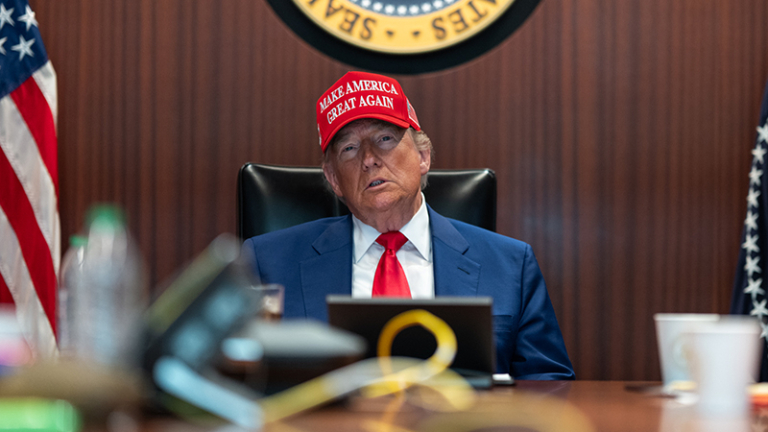
Featured image credit: The White House via Flickr