On June 17, 2026, the United States and Iran signed an interim ceasefire deal that provides for an “immediate and permanent termination of military operations on all fronts, including in Lebanon.” This agreement, however, does not address the underlying condition that makes Lebanon a perpetual theater of conflict.
Lebanon has never possessed genuine sovereignty, and this chronic deficit of internal and external control renders it a permanent arena for proxy warfare. Israel’s major military escalation into South Lebanon since March 2026 reflects and reinforces a deeper reality: Lebanon’s weakness is not a temporary failure of governance, but a structural condition that external powers have preserved and exploited for their own advantage. The recent deal, negotiated by two foreign states over Lebanese territory, exemplifies the conundrum rather than offering a solution.
Lebanon’s sovereignty deficit is perpetuated by a destructive feedback loop. Weak institutions and the absence of a state monopoly on violence invite intervention, whether from Iran, Israel, Syria, or the United States. Each intervention further erodes the state’s capacity to assert control, which in turn invites more interference. Lebanese factions cannot survive without foreign patrons, yet those patrons have no interest in a strong, unified Lebanon. The result is a self-reinforcing cycle in which sovereignty is perpetually promised but never delivered. The deficit has been so consistently reproduced by the actions of both external powers and local actors that it functions as a durable condition. All sides weaponize Lebanon’s sovereignty as a selectively enforced legal principle, a justification for intervention, a bargaining chip in ceasefires, and a cover for foreign military strategy. This weaponization is possible precisely because sovereignty does not truly exist, yet every actor invokes it when convenient.
Israel’s 2026 offensive cannot be understood without the context of this conundrum. On May 29, Israeli forces crossed the border and reached the Lebanese town of Nabatieh because no effective Lebanese state existed to stop them. Israeli Defense Minister Israel Katz vowed to turn the area south of the Litani River into a military-controlled zone. The June 1 partial ceasefire mediated by the United States carved out exemptions that allowed Israel to continue bombing South Lebanon, an arrangement no genuinely sovereign state could have accepted. Israel’s actions are not merely a response to Lebanon’s failure; they are a contributing cause of that failure. They exploit the pre-existing deficit while simultaneously deepening it, making it ever harder for any future government to reclaim authority. In this sense, Israel is both a beneficiary and a producer of Lebanon’s sovereignty conundrum. Similarly, Iran uses Hezbollah’s arsenal as an extension of its own deterrence doctrine, turning Lebanon into a forward outpost of Iranian national security.
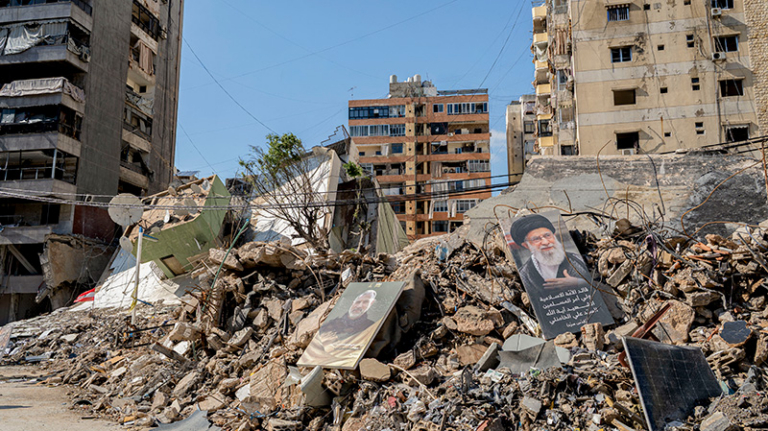
Israel’s offensive has produced three interconnected phenomena—ecocide, domicide, and ethnocide—that together constitute an integrated strategy to make South Lebanon uninhabitable, displace its population, and erase its historical memory. Ecocide attacks the land itself. The Lebanese Ministry of Environment and Lebanon’s National Council for Scientific Research documented 5,000 hectares of forest cover was destroyed during the 2023-2024 Israel-Hezbollah conflict alone, with agricultural losses of 2,100 hectares of orchards, including more than 800 hectares of slow-maturing olive groves. Soil contamination has now reached dangerous levels, with phosphorus concentrations far above baseline. Human Rights Watch has documented the use of white phosphorus over residential areas, an unlawfully indiscriminate practice under international humanitarian law. In February 2026, after Israeli forces sprayed chemical herbicides across farmland, the Lebanese Agriculture Minister reported 20 to 30 times the normal concentrations of glyphosate, which had destroyed vegetation and created a barren, desert-like strip. The Litani River, wholly inside Lebanon, has been targeted through the destruction of bridges and the disruption of water supplies, threatening food security. When a state cannot protect its own rivers and soil, it ceases to function as a sovereign entity, and external powers can treat Lebanese resources as prizes rather than protected national assets.
Domicide complements this ecological destruction by systematically destroying homes to make territory uninhabitable. In March 2026, Katz warned that Lebanon would “pay increasing costs through damage to infrastructure and loss of territory” until Hezbollah was fully disarmed, later explicitly calling for the destruction of all houses in the border villages, invoking the Gaza model where more than 90 percent of homes in Rafah had been destroyed. The Israeli military then warned residents south of the Litani River that they could not return before residents in northern Israel were safe. Israel’s systematic demolition has displaced 1.2 million people in Lebanon, roughly one-fifth of the population. Domicide does more than displace people; it severs the bond between a population and its territory. Without that bond, sovereignty becomes a hollow word. The destruction of homes prevents return, which in turn prevents any future claim of sovereign control over the land, preparing the ground for alternative occupation or annexation. The settler organization Uri Tzafon has notably advocated for permanent Israeli settlements in South Lebanon, possibly as a first step toward a “Greater Israel.”
Ethnocide, or cultural genocide, erases memory and cultural continuity, directly attacking the foundations of national identity. This term describes the deliberate destruction of cultural heritage as a strategy of war, wiping out a people’s historical rootedness and their confidence that the state can protect its symbols. On May 30, 2026, Lebanese Prime Minister Nawaf Salam accused Israel of trying to “uproot Lebanon’s memory and erase the people’s history.” The destruction of historic landmarks, including UNESCO heritage sites, fits a clear pattern of erasing the past to foreclose any future claim of sovereignty. Without memory, without homes, and without a living landscape, sovereignty is not merely weak; it is effectively dead. The three phenomena work in concert: ecocide makes the land barren, domicide empties it of people, and ethnocide erases the stories that tie those people to that land. Together they reconfigure the territory into a blank slate, ready for redefinition by external powers.
Lebanon will never achieve sovereignty as long as outside actors treat it as a chessboard and local elites continue to rely on foreign patrons. Israel’s 2026 offensive is not only a response to a sovereign state’s failure; it is a driving force behind that failure. The ecocide, domicide, and ethnocide inflicted on South Lebanon are not collateral damage. They transform territory, erase memory, and foreclose the possibility of return. Lebanon needs more than a ceasefire negotiated by outside powers. Israel must unconditionally respect Lebanon’s borders, and the international community must enforce existing legal protections. Lebanese factions must also imagine a new political order that does not depend on external backing. Until these conditions are met, Israel’s actions will remain not a violent symptom of Lebanon’s sovereignty deficit but a direct assault on the very possibility of sovereignty itself. A sovereign state cannot exist while its land, homes, and memory are systematically destroyed.
The views expressed in this publication are the author’s own and do not necessarily reflect the position of Arab Center Washington DC, its staff, or its Board of Directors.
Featured image credit: Photo by SILVIA CASADEI / MIDDLE EAST IMAGES / MIDDLE EAST IMAGES VIA AFP