
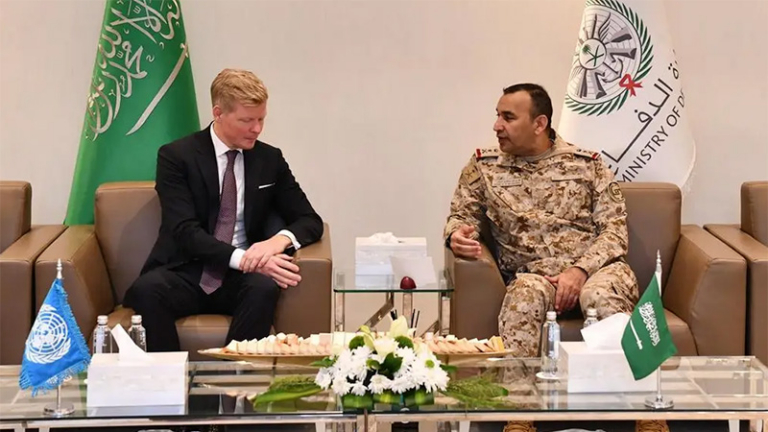
Although originally established to facilitate a negotiated political settlement to the Yemen conflict, for over a decade the focus of the United Nations (UN) Office of the Special Envoy of the Secretary-General for Yemen (OSESGY) has shifted toward reactive crisis management. Successive UN special envoys—including the current incumbent, Hans Grundberg—have been forced to pivot from governance reform to taking short-term steps to support fragile ceasefires.
The UN mission currently operates with a focus on damage control in small steps. For instance, it facilitates limited prisoner exchanges, conducts routine consultations with local and regional actors, and keeps basic lines of communication open to potentially negotiate incremental roadmaps to peace. These efforts, however, remain short-term tactical fixes. Today, the overall strategy of UN mediation efforts in Yemen has been fundamentally compromised by contextual disconnects, institutional self-preservation, and perceived conflicts of interest. Diplomatic resolution of the conflict will continue to be futile unless the UN mission in Yemen undergoes a fundamental overhaul.
Frozen in Time: The UN in Yemen
The United Nations launched its mediation process in Yemen during the 2011 uprising. Ban Ki-moon, UN secretary-general at the time, appointed UN diplomat Jamal Benomar as his representative. Benomar began in an advisory role, but in June 2012 the UN institutionalized the role with the establishment of the Office of the Special Adviser to the Secretary-General on Yemen (OSASGY). Two months later, Benomar was formally appointed as its first special adviser. As Yemen’s streets were boiling with protests amid deadly security crackdowns in the early 2010s, the UN mission’s initial focus was to transition Yemen toward democracy. It facilitated a November 2011 political transition agreement between former President Ali Abdullah Saleh’s regime and opposition forces, with a power transfer deal from Saleh to Vice President Abdrabbuh Mansur Hadi, and supported the 2013–2014 National Dialogue Conference.
In 2015, OSASGY transitioned into the Office of the Special Envoy of the Secretary-General for Yemen (OSESGY). UN Security Council Resolution (UNSCR) 2216 on the Yemen conflict was passed in April 2015, requesting the Secretary-General to use his good offices to facilitate “a peaceful, inclusive, orderly, and Yemeni-led transition process that meets the legitimate demands and aspirations of the Yemeni people.” This resolution provided the basis for subsequent UN mediation efforts. But since then, UNSCR 2216 has been neither updated nor replaced, which means that today’s mediation framework incorporates understandings of Yemeni power dynamics from 2015 that are now outdated. The resolution penalizes former President Ali Abdullah Saleh for his alliance with the Houthis, for example, but Saleh was killed by the Houthis in 2017. The resolution similarly commits to restoring the government of President Hadi, but Hadi resigned in 2022 and transferred authority to the Presidential Leadership Council (PLC). UNSCR 2216 is based on political conditions that no longer exist.
The Houthis seem poised to become a regional actor with potentially global economic leverage.
UNSCR 2216 also treats the Houthis primarily as armed rebels. It demands that the Houthis unconditionally disarm and fully withdraw from all the cities they had seized, including Sanaa. But the movement has now been entrenched in Sanaa and northern Yemen since 2014: treating the de facto Houthi authorities in the north as a short-lived insurgency is an unrealistic approach to peace negotiations. This detachment from current realities in Yemen has been underlined by the international community’s failure to enforce other terms of the resolution. UNSCR 2216 established an open-ended arms embargo to curtail Houthi capabilities, but the group has persistently managed to circumvent sanctions through smuggling, successfully maintaining its domestic missile and drone manufacturing capabilities. Many sanctions have proved ineffective because the group had few external assets or foreign vulnerabilities; punitive blacklists have barely affected them. As documented in the 2025 report by the UN Security Council Panel of Experts on Yemen, furthermore, the Houthis have largely consolidated military and societal control across areas under their dominance.
The 2015 resolution also considered the Houthis as a local Yemeni actor. But in 2026, the Houthis seem poised to become a regional actor with potentially global economic leverage, as demonstrated by the group’s involvement in the Gaza war and its military activities in the Red Sea. The rigid mandates of UNSCR 2216 are decoupled from current geopolitical realities and are ill-suited for contemporary conflict resolution. The existing framework offers no mechanisms to address the expanded threat of the Houthis. Neither the UN secretary-general nor the special envoy has publicly pressed the Security Council for an updated resolution.
Inertia has further compromised the effectiveness of the UN mission, which increasingly functions as a self-preserving administrative apparatus rather than an effective mediation operation. Peacemaking has been turned into a self-perpetuating bureaucratic exercise, which critics argue prioritizes the preservation of a formal mandate over achieving real conflict resolution. The UN has annually reauthorized the mandate of the UN Mission to Support the Hodeidah Agreement (UNMHA), established in 2019 by UNSCR 2452, as a matter of routine, even though its underlying political framework to demilitarize Yemen’s vital Red Sea ports had already failed. In effect, the UN mission maintained a multi-million-dollar presence simply to preserve its diplomatic footprint, favoring mandate survival over actual conflict resolution. UNMHA was not terminated until March 2026. Diplomatic activity often seems to outlive the developments to which it was intended to respond.
Above Suspicion
Appointing a Swede, Hans Grundberg, as UN Special Envoy in August 2021, initially leveraged Sweden’s long-standing reputation among Yemenis for the country’s respect for human rights and neutrality. Grundberg officially maintains clear structural neutrality, with no partisan ties to the Saudi-led coalition, the Yemeni government, or the Houthis. Grundberg has nevertheless encountered some significant obstacles in advancing his mission.
While previous UN envoys have met face-to-face several times with the Houthi leader, Abdulmalik al-Houthi, Grundberg has never managed to do so. UN high-level access to Sanaa was already constrained. After a visit to the capital in May 2023, Grundberg was unable to travel there again for nearly two years. During that time, matters deteriorated further following the Houthis’ mid-2024 arbitrary detention campaign of UN and civil society personnel. After Houthi authorities publicly accused the detainees of belonging to an alleged “American-Israeli spy network,” direct UN visits to the capital were frozen. Apart from a rare three-day visit in January 2025—aimed primarily at demanding the release of detained personnel—direct UN visits to the capital have remained frozen. This lack of contact has functionally paralyzed in-person mediation between the two sides.
On August 15, 2024, Grundberg’s spouse, Alexandra Rydmark, was appointed as Sweden’s Ambassador to Israel. Her appointment came just one month after the Houthis’ unprecedented drone attack on Tel Aviv on July 19, 2024. The attack was the first time a Houthi projectile had successfully penetrated Israel’s advanced multilayered air defenses to hit the city center, killing one person and injuring ten others. Retaliatory Israeli attacks rained down on the Houthi-controlled Hodeidah Port the following day. Pro-Houthi media argued that Rydmark’s appointment would compromise Grundberg’s position, undermine the UN’s perceived neutrality, and create an acute conflict of interest in mediating the Yemen conflict.
Once the Houthis entered direct fighting with Israel, Grundberg’s personal connections cannot be considered in isolation. In high-stakes conflict mediation, where perceived impartiality is as decisive as structural neutrality, even indirect familial and marital ties to an active belligerent risk compromising the envoy’s standing as a neutral broker. Grundberg’s effectiveness as the UN special envoy is further undermined by his inability to speak Arabic, which makes it difficult for him to grasp this local social and cultural context.
Institutional Overhaul Required
A comprehensive reform in the UN mediation framework—legal, structural, diplomatic, and operational—is essential for genuine progress in UN peace efforts in Yemen. The responsibility lies on the shoulders of the UN Security Council and the secretary-general.
First, the UN Security Council, led by its permanent five members China, France, Russia, the United Kingdom, and the United States, should immediately draft and promote an updated resolution on Yemen. The new resolution must formally abandon the old text and political references from 2015. It must reflect current power dynamics, such as the PLC and current de facto territorial authorities, establish a multipolar conflict resolution framework, and replace unconditional disarmament demands against the Houthis with a structured, phased security architecture. Punitive and static sanctions should be replaced by dynamic incentives. By treating full disarmament as a prerequisite rather than a phased outcome, moreover, the UNSCR 2216 left the Houthis with no political incentive to negotiate, effectively reinforcing their drive to fight. To achieve meaningful peacemaking, the UN must replace open-ended penalties with flexible, benchmarked incentives tied to realistic, phased security commitments.
TheUN Security Council should immediately draft and promote an updated resolution on Yemen.
A new Security Council resolution should also establish a mechanism for distributing humanitarian operations to regional hubs, depriving central authorities of their ability to exploit dependency or detain staff for political gain. Even though in September 2025 the UN resident and humanitarian coordinator relocated to Aden, such ad hoc relocations are insufficient given the concentration of administrative clearance, logistical approvals, and country headquarters in Sanaa, which give the Houthis a quasi-monopoly over aid distribution. A new resolution must mandate that UN agencies, funds, and programs systematically distribute procurement, logistical clearances, and staff management across regional hubs such as Aden, Marib, Mocha, and Mukalla.
The most significant reform in the mediation framework is enforcing strict conflict-of-interest protocols by the UN Secretariat. Establishing explicit diplomatic firewalls and ethics standards for UN envoys to Yemen will help prevent the already dire situation from deteriorating. During regional wars, the UN must enforce mandatory disclosures and assessment protocols for potential perception risks—such as diplomatic postings of immediate family members—that jeopardize perceived impartiality and potentially endanger both local and international UN personnel. Simple details, such as local language proficiency, must also be addressed in the reform. Senior leadership and core mediation teams on the ground must be able to verify their Arabic proficiency and deep understanding of the local context.
The UN has no magical powers to force warring parties to engage and cooperate, whatever peace model it adopts. Mediation in Yemen fundamentally depends on the political will of local and regional parties. But to have a chance to improve the situation, the UN must first set up its mediators for success.
The views expressed in this publication are the author’s own and do not necessarily reflect the position of Arab Center Washington DC, its staff, or its Board of Directors.
Featured image credit: SPA

