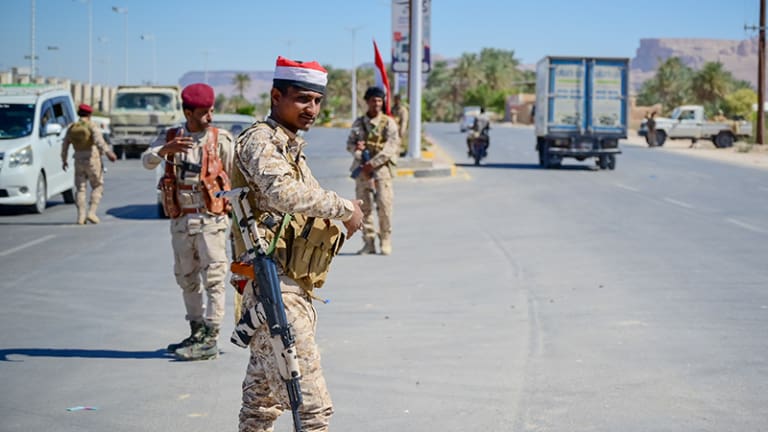
The May 28, 2026, death of former president Abdrabbuh Mansour Hadi marked the end of an era for Yemen. As vice president from 1994-2012, Hadi was often overshadowed by President Ali Abdullah Saleh. Upon taking over as president following Saleh’s 2012 abdication, Hadi faced a worsening crisis caused by the failed national dialogue (2014), the subsequent Houthi takeover of the capital Sanaa (2014), and the Saudi-led Arab Coalition’s intervention in the war against the Houthis (2015). Hadi’s removal as president came in April 2022, when his ally Saudi Arabia decided to extricate itself from the Yemen quagmire and to replace him with an eight-person Presidential Leadership Council (PLC), headed by former interior minister Rashad al-Alimi and serving as the internationally recognized Government of Yemen. The Houthis, having survived an earlier six-year war against Saleh (2004-2010) and the Arab Coalition’s military intervention since 2015, are currently regrouping from the punishing 2025 US and Israeli air strikes. They are reportedly mobilizing and training new forces, potentially in preparation for a full entry in support of their ally Iran during the US-Israeli war on the Islamic Republic. Meanwhile, the humanitarian situation for Yemenis, both those living in Houthi-controlled areas in the north and those nominally under PLC governance in the south, remains dire.
The Houthis are currently regrouping from the punishing 2025 US and Israeli air strikes.
On February 6, 2026, the PLC formed its fourth government in as many years, composed of a new prime minister, Shaya al-Zindani, and a 34-member cabinet that was intended to broaden representation of different regions of Yemen and to dilute the influence of the United Arab Emirates (UAE)-backed secessionist Southern Transitional Council (STC), which was part of the PLC but in December 2025 launched an unsuccessful military campaign to take over the south. The Zindani government faces an uphill struggle to distinguish itself from its predecessors in consolidating control in the south, in initiating economic reform, and in implementing development projects—all while holding on to the ambition of eventually retaking Sanaa from the Houthis and reunifying the country.
Saudi Arabia continues to be the principal patron of the PLC. Not only did Riyadh intervene against the STC’s failed takeover attempt, but in January 2026 it announced a $500 million development package in recognition of the dire humanitarian situation in the south, where, 11 years after the Arab Coalition’s intervention, disease, acute food insecurity, and collapsed government services are rampant. UN reports continue to sound the alarm—and anticipate even worse conditions to come. Yemen has been plagued with corruption for decades, a problem from which the PLC still suffers. The PLC has few, if any, economic achievements.
In northern Yemen, the Houthis (also called Ansar Allah), one of Iran’s few remaining allies in the region, have focused on armament and mobilization to maintain themselves in power, at the expense of improving the humanitarian situation of the roughly 80 percent of the Yemeni population over whom they rule. Just weeks after Israel launched its post-October 7 war on Gaza, the Houthis started firing missiles at Israel and attacking Red Sea shipping. The May 2025 agreement between the Trump administration and the Houthis halted the group’s attacks on Red Sea shipping, while Houthi attacks on Israel, seemingly exempted from the US-brokered truce, dwindled. One month into the Iran war, on March 28, 2026, the Houthis fired a barrage of missiles against southern Israel, but have not launched any such attacks since. The Houthis have not changed their ideology, which has inspired the pro-Palestinian and pro-Iran policies that they have emphasized since taking power in Sanaa in 2014. The reasons for their current relative military restraint are the subject of speculation. Certainly, the punishing 2025 US and Israeli bombing campaigns have something to do with it. Israeli strikes hit key Houthi infrastructure, fully disabling the Sanaa airport and damaging the Hodeidah seaport on the Red Sea—through which most of the Houthis’ shipping occurs—and destroying Houthi weapons depots. These losses, on top of Israel’s assassinations of important political figures and personnel, suggest that the Houthis would have to weigh carefully the costs of resuming their military attacks on Israel and in the Red Sea. Yet the Houthis remain a serious force in any regional equation; if the war on Iran resumes in full force, it may be difficult for the Houthis to stay out of it.
If the war on Iran resumes in full force, it may be difficult for the Houthis to stay out of it.
In part due to the international sanctions on the Houthi regime and in part due to the Houthis’ own corruption and mismanagement, the economy in the areas under its control is not healthy. The group’s international isolation is at least somewhat a self-inflicted wound, resulting from the group’s deep paranoia regarding foreign institutions, including the international NGO community that has sought to help import and distribute food and medicine in the country. The Houthis have arrested and imprisoned Yemenis involved with UN and internationally linked NGO work, either as employees or as beneficiaries. Citing a dangerous working environment, UN agencies and NGOs have curtailed their activities in solidarity with their Yemeni employees.
Neither proxies nor free agents, the PLC and the Houthis are similarly constrained by their regional and international environments. Saudi Arabia and the UAE each support the internationally recognized PLC; some council members operate out of Riyadh (and others out of Aden). The luxurious living conditions for these ministers and the exceptionally high salaries of top functionaries make for lucrative positions cushioned from pressure for reform or punishment for lack of performance. PLC members appear primarily preoccupied with maintaining their comfortable lives in exile or their relatively privileged existence in Aden, not providing for the needs of the Yemenis whom they ostensibly serve. Meanwhile, in Sanaa, the Houthis prioritize playing a role in regional geopolitics that consumes most of their resources, leaving the population under their control in dire straits.
The views expressed in this publication are the author’s own and do not necessarily reflect the position of Arab Center Washington DC, its staff, or its Board of Directors.
Featured image credit: Mohammad Bash via Shutterstock