

International attention has focused on the energy and economic impact of Iran’s effective closure of the Strait of Hormuz. Yet for people living in the Gulf Cooperation Council (GCC) states and Iran, the war also has the potential to jeopardize an even more vital resource: water. In this region, the most water-stressed globally, water desalination—turning saltwater into fresh water suitable for human consumption and other uses—is essential to sustaining lives, economies, and security. Since the United States and Israel launched their war on Iran on February 28, 2026, several desalination plants in the Gulf region have been hit, affecting the operation of water systems that are critical for civilian populations.
Both sides have accused the other of attacking water facilities in the Gulf, while denying doing so themselves. On March 7, 2026, Iranian Foreign Minister Abbas Araghchi accused the United States of striking a desalination plant on Qeshm Island in the Strait of Hormuz, affecting water supply in some 30 villages; the plant remained out of service a month later. Both the United States and Israel denied carrying out the attack. On March 8, Bahrain’s Foreign Ministry accused Iranian drones of “randomly” targeting civil infrastructure including a desalination plant. Iranian drones also reportedly attacked the Fujairah F1 power and water plant in the United Arab Emirates (UAE) and two desalination plants in Kuwait. Iran has denied attacking the desalination facilities in Bahrain and Kuwait, shifting the blame to Israel. An earlier attack on Dubai’s Jebel Ali port landed dangerously close to 43 desalination units. On April 6, 2026, Israel confirmed attacking Iran’s Pars petrochemical complex in Assaluyeh, but Iran claimed that power and desalination plants supplying the complex were also hit. Fortunately, the damage so far from all these attacks has been limited, and no significant disruption to water supply has been reported.
Nevertheless, the ongoing conflict may still cause a major water crisis. On March 13, 2026, US President Donald Trump threatened to destroy Iran’s energy and water desalination plants, and on April 1 said that he would hit Iran “very hard,” throwing it back “to the Stone Ages.” This rhetoric could prompt further Iranian strikes against civilian infrastructure, including water facilities, in GCC states. Iran’s foreign minister insinuated as much in response to the March 7 strike on Qeshm Island, saying that “attacking Iran’s infrastructure is a dangerous move with grave consequences. The U.S. set this precedent.”
Attacks on desalination plants not only contravene international law, but also risk creating a regional humanitarian water crisis, with negative effects that could cascade for years to come in the Gulf and beyond.
Desalination in the Gulf
The Middle East and North Africa (MENA) is the most water-stressed region on the planet. In the Gulf region, GCC states are among the top eight water-stressed countries, Iran is 14th, and Iraq is 23rd. GCC countries and Iran are home to about 155 million people. GCC states have low irregular rainfall (just 50-100 mm annually), limited groundwater, very few permanent rivers or lakes, and insufficient renewable water levels. In the last decade, Iran also has experienced severe water deterioration because of drought and poor water management. The MENA climate is warming at double the global average, exacerbating water scarcity. GCC states’ average per capita daily water consumption of 560 liters is among the highest globally, so desalination helps meet demand and, in 2023, supplied 60 percent of consumption needs.
Desalination involves removing salt, minerals, and impurities from brackish groundwater, seawater, or mineralized groundwater to produce fresh water. Its two primary processes are membrane/reverse osmosis (which pushes water through specialized membranes at high pressure to remove salts) and thermal desalination (which heats water to create steam that condenses into clean water). As desalination is very energy intensive, in the GCC it is often integrated with power facilities for cogeneration. Adjacency to power plants offers reliable electricity supply and effectively uses waste heat for desalination while simultaneously using water for cooling the power plants—rendering such desalination facilities vulnerable if power plants are attacked.
Most GCC drinking water is desalinated, accounting for as much as 90–99% in the smaller states.
The approximately 400 desalination plants in the GCC desalinated 7 billion cubic meters (m³) of water in 2022—about 19 million m³ per day, nearly 20 percent of reported global production that year. (The GCC’s overall capacity in 2022 was 8.5 billion m³, or 23.28 million m³ per day, the equivalent of 33.6 percent of global capacity that year.) Desalination is energy-intensive and expensive; between 2020–2025, GCC states invested up to $100 billion to increase capacity.
While dependence on desalination varies across these countries, in 2023, 76 percent of GCC’s municipal drinking-grade water supply (to homes, companies, public, and regional institutions) was desalinated, a problematically high share given insufficient viable freshwater alternatives. Most GCC drinking water is desalinated—a reported 42 percent in the UAE, 70 percent in Saudi Arabia, 86 percent in Oman, and 90-99 percent in the smaller states of Bahrain, Kuwait, and Qatar.
Most GCC desalination plants draw water from the Gulf itself, with two exceptions. First, Saudi Arabia is one of the world’s largest producers of desalinated water, with a daily capacity of 11.5 million m3. Its Gulf coast hosts al-Jubail Plant and Ras al-Khair Plant (the world’s largest plant for hybrid desalination technology), which serve the eastern region plus Riyadh and environs through a pipe transfer, collectively supplying nearly 14 million people. Saudi Arabia’s desalination corporation also operates 12 plants on the Red Sea that service the kingdom’s western areas. Second, Oman’s desalination plants are primarily on the Sea of Oman and the Arabian Sea.
Figure 1: Desalination plants in the Gulf

Source: Author-generated cartographic visualization based on data compiled and analyzed from Natural Earth, DesalMap, SWCC, Nama Power & Water Procurement, and other publicly available reports.
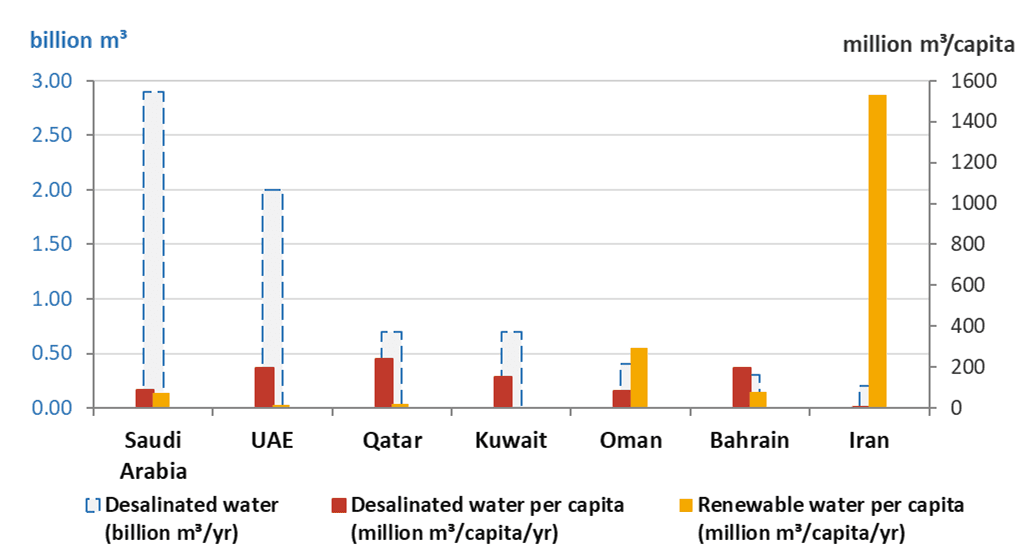
By contrast, Iran relies less on desalination. Its operational desalination capacity is an estimated 1 million m³ daily, just 4 percent of GCC capacity. In 2023, Iranian state media reported the country had 95 operational desalination plants, which desalinated around 233 million m³ annually (638,000 m³ daily). Based on the author’s calculations, Iran’s renewable water in 2022 was 1,531m3 per capita—32 times the GCC median.
According to 2022 data, more than 90 percent of Iran’s desalination plants are located in the drought-ridden southern provinces of Bushehr, Hormozgan, Khuzestan, and Sistan-Baluchistan, where a total of some 12 million people live and renewable water resources are especially scarce. Desalination plants in Iran’s south are mostly small or medium-sized, although several larger projects transfer water from the Gulf to provinces further inland. The Hope Transfer Line desalination pipelines notably serve cities including Isfahan, Kerman, Khorasan Razavi, South Khorasan, and Yazd, collectively home to some 18 million people and numerous industries. Thus, Iran’s Gulf coast desalination plants and pipelines provide water to a total of some 30 million people—a third of the Islamic Republic’s population.
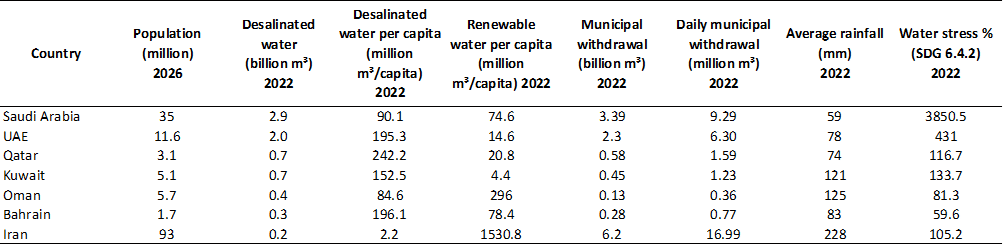
The following graph and table compare key water indicators across GCC states and Iran in 2022, the latest year with reliable comparative data for all indicators. Per capita values are calculated using 2022 totals and population figures.
Figure 2: Desalinated water and renewable water in Gulf states (2022)
Source: Author’s calculations, using data from GCC-STAT Water Bulletin (2022) and FAO-AQUASTAT country fact sheets (2022).
Table 1: Comparative assessments of water availability in Gulf states (2022)
Source: Author’s calculations and data from GCC-STAT Water Bulletin (2022), FAO-AQUASTAT country fact sheets (2022), and Worldometer population data (2026).
Vulnerabilities
Not only is the Iran war already harming water supply and desalination processes in the Gulf, but disruptions to desalination plants there also have the potential to cause a humanitarian crisis that could deprive as many as 73 million people of access to water. Desalination plants themselves are most vulnerable to direct attacks but are also subject to disruption by strikes on adjacent power stations, by contaminated intake, and by cyberattacks.
The 1990-1991 Gulf War—when invading Iraqi forces set fire to Kuwaiti oil wells, hit desalination facilities, and deliberately released oil into the Gulf—offers a cautionary lesson. The oil introduced into seawaters carcinogens (such as benzene) that desalination could not remove, forcing many Kuwaiti plants to cease operations. Kuwait’s groundwater and aquifers were contaminated, leaving the country almost entirely without fresh water, reliant on emergency tanker deliveries, and forced to ration household supply to a few days a week. Full recovery took years. The oil released by Iraq also contaminated waters along the Saudi coastline, forcing temporary shutdowns of key desalination plants. Both Kuwait’s and Saudi Arabia’s agricultural sectors were harmed by water and air pollution, and the Gulf suffered the largest marine environmental pollution incident at the time.
Even if not directly attacked, desalination plants can be disrupted. Military strikes on energy and port infrastructure as well as on oil tankers can contaminate fresh water and shallow seawater in the Gulf. Fuel discharges and pollutants can clog the water intake of desalination plants, affecting pipes and filtration membranes in the short and long terms. Oil-spill contamination would immediately cut desalinated water to millions.
Disruptions to desalination plants could deprive as many as 73 million people of access to water.
GCC states, especially those with desalination plants concentrated on the Gulf coast, are acutely vulnerable if those plants are shut down, leaving some cities without water within days. As official sources rarely report up-to-date figures on water reserves, we can estimate the approximate number of days reserves would last by comparing reported storage capacity against consumption. Assuming that storage is filled to maximum capacity, these reserve estimates can be compared against desalinated water consumption and municipal water withdrawal levels shown in the table above, used as proxies for current levels. In emergencies, however, water consumption would decline significantly, enabling those water reserves to cover longer periods.
Bahrain’s government reports having reserves for four days of water if desalination plants are shut down. Qatar’s officially reported water reserves (2,417 million gallons) might cover 7-10 days of municipal water needs only. However, in March 2026 official sources stated that Qatar’s water reserves would cover four months of consumption. Kuwait’s reported reserves are much higher (4,186 million gallons in 2024). If available, this level might be sufficient to cover 10-15 days of desalination consumption and municipal withdrawal at current levels. The UAE’s vulnerability is its high water consumption (520 liters per capita daily), with limited reserves in some emirates. The UAE has reportedly secured strategic water storage aligned with its 2036 Water Security Strategy, under which reserves would cover two days at current consumption levels, 16 days in emergencies with reduced consumption, or 45 days in extreme emergencies with severely rationed consumption. The author’s estimates relying on reported storage capacity are broadly consistent with a two-day duration at current consumption levels. Dubai’s official reported capacity (822 million gallons) would cover its municipal water needs for only a couple of days, while Abu Dhabi’s reported strategic water reserves (26 million m3), if distributed nationwide, would cover only four days of the whole country’s current water consumption and municipal withdrawals.
Saudi Arabia’s strategic capacity (22 million m3), if full, can cover five to six days of current water consumption in the affected provinces (328-330 liters per capita daily), while Riyadh’s dams, if full and usable, can theoretically cover more than double that period. Large facilities on the Red Sea have capacity to desalinate more water, and could support an influx of population from the east if use is rationed (even if supplemented by renewable water). Oman consumes significantly less water than other GCC states and has buffers: access to the Sea of Oman, aquifers, and renewable water sources. If desalination plants in Iran’s southern provinces are fully disrupted, these regions would be left without water immediately, as would large parts of inland provinces that rely on water transfers. Iran’s rivers, reservoirs, and groundwaters are substantial, so could in principle replace some of the lost desalinated water in the longer term, but the country’s renewable waters are fast diminishing, at risk of contamination, and absent in the south. In the short term, tanker trucks and local reserves would provide a few days of emergency relief. Any large-scale transfer of inland renewable waters would be slow and expensive, requiring major new infrastructure.
The possible consequences include a fast-moving humanitarian emergency, public health crisis, and economic fallout. Water outages can lead to malnutrition, dehydration, sanitation systems collapse, waterborne diseases, food shortages, and loss of life especially for people in vulnerable situations—children, the elderly, pregnant women, the poor, and guest workers living in crowded conditions in GCC states. These effects have intergenerational health and economic implications. Even with emergency domestic water transfers and large-scale external emergency relief, strict water rationing would be needed. A severe shortage would necessitate population evacuations within just a few days—in larger numbers in the more populous UAE and Saudi Arabia, and possibly in southern Iran. Population displacement, including in Saudi Arabia, would put increased pressure on infrastructure, water transmission, and electricity demand in receiving regions. The water-dependent agriculture and tourism sectors could collapse, and manufacturing, petrochemicals, and energy sectors also likely would be disrupted. The financial costs of welfare support and water systems restoration would be substantial and last for years.
Water Infrastructure Must Be a Red Line
All parties in the current war—Iran, Israel, and the United States—should exercise restraint and respect international law. Article 52 of Additional Protocol I to the 1977 Geneva Convention states that “civilian objects” such as infrastructure shall not be the target of attack or reprisal. Article 7 of the Rome Statute of the International Criminal Court affirms that “intentional infliction of conditions of life inter alia the deprivation of access to food and medicine” to bring about a population’s “destruction” is a crime against humanity. More than 100 US-based legal experts recently warned that such attacks violate international humanitarian law. As an essential part of water infrastructure, desalination plants are not legitimate military targets.
As an essential part of water infrastructure, desalination plants are not legitimate military targets.
Iran’s leaders and the GCC leaders undoubtedly are aware of the mutually assured destruction that can be unleashed by targeted attacks that intentionally disrupt water supply. Iran’s strikes on GCC desalination plants have so far not disrupted supply or operations. Yet, despite the current US-Iran ceasefire, President Trump has warned that if talks with Iran fail, Washington could unleash new attacks on Iran—which could be envisioned as attacks on water systems in light of Trump’s threats to destroy desalination plants and to cause Iran’s “civilization [to] die.” For its part, Israel is unlikely to deter Trump, and, given its record of using water as a weapon of war in Gaza, may attack Iranian desalination plants. A new round of US-Israel escalation could trigger an even harsher Iranian response, potentially damaging GCC desalination plants and causing GCC states themselves to respond. In this scenario, humanitarian crises would soon engulf the region.
Although international law and humanitarian concerns may be unlikely to deter the United States or Israel from escalation, strategic interests should. Devastating effects in the GCC—including population evacuations, public health and food security crises, economic contraction, and ballooning government expenditures to support population and industries—would strain alliances, raise pressure on the United States to defend regional infrastructure and to provide humanitarian assistance, and encourage GCC states to look beyond Washington for security and support.
Protecting water infrastructure requires US-Iran dialogue and genuine negotiations. As the most directly affected parties, the GCC and Iran should undertake diplomatic engagements despite the mutual distrust that has developed during this war. Finally, key US actors—including experts in the research, private, and nonprofit sectors—and their international partners should advocate restraint and exert pressure on the Trump administration to ensure that attacking water infrastructure is a red line.
The views expressed in this publication are the author’s own and do not necessarily reflect the position of Arab Center Washington DC, its staff, or its Board of Directors.
Featured image credit: Shao Weiwei via Shutterstock