
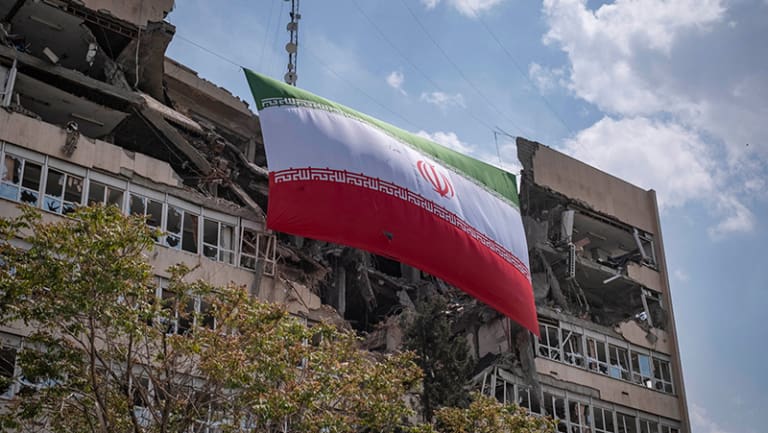
The ferocity of the US-Israeli war with Iran that began on February 28, 2026, has given way to a shaky ceasefire, desultory negotiations, and competing blockades of the Strait of Hormuz. The debate in Washington now revolves around who won and who lost, the political impact of high gas prices, the uncertain future of US relations with the Gulf states, and the implications of long-term Iranian control over passage through the Strait. Amid these critically important matters of high politics and grand strategy, it is easy to lose sight of the sheer scope and scale of the catastrophe that has been inflicted upon the people of Gaza, Iran, and Lebanon, and to a lesser extent Israel and the Gulf states. The magnitude of displacement, death, and immiseration will reverberate for years, intensified by the degradation of state capacity across the region to manage or mitigate the aftermath.
The Iranian regime has survived many weeks of targeted assassinations of much of its political and military leadership and sustained its ability to launch missiles and drones at Israel and the Gulf states. The effective closure of the Strait of Hormuz, the targeting of US military bases, and attacks on energy production facilities across the Gulf have demonstrated Iran’s ability to fight back against the onslaught, producing the kind of balance of power that might, in principle, be conducive to a negotiated outcome. But in the face of such extreme destruction, what does it mean to speak of an Iranian victory in the war, or even—as some would have it—Iran’s emergence as a fourth world power?
In the face of such extreme destruction, what does it mean to speak of an Iranian victory in the war?
If Israel and the United States have failed at their strategic objectives, however, they have done immense damage to every aspect of Iran’s military, economy, state, and society. Their ferocious bombardment has targeted Iran’s infrastructure, state institutions, and civilian population alike. Beyond the horrific death toll, the US-Israeli strikes have destroyed schools, universities, hospitals, bridges, water desalination plants, police stations, oil refineries, and more. Analysts often note Iranian society’s resilience in the face of such horrors, pointing to the long eight years of war with Iran in the 1980s or to its adaptation to ever more intense international and US sanctions over the last 20 years. But that resilience does not make the devastation any less traumatic. Countless Iranians have lost their loved ones, their homes, their schools, and their livelihoods. US and Israeli officials boast of how many bombs have been dropped and how many targets destroyed, and President Donald Trump warns of destroying “every bridge” and “every power plant” if Iran does not comply. Such rhetoric erases as inconsequential the people whose lives they are destroying along the way—or, even worse, pretends that somehow those people celebrate the devastation of their homes and welcome the bombing.
What end does this all serve, other than destruction for its own sake? Perhaps in the early days of the war, the United States and Israel believed that a massive opening salvo would bring the regime down and allow a quick victory. Today, they do not have such an excuse. Even extreme ruin is unlikely to bring Iran’s regime to its knees. Nor is the blockade of Iranian oil shipping, the latest magic bullet that the United States claims will finally bring the regime down (or, at least, to the table). Washington should have learned of the limits of economic pressure on Iran from long years of imposing sanctions and the first Trump administration’s efforts at “Maximum Pressure.” Iran’s economy, society, and state have long since adapted to these international constraints, with the misery inflicted concentrated among the poorer and more marginal sectors of the population with the Islamic Revolutionary Guard Corps and key regime supporters largely protected. Israel may not care about that, since from its perspective weakening the Iranian state and encouraging regional chaos are its own reward. But that strategic approach is profoundly short-sighted even for Israeli strategy—to say nothing of its immorality and disregard for international humanitarian law and institutions.
The destruction of state capacity and the infliction of extreme violence will not produce the kind of stable states and moderate publics that could plausibly create a robust regional order that both protects Israeli security and satisfies the core goals of the rest of the region. Israel’s 1982 invasion of Lebanon produced Hezbollah. The 2003 US-led invasion of Iraq triggered the transformation of al-Qaeda from a de-territorialized, transnational terrorist network into the even more extreme insurgency of the so-called Islamic State. Failed states and civil wars have always been the environment in which new forms of violent resistance and extremist ideologies evolve. Why would it be any different this time?
Failed states and civil wars have always been the environment in which new forms of violent resistance and extremist ideologies evolve.
This same dynamic is playing out not only in Iran, but across the region. Faced with its failure to accomplish its strategic goals through military intervention, but unable to admit defeat, the Israeli government seems to have no other ideas than to relentlessly expand its wars. Israel took advantage of the war in Iran to invade Lebanon again, striking at will across the country at a shockingly wide range of targets. It displaced more than a million Lebanese from the south and the Beirut suburbs, destroying bridges and demolishing entire villages to ensure that residents would not return. Israel’s “Black Wednesday” attacks on April 8, 2026—likely a failed attempt to scuttle the US-Iranian ceasefire agreement—targeted residential buildings in the city center with no warning and killed at least 350 people in one day, more than the 2020 Beirut Port explosion that so deeply scarred the city. Israelis speak openly of re-creating the Gaza doctrine in Lebanon, a prospect which should horrify all of humanity.
The similarities between the US-Israeli war on Iran and Israel’s war on Lebanon are striking. Israel believed that its November 2024 decapitation strike that killed Hassan Nasrallah had permanently degraded Hezbollah and left it vulnerable to a final defeat. As with Iran, it clearly miscalculated. Hezbollah has proved capable of fighting back, mounting dogged resistance to the land invasion while launching the kinds of barrages of missiles at northern Israel of which it was no longer thought to be capable. Inflicting massive suffering on large swathes of Lebanon has brought it no closer to achieving its avowed goals. Israel’s hopes that the Lebanese Armed Forces might disarm Hezbollah did not just dramatically overestimate its ability to do so, but also showed profound disregard for the risks of re-igniting civil war. As with Iran, all of this may sound like a scorecard in which Hezbollah or Israel have the upper hand. But again, the costs to ordinary Lebanese civilians are simply unbearable. Perhaps Lebanese are resilient, but they should not have to be.
The situation could get worse. Most observers fail to grasp how deeply and permanently a return to war could unravel even the basic conditions of life in the region. The targeting of desalination plants on both sides of the Gulf could lead to mass starvation as people die of thirst and agriculture fails. Toxic shrapnel, mines, white phosphorous, and cluster bombs turn the landscape into uninhabitable hellscapes. The destruction of oil and gas fields has an environmental as well as an economic impact. If the Bushehr nuclear reactor fails under repeated Israeli strikes, the radioactive fallout will respect no borders and could put life in the Arab Gulf states at extreme risk. Beyond all the talk of winners and losers, and the recalibration of the balance of power, we must not lose sight of the humanity of the victims of these wars and the long-term implications of their suffering.
The views expressed in this publication are the author’s own and do not necessarily reflect the position of Arab Center Washington DC, its staff, or its Board of Directors.
Featured image credit: MORTEZA NIKOUBAZL / NURPHOTO / NURPHOTO VIA AFPP