
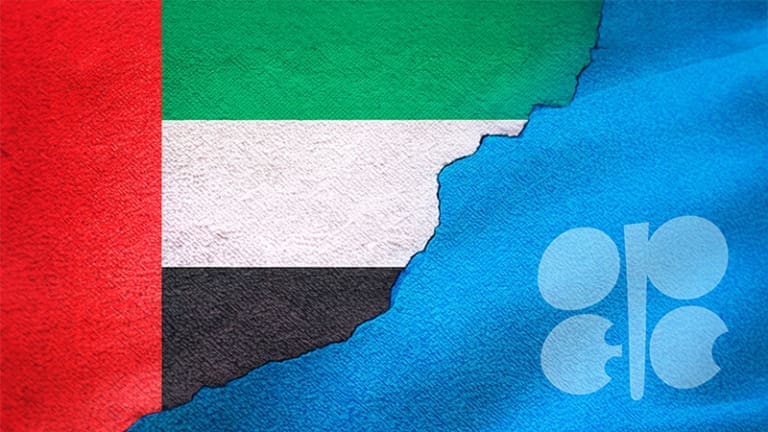
The United Arab Emirates’ (UAE) withdrawal from OPEC, which took effect on May 1, 2026, is the most significant departure yet from the organization because it marks the first time that one of the major oil producing members has decided to go its own way. While other members have withdrawn from the cartel in recent years, the impact of the UAE’s departure is on a far greater scale as it affects about 12 percent of OPEC’s total oil output. Furthermore, the departure of the UAE, as one of the few major producers holding significant spare capacity to address supply shortfalls, weakens OPEC’s ability to respond rapidly to changing market conditions.
Despite first impressions, the UAE decision is only partly about oil. The UAE—in practice, Abu Dhabi, which accounts for about 95 percent of oil reserves in the federation—is in the process of expanding its production capacity. Initial plans to raise capacity from approximately 4 million to 5 million barrels per day by 2030 were accelerated, and the UAE now expects to reach this milestone in 2027. Shorn of the constraints of output quotas in OPEC, against which the UAE had chafed, officials in Abu Dhabi will be able to raise production, should they wish, once agreement is reached to unblock the Strait of Hormuz and market conditions return to some sort of postwar normality. This may not happen straight away, and the current impasse between the United States and Iran means that the immediate market impact of the UAE withdrawal is limited. But the option to raise production is there for the future.
There is no longer utility in belonging to an organization dominated by the interests of Saudi Arabia.
The UAE decision to withdraw was more a surprise of timing than substance. Emirati and Saudi oil strategies have differed markedly in their objectives regarding optimal pricing and output levels, and officials had clashed at OPEC/OPEC+ summits in 2020 and, very visibly, in 2021. The UAE gave just three days’ notice of its departure from OPEC, whereas Qatar in December 2018 announced its plan to withdraw a month in advance. With a more diversified economy, the UAE is less reliant on high oil prices to generate revenues to fund economic and development initiatives, such as Saudi Arabia seeks to do with its ambitious Vision 2030 plan. Instead, Emirati officials seek to monetize the country’s reserves and to bring the oil to market to avoid the risk of stranded assets—oil resources and infrastructure that become unusable—if global demand falls in any future transition away from fossil fuels.
The decision underscores the determination of Abu Dhabi policymakers, once again, to move decisively to reconfigure regional dynamics and to jettison arrangements that they no longer feel serve their original purpose. In that respect, withdrawing from OPEC is similar to the UAE’s August 2020 decision that it would break with settled Arab consensus (as laid out in the Saudi-designed 2002 Arab Peace Initiative) and normalize relations with Israel through the Abraham Accords. The broader geopolitical rift between the UAE and Saudi Arabia burst into the open in December 2025 with competing visions for security and stabilization in southern Yemen. This rift is an inescapable backdrop to the Emirati conclusion that there is no longer utility in belonging to an organization—OPEC—that they feel is dominated by the interests of Saudi Arabia. To be sure, OPEC will weather the UAE withdrawal, and Saudi officials are likely to maintain an element of cohesion over members that are already producing near capacity and that benefit from controlled oil prices. But the impact of the UAE walking away is a blow to the Saudi-led regional order.
The Emirati decision counters notions that the threat posed by Iran might bring the six Gulf Cooperation Council (GCC) states closer together in the face of a shared external challenge, as has happened at various points in the past. Emirati withdrawal from OPEC was announced on the same day that senior officials gathered in Saudi Arabia for an emergency GCC summit to address the crisis of the Iran war. The UAE was represented only by its foreign minister, Sheikh Abdullah bin Zayed Al Nahyan, in contrast to attendance by the heads of state of Bahrain and Qatar and by the crown princes of Kuwait and Saudi Arabia. While the summit affirmed a “unified Gulf stance” on the war and on the right of collective self-defense, and called for intensifying joint projects to increase regional connectivity, it was the UAE’s OPEC announcement that dominated global headlines and that will have greater practical effect.
The impact of the UAE walking away is a blow to the Saudi-led regional order.
The UAE withdrawal from OPEC will play well with the Trump administration and with President Donald Trump himself, even if he has been less vocally critical of the oil cartel during his second term (so far) than he was during his first term. The White House is likely to welcome both a weakened OPEC and the prospect of lower oil prices, should the UAE be in a position to increase production. The optics of doubling down on fossil fuels may be awkward for the UAE, which hosted the COP28 climate change conference in 2023, but they are entirely in sync with US priorities in 2026. During the current Iran war, the UAE has also been more hawkish than other Gulf states in its position toward the Islamic Republic. If Abu Dhabi is signaling that it is no longer bound to an organization (OPEC) in which Iran remains a major player, after coming under such intense missile and drone attacks from a fellow member, then the White House may interpret the UAE withdrawal as endorsement from a key regional partner for its approach to Tehran.
The UAE’s withdrawal from OPEC is thus a sign that it sees the older, Saudi-dominated regional order as no longer suitable for its own rising power—and that it will not hesitate to revise longstanding arrangements to advance its own interests.
The views expressed in this publication are the author’s own and do not necessarily reflect the position of Arab Center Washington DC, its staff, or its Board of Directors.