For a president who has so often signaled his wish for a Nobel Peace Prize, Donald Trump has resorted to military force with remarkable frequency in the 15 months since he returned to the White House. US naval strikes targeting alleged drug-smuggling vessels in the Caribbean, bombing raids in Nigeria, Somalia, and Syria, the abduction of Venezuelan President Nicolás Maduro by US Special Forces, and the US-Israeli 12-Day War on Iran were all overshadowed in February 2026 by Operation Epic Fury. This new and far more extensive US-Israeli campaign against Iran, apparently aimed at degrading the Islamic Republic’s nuclear program, missile capabilities, navy, and regional network of non-state armed actors, must be viewed alongside Israel’s ongoing assaults on Gaza and Lebanon as an attempt to reshape the regional order through sheer military power.
The historical record offers little evidence for the idea that overwhelming military force translates into durable political transformation.
At first glance, the scale of destruction and the assassinations of leaders of the Islamic Republic, Hamas, and Hezbollah might suggest that this effort is succeeding. Yet the historical record offers little evidence for the idea that overwhelming military force translates into durable political transformation. For all the death and destruction caused, the US military campaigns in the Middle East remain of questionable value. Across the region—from Gaza and Iran to Lebanon and Yemen—regimes and non-state groups have been degraded but not defeated by violence; their ability to resist continues. Rather than the Middle East taking the shape desired by the Trump administration and its allies, the more plausible outcome is protracted instability and chaos.
The Abraham Accords in Action
The 2020 Abraham Accords were signed near the end of Trump’s first presidential term by Israel and the United Arab Emirates (UAE) and subsequently by Israel and Bahrain and Morocco. The Accords, the Trump administration believed, promised to provide the foundation of a new and more peaceful Middle East grounded in investment, trade, and normalization between Israel and Arab states. Promoted as the vision of Trump’s son-in-law Jared Kushner, the Accords were expected to expand across the region, displacing conflict with economic integration.
From the outset, the approach rested on the premise that trade and investment could substitute for unresolved political conflicts, particularly the struggle to end the occupation and to achieve Palestinian statehood. The Accords effectively sidelined the Palestinian issue. Proposals for Gaza’s future—many of which involved rebuilding the Strip with Arab and Western investments to create a hub for tourism, industry, and trade (“the Riviera of the Middle East”)—considered the fate of the Palestinians of Gaza almost as an afterthought, assigning them to temporary relocation or to permanent exile.
Events since October 7, 2023, have exposed the limits of this vision. The Israeli onslaught has devastated Gaza, killed at least 70,000 people, and injured at least double that number. The surviving Palestinians are trapped in increasingly limited areas with nowhere to escape. Hamas, although greatly weakened, still stands as the only organization with which Israel could negotiate an end to the conflict. Israeli proposals for large-scale population transfer have stalled, not least because no country is willing to absorb such numbers, especially when it would implicate the host in ending the chances for a viable Palestinian state once and for all.
It is hard to imagine how Gaza could be promoted as a hot real estate deal when it lies in
ruins.
Other initiatives associated with Trump further underscore the gap between grand economic vision and harsh political reality. The so-called Board of Peace, initially conceived as a reconstruction body for Gaza, has expanded into an international conflict resolution mechanism with representatives of 28 countries so far. In his speech at the January 2026 World Economic Forum in Davos, Switzerland, Trump referred to Gaza as prime real estate. “This is a great location,” he exclaimed, adding, “I’m a real estate person at heart and it’s all about location.” It is hard to imagine how Gaza could be promoted as a hot real estate deal when it lies in ruins, its people huddled for cover under tents and open skies. It is harder still to imagine a political future for the Palestinians when West Bank towns and villages are subjected to daily attacks, dispossession, and apartheid barriers that isolate them from one another and from the rest of the region.
Instability Across the Region
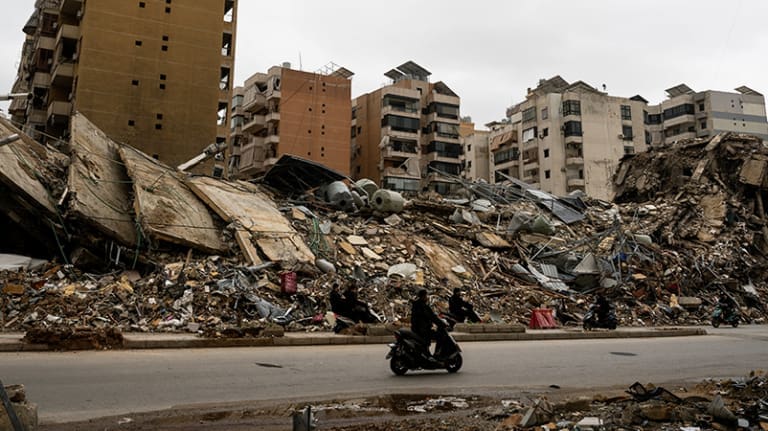
In Lebanon, the regional spillover has taken a different but equally unstable form. Lebanon suffered during 14 months of war between Israel and Hezbollah in 2023-24, followed by a ceasefire during which Israeli “fire” never “ceased.” In March 2026, a new war broke out, again followed by another “ceasefire” in which attacks continue. Lebanon now risks a domestic conflict that could mirror the 1975-1990 civil war that devastated the country. The Trump administration and Israel tout a more pliant Lebanese government that has declared Hezbollah’s military wing illegal and that has agreed to engage in direct talks with Israel, all while the latter continues to occupy a large chunk of territory in South Lebanon and has displaced a fifth of the country’s population. A victory for the Lebanese state in a violent confrontation with Hezbollah is not at all guaranteed, while reconciliation between Hezbollah’s supporters and critics seems equally unlikely. Mounting pressure from outside, coupled with internal fissures, raises the specter of chaos and state collapse.
In Yemen, the Houthis (also known as Ansar Allah)—the third leg of a triad of pro-Iran forces in the region (after Hezbollah and Hamas)—are still standing after repeated strikes by the Biden administration in 2024 and extensive strikes by the Trump administration and Israel in 2025, with the latter threatening to do to the Houthis what it did to Hamas and Hezbollah. Perhaps the only achievement of the intense and intelligence-informed US strikes was to convince the Houthis to hold off from threatening shipping in the Red Sea in return for the United States’ agreeing to look the other way when the group fired missiles into Israel. A US-Houthi truce reached in May 2025 may have allowed the Houthis to regroup and to rebuild weapon caches in preparation for reopening the front to support Iran in its desperation. The Houthis’ rearmament may have reached pre-strike levels and their armed forces may have risen in numbers and readiness. Nor has their control of northern Yemen been affected, especially following events in late 2025 and early 2026 that led to the weakening of anti-Houthi forces in the south.
For Iran, the human, economic, and infrastructure costs of just the current war are staggering, with an estimated 3,300 dead, 24,800 injured and 3.2 million displaced. Homes, health facilities, and schools are among the more than 70,000 homes and other buildings destroyed. It is difficult to estimate the impact of the loss of Iran’s civilian and military leaders so far, especially the February 28, 2026, targeted killing of its Supreme Leader, Ayatollah Ali Khamenei. Nevertheless, the clerical regime has not fallen and by all accounts continues to function and to fight back.
During the 12-Day War and Operation Epic Fury, Iran’s nuclear facilities took direct hits from Israel and the United States. Iran’s nuclear program certainly has been degraded, although most analysts consider Trump’s claim that it was “obliterated” to be exaggerated. The head of the International Atomic Energy Agency (IAEA) and other experts have concluded that enough nuclear material and facilities have survived to make the program viable if no further damage is done by new strikes or by the deployment of US and Israeli special forces to finish the job. The estimated 440 kg (970 pounds) stockpile of highly enriched uranium and facilities buried deep underground in mountainous areas, not to mention Iran’s technical know-how and expertise, are all very hard to extract and to destroy.
The Gulf Cooperation Council (GCC) countries are uniquely vulnerable in this latest wave of conflict. At the receiving end of Iranian missile and drone attacks, Gulf countries’ air defenses were able to intercept the majority of Iranian projectiles, but damage occurred nevertheless, hurting oil and gas production, and raising fears that more direct hits could result in long-term losses in their energy sectors as a whole, compounding the energy export crisis caused by Iran’s closure of the Strait of Hormuz. Countries like Qatar and Oman are in a difficult spot, having mediated with Iran and yet not having been spared from Iran’s missile strikes. GCC states found their superpower ally the United States too engaged in defending its own troops and the state of Israel to protect them. When the guns fall silent, GCC countries will no doubt review their defense strategies, perhaps to include both a more varied weapon procurement system and a broader range of strategic partners in the future.
Balance of Power
The dictum of Stephen Miller, Trump’s deputy chief of staff, that “naked force has resolved more issues throughout history than any other factor” typifies the arrogance of the Trump administration’s approach. The United States has invested considerable treasure and effort to root out adversaries and to pave the way for a new Pax Americana. There is little doubt of the overall superiority of the combined forces of Israel and the United States compared with Iran and any other forces that might be deployed against them in the ongoing war. But the war reveals the limits of sheer firepower, which cannot subdue a stubborn enemy bolstered by ideological conviction and by the sense that they are fighting for existential survival against a great power fighting a war of choice.
Asymmetrical warfare, in contrast, favors small powers and non-state actors that use cheap, easy-to-replace weaponry against larger, richer nations with sophisticated and expensive weapons. New emerging technologies might tilt the odds even further in favor of the underdogs. Hezbollah’s new fiber optic cable-guided drones that are resistant to electronic jamming, for example, are the latest entry into the conflict in South Lebanon, and by Israel’s own admission are causing a rising toll of casualties. Meanwhile, other forms of asymmetrical warfare weapons, including “intelligence-age tools,” are being developed. These developments could make the larger and more powerful protagonists more vulnerable to attack and specifically to disruption by sophisticated weaponry, the depletion of which may factor heavily in discouraging the United States from continuing its war against Iran indefinitely.
The US-Iran conflict seems to have devolved into a war of attrition, with each side hoping the other will retreat and accept defeat first.
For the time being, the US-Iran conflict seems to have devolved into a war of attrition, with each side hoping the other will retreat and accept defeat first. On the one hand, Iran has suffered significant damage and could suffer significantly more should the war resume in full force. Iran’s allies, particularly in Lebanon and Gaza, have received heavy blows. On the other hand, the financial and political costs of this war for the Trump administration have mounted rapidly, precipitating a backlash which could cause long-term damage to the US economy and significant losses for the administration in the November 2026 congressional elections.
The Rational Path Not Taken
A more peaceful Middle East is contingent upon Washington realizing the limits of force and acknowledging the enduring capacity of regional actors to resist even in the face of superior firepower. This resilience may signal that a more multipolar world is emerging. If so, it will hamper the ability of the United States to impose its will around the world. Wiser leadership may yet emerge in Washington that is more cognizant of the limits of power and of the need to recognize the right to resist occupation. In a complex part of the world such as the Middle East, people must choose their own political vision rather than submit to external plans to remake the region and impose a destiny upon them.
The views expressed in this publication are the author’s own and do not necessarily reflect the position of Arab Center Washington DC, its staff, or its Board of Directors.
Featured image credit: Photo by ALFONS CABRERA / NURPHOTO / NURPHOTO VIA AFP