
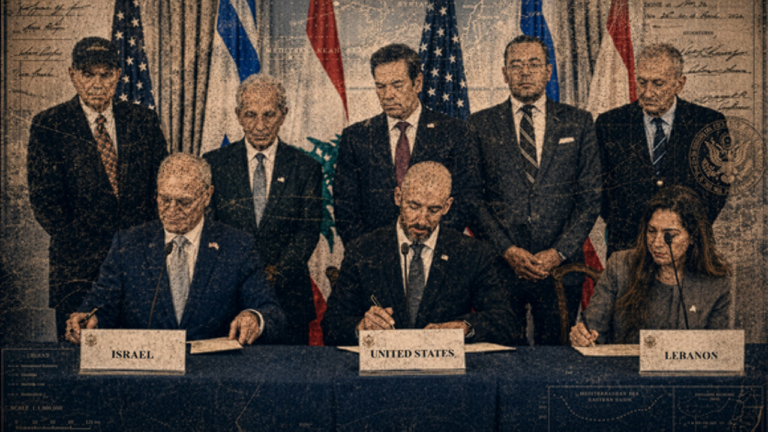
On 26 June, the United States announced that a “trilateral framework” had been agreed between Lebanon and Israel – with US support, redefining the nature of the conflict between them.1 This followed five rounds of US-sponsored direct negotiations since 14 April. The text of the agreement, announced by the US State Department and signed by the Lebanese side, stipulates that an end to the war and an Israeli withdrawal from occupied Lebanese territory will come as a result of security arrangements based on the disarmament of Hezbollah – not only in the South, but across the whole of Lebanon’s territory. These arrangements are to be implemented by the Lebanese government, overseen by the US, and verified by Israel.
In its substance, language, and tone, the agreement goes beyond all previous accords Lebanon has signed with Israel – including the 1949 Armistice Agreement, the “May 17 Agreement” of 1983, United Nations Security Council Resolution 1701 (which ended the July 2006 war), and even the November 2024 agreement that concluded a 66-day war between Hezbollah and Israel. Through the latest accord, the Lebanese state has effectively acquiesced to the Israeli occupation, pending the complete disarmament of Hezbollah. The framework replaces the official Lebanese demand for an Israeli withdrawal with an obligation on the Lebanese state itself: that it disarm Hezbollah first, as a condition for Israel’s withdrawal. This is a task it is incapable of executing.
The Agreement’s Key Clauses
The 14-clause agreement is built on a fundamental premise: that any Israeli withdrawal or redeployment from southern Lebanon is conditional on the Lebanese government disarming Hezbollah. It gives the US a central role in overseeing its implementation, and links reconstruction and economic support to the rebuilding of Lebanon’s security apparatus,2 all subject to official Lebanese consent. The details of the agreement outline the parties’ intent to end the state of war between them and transition to a process of direct negotiations, sponsored by the US, to resolve outstanding issues and achieve a lasting peace.
The accord also establishes a phased framework for the Lebanese Army to restore the state’s authority across the whole of Lebanon’s territory, through phased deployments to “pilot zones” in the south. This is to proceed in parallel with the disarmament of non-state armed groups and the dismantling of their military infrastructure, thereby enabling the gradual exit of Israeli forces from Lebanese territory. The agreement affirms the Lebanese government’s exclusive right to the use of force on its territory and authority to decide on matters of war and peace. It also establishes a military coordination mechanism, involving the US, to oversee and verify the implementation of the associated security arrangements.
Furthermore, the agreement links the fulfilment of these security obligations to the launch of a comprehensive process for Lebanon’s reconstruction and economic recovery. International support, particularly from the US, is conditional on the achievement of specific, verifiable milestones regarding the extension of state authority, the disarmament of armed groups, and preventing them accessing funding or benefitting from funds allocated for reconstruction. It stipulates the establishment of working groups to negotiate a comprehensive peace and security agreement between Lebanon and Israel, as well as the adoption of confidence-building measures (including a cessation of hostilities, cooperation over detainees, and the recovery of the remains of the deceased). All this aims at a gradual transition from ceasefire arrangements toward a stable, peaceful relationship between the two countries.
The Context of the Agreement
The agreement between Lebanon and Israel was signed against the backdrop of a war launched by the US and Israel against Iran on 28 February. Hezbollah joined that conflict of its own volition, without consulting the Lebanese public or even its own social base. That said, it had until then adhered to a ceasefire in place since 27 November 2024, a commitment Israel had failed to honour – just as it continues to violate the ceasefire in Gaza. After Hezbollah attacked Israel on 2 March, and in an effort to prevent Lebanon from being dragged into yet another war, the Lebanese government hastily convened a session chaired by President Joseph Aoun. The government issued a resolution condemning any military action launched from Lebanese territory and affirming that decisions over war and peace must rest exclusively with the state. The resolution also imposed an immediate ban on Hezbollah’s security and military activities.3 Prior to the cabinet meeting, the President had characterized Hezbollah’s actions as “irresponsible,” noting that they risked dragging Lebanon into the regional conflict – a view shared by Prime Minister Nawaf Salam, who pledged to protect the interests of the Lebanese people.4
The Lebanese government’s decision on 2 March marked the culmination of a long process of US pressure aimed at disarming Hezbollah. This had begun on 7 August 2025, when Beirut agreed to a proposal by US envoy Tom Barrack to consolidate the 2024 ceasefire between Lebanon and Israel, including by introducing a timeline for Hezbollah’s disarmament.5 However, the war on Iran introduced a new dimension to the internal Lebanese struggle over Hezbollah’s disarmament. While Iran insisted that Lebanon be included in the ceasefire agreement with the US brokered by Pakistan on 8 April 2026, particularly given that Hezbollah had entered the war in support of Iran, Israel insisted on decoupling Lebanon from the Islamabad track and retaining its own freedom of action within Lebanese territory – a stance it had maintained since the November 2024 agreement.
Prior to the announcement of the ceasefire with Iran, Israeli Prime Minister Benjamin Netanyahu had informed US President Donald Trump that Israel would abide by the truce – but publicly emphasized that it “does not include Lebanon.”6 In an effort to prevent Iran from linking the two tracks, Israel also agreed to a proposal submitted by President Aoun on 9 March – which it had previously ignored – to declare a comprehensive ceasefire, alongside with an Israeli withdrawal from occupied Lebanese territory and efforts to address the issue of weapons held beyond the control of the state, in exchange for entering into direct negotiations with Israel to end the state of war between the two countries.7
Following the shift in Israel’s stance on the Lebanese proposal, the US hosted direct bilateral negotiations in Washington between Lebanon and Israel on 14 April 2026, roughly a week after the ceasefire agreement was reached with Iran. After the first round of negotiations between Lebanese and Israeli delegations on 16 April 2026, Trump announced a 10-day truce8 in Lebanon, which took effect the following day. The ceasefire agreement thus appeared to be the outcome of those negotiations. However, the truce announced by Trump did not cover all Lebanese territory. Instead, Israel subsequently sought to link Beirut’s southern suburb and Hezbollah stronghold Dahiya to Israel’s northern urban centres, while retaining its freedom of action against Hezbollah in southern Lebanon, where the group’s attacks had been limited to targeting Israeli forces present on Lebanese soil.
Lebanese Divisions over Iran
Israel’s efforts to decouple the US negotiations with Lebanon from the Iranian track chimed with the wishes of the Lebanese government, particularly after Iran retaliated against a June 7 Israeli strike on Beirut’s southern suburbs under the pretext that two projectiles had been fired from Lebanon into northern Israel. This exchange firmly linked the trajectory of the war in Lebanon to that of Iran’s conflict with the US in the Gulf. This dynamic crystallized in the memorandum of understanding signed by Washington and Tehran in Geneva on 18 June, which stipulated a cessation of hostilities on all fronts – including Lebanon – as well as the reopening of the Strait of Hormuz and the launch of negotiations over Iran’s nuclear programme, in exchange for the lifting of the US blockade on Iranian ports and the creation of a package of economic incentives and sanctions relief.9
Lebanon’s domestic struggle over its relationship with Iran was a primary driver behind the Lebanese authorities’ decision to enter direct negotiations with Israel and accept an agreement that an Israeli withdrawal from southern Lebanon conditional on Hezbollah’s disarmament. The agreement went so far as to include a pledge by both countries to cease “all hostile or adverse actions in international political or legal fora” – a demand beyond even those included in normalization agreements. This official Lebanese insistence on decoupling the two tracks – or, as critics termed it, Beirut’s failure to capitalize on the new circumstances – accelerated the negotiation process, ultimately leading to the signing of the trilateral framework.
While the President and the Prime Minister insist on Lebanon’s sovereign right to negotiate for itself, reject any linkage between Beirut’s decision-making and the negotiations between Iran and the US, and view negotiation as the sole path to halting the war and securing an Israeli withdrawal from the South, Hezbollah insists that the pressure Iran exerted on the US by closing the Strait of Hormuz – not the government’s direct negotiations with Israel – was responsible for forcing a ceasefire in Lebanon. The movement believes that it is armed resistance and coordination with Iran that will compel Israel to withdraw from occupied Lebanese territory. Therefore, it favours an approach rooted in a regional settlement, and seeks to leverage any international or regional pressure on Israel, rather than engaging in a direct negotiation process within which Lebanon holds little leverage.10
Given this deep domestic division and the Lebanese government’s own desire to break free from Iran’s orbit, Beirut agreed to an accord linking an Israeli withdrawal from the South, reconstruction efforts, and the return of displaced persons, to Hezbollah’s agreement to disarm. In reality, however, it tied these outcomes to its own capacity – and that of its backers – to disarm the movement, while simultaneously binding itself with further constraints by accepting American dictates, exactly as presented and without discussion.
Analysing the Agreement
A careful reading of the trilateral framework reveals a US-Israeli attempt to reshape the security and political landscape that had emerged in Lebanon following the July 2006 war. Unlike previous accords, the latest agreement does not merely end the war: it redefines its root causes. For the first time in the history of Arab Israeli agreements, the text identifies the resistance, rather than the occupation, as the primary cause of the conflict between Lebanon and Israel. In doing so, it shifts the essence of the Lebanese Israeli conflict to the internal structure of the Lebanese state itself. More critically, it places the blame for the ongoing occupation on Hezbollah, framing the group’s insistence on retaining its weapons as the reason for Israel’s continued occupation of Lebanese territory. In other words, it portrays the effect as the cause. From this perspective, and unlike the 2006 and 2024 accords, the agreement aims not simply to halt military operations or establish border security arrangements. Instead, it seeks to alter the environment that Israel and the US view as the source of the conflict: the existence of a military force independent of the Lebanese state, whose continued possession of arms poses a threat to Israel.
Furthermore, the text redefines the concept of Lebanese sovereignty. In Lebanese political discourse since the 1989 Taif Agreement which ended the country’s civil war, sovereignty has been linked to ending the Israeli occupation. By contrast, the latest deal ties sovereignty to the disarmament of Hezbollah. Moreover, although the framework presents itself as reciprocal, a close reading of its terms reveals a clear imbalance between the obligations of the two signatories. Lebanon is required to disarm all armed groups on its territory, dismantle their military infrastructure, secure its borders, prevent the flow of funds to those groups, restructure its security apparatus, and establish oversight mechanisms; economic aid is contingent on the fulfilment of these obligations. Israel, on the other hand, offers no such commitment. Instead, it makes the redeployment of its forces conditional on Lebanon’s compliance with these terms. Israel’s withdrawal is thus contingent upon Lebanese implementation, rather than constituting a stand-alone legal obligation. This arrangement grants Israel the right to halt implementation of the agreement whenever it deems that Lebanon has not met its obligations, effectively legitimizing the continued occupation unless the Lebanese side meets the key condition for ending it – namely, the disarmament of Hezbollah.
The agreement also signals a marked shift in the role of Washington. The US is not merely the sponsor of the accord, but the primary authority overseeing its implementation. Washington is involved in verifying Hezbollah’s disarmament, it leads the military coordination group, supervises financial and military support mechanisms, and makes economic aid conditional upon its own assessment of the implementation process. A further key paradox lies in the fact that the agreement downplays issues that once formed the core of the Lebanese Israeli conflict, such as the Israeli occupation, borders, Israeli violations, and prisoners. Instead, it focuses on restructuring the balance of power within Lebanon.
Consequently, the deal transforms the issue of Hezbollah from a matter linked to the Arab Israeli conflict into one that concerns the construction of the Lebanese state and its capacity to maintain a monopoly on the use of force. This reflects a shift in the approach of the US, which now believes that the Lebanese Israeli conflict must first be addressed through the restructuring of the Lebanese state, rather than an end to the occupation. This premise runs counter to the reality that Hezbollah is not merely a military organization, but a political and social actor with a popular base and a network of domestic and regional alliances. All this heightens the risk that Lebanon will be pushed to the brink of civil war, by pitting Lebanese political and social forces against one another and exposing the Lebanese military establishment to grave dangers by tasking it with disarming Hezbollah before a domestic Lebanese consensus is reached – and without addressing the reasons Hezbollah cites for retaining its arms, by pushing for an Israeli withdrawal and securing the return of refugees and displaced persons to their villages.
Conclusion
The trilateral framework does not represent a step toward ending the war, the root causes of which are the ongoing occupation and Israel’s attacks against Lebanon. Instead, it is an attempt to redefine the conflict by placing the onus on Hezbollah and linking resolution to the Lebanese government’s ability to disarm the movement, regardless of whether the necessary conditions for such a move can be met. Given that the state cannot disarm Hezbollah without triggering a civil war, it has effectively trapped itself between two options: civil war, or ongoing Israeli occupation and displacement of residents of the South. Consequently, the reality on the ground remains unchanged, and the Israeli occupation persists – but now the arrangement has Lebanese consent.
For his part, Netanyahu views the agreement as a personal achievement. Should any international actor demand a withdrawal, he can now brandish an agreement bearing the signature of Lebanon’s representative. Lebanon continues to face internal divisions, particularly regarding Iran’s role in the country, Hezbollah’s rejection of the framework, and the difficulty of decoupling the Lebanese arena from the trajectory of US-Iran relations. Accordingly, the state will not be able to monopolize the use of force, assert its sovereignty and independence over its territory, or control decisions of war and peace – rights inherent to Lebanon just as they are to any other nation – unless these steps are linked to an Israeli withdrawal from occupied Lebanese territory, a domestic political settlement redefining the relationship between the state and Hezbollah, and a broader regional understanding that halts foreign interference in Lebanese affairs.
Absent such steps, the agreement risks becoming merely a new framework for crisis management, or even triggering a fresh crisis at the heart of Lebanon, rather than serving as a gateway to a sustainable resolution of the conflict. This is a possibility that the Lebanese authorities, in their eagerness to shake off “Iranian tutelage” at any cost, have clearly failed to take into account.
2 “Full Text of Lebanon-Israel Framework Agreement,” Naharnet, 27/6/2026, accessed on 29/6/2026 at: https://acr.ps/hBy1ClV
3 “Lebanon bans Hezbollah’s military activities and demands that it hand in its arms,” (in Arabic) Al Jazeera, 2/3/2026 accessed on 29/6/2026, at: https://acr.ps/1L9B9DF
4 Sohair Mahmud, “Nawaf Salam warns of ‘irresponsible adventures,'” (in Arabic) Arabian Week, n.d. accessed on 29/6/2026, at: https://acr.ps/1L9B9XM
5 “Lebanon Seeks a State Monopoly on Arms: Political and Security Implications,” Situation Assessment, ACRPS, 13/8/2025, accessed on 29/6/2026, at: https://acr.ps/hBy1CJB
6 Alexander Ward & Michael Amon, “Israel Says Cease-Fire Doesn’t Extend to Its Invasion of Lebanon,” The Wall Street Journal, 7/4/2026, accessed on 29/6/2026, at: https://acr.ps/hBxMwjl
7 “The Iran–Israel Standoff over Lebanon: A Truly United Front?” Situation Assessment, ACRPS, 11/6/2026, accessed on 29/6/2026, at: https://acr.ps/hBy1CpC
8 Barak Ravid and Dave Lawler, “Trump Announces 10-day Ceasefire between Israel and Lebanon,” Axios, 16/4/2026, accessed on 29/6/2026, at: https://acr.ps/hBxNM8b
9 “The Islamabad Memorandum: Ceasefire or Strategic Pause?” Situation Assessment, ACRPS, 22/6/2026, accessed on 29/6/2026, at: https://acr.ps/hBy1Ctj
10 “Naim Qassem: Four factors will help us overcome this phase, and surrender is not the solution,” (in Arabic) Arab 48, 4/5/2026 accessed on 29/6/2026, at: https://acr.ps/hBxNMgH