Earlier this month, Lebanon and Israel wrapped up another negotiating session in Rome—the seventh since their signing of the June 26, 2026, US-brokered Framework Agreement in Washington. The imbalance of power between the two countries is both clear and consequential: Israel is dictating how the agreement applies to its withdrawal from South Lebanon and the disarmament of Hezbollah. Bereft of the ability to resist Israel’s diktats, Lebanon can only appeal to none other than the United States, Israel’s principal ally, supporter, and facilitator, to shape how the framework agreement will be implemented.
Since the resumption of Israel’s war on Hezbollah and Lebanon in March 2026, after the Islamist militia targeted northern Israel with missiles in retaliation for the killing of Iran’s Supreme Leader Ali Khamenei, Israeli forces have attacked and occupied large areas of South Lebanon. By the end of July 2026, more than 4,300 Lebanese had been killed and more than 12,000 had been injured in Israel’s military operations, according to Lebanon’s Health Ministry. Israel has also detonated what it called Hezbollah’s tunnels and underground bunkers, including one alleged facility in the vicinity of the Crusader-era Beaufort Castle, a UNESCO-designated world heritage site.
The occupying forces have also destroyed homes and infrastructure in a six-mile-wide security zone that encompasses some 60 villages close to the Lebanese–Israeli border. They have made agricultural land unusable and burned ancient olive trees, preventing farmers and residents from returning to normal life. These acts are consistent with Israel’s post-October 2023 policy of using white phosphorus on agricultural lands in Lebanon, burning homes and fields. Even during the Rome talks that were optimistically regarded as a step forward in a peace process that would result in Israel’s withdrawal, Israeli forces were ordering residents in South Lebanon to evacuate and move north, away from the Israeli border, under the pretext of conducting military operations against Hezbollah.
Israeli officials have not been shy about refusing to withdraw from South Lebanon.
Israeli officials have not been shy about refusing to withdraw from South Lebanon. They explicitly tied the withdrawal requirement in the framework agreement to the Lebanese Army’s successful disarmament of Hezbollah. During the August 4, 2026, negotiations between Lebanese and Israeli representatives in Rome, the Israeli team refused to expand the “pilot zones” of withdrawal that had been agreed upon in the framework agreement, and instead demanded that Lebanon should first demonstrate that it had fully assumed control of the initial two zones. In July 2026, Israel’s Defense Minister Israel Katz flatly contradicted US President Donald Trump’s announcement that Israeli forces would withdraw from Lebanon. He said that his country did not “need permission to stay in Lebanon,” highlighting how Israel can willfully ignore any pressure from the United States, notwithstanding its reliance on the latter’s military, financial, and political support.
Israel’s unchecked behavior in South Lebanon reflects the same preponderance of Israeli power and influence that produced the lopsided June 26 framework agreement in the first place. Article 5 of the agreement tied Israel’s ending hostilities and withdrawal from South Lebanon to the Lebanese Army’s responsibility for and ability to disarm Hezbollah; Article 13 required Lebanon to show good faith by refraining from initiating legal action in international courts in response to Israel’s actions. In other words, the accord allows Israel the right to continue to do what it has been doing in Lebanon as long as the Lebanese Army remains incapable of disarming Hezbollah—a near-impossible task given the army’s limited capabilities and concerns that enforced disarmament could lead to domestic conflict. Article 13 also means that Israel has even less need to fear charges of war crimes, ethnic cleansing, or crimes against humanity, which might provide a modicum of accountability for its actions.
Lebanon tied its own hands by believing that a US-sponsored peace process and supervision of negotiations could end Israel’s war and secure its withdrawal. Anxious to reassert state authority over issues of war and peace and state sovereignty over its territory, Lebanese President Joseph Aoun embarked on a path of diplomacy that eventually led to the signing of the June 26 agreement. Although domestic support for the diplomatic path he chose was sizeable, it was paralleled by strong opposition from Hezbollah and its supporters. The fact that Hezbollah still possesses a military veto over any agreement with Israel—especially disarmament—is Aoun’s major stumbling block.
Lebanon tied its own hands by believing that a US-sponsored peace process could secure Israel’s withdrawal.
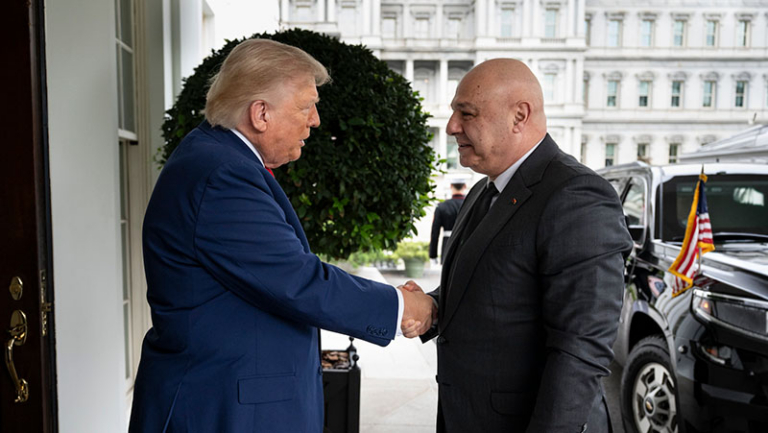
Aoun’s July 22, 2026, trip to Washington and meeting with President Trump undoubtedly made for good television coverage in Beirut, but it hardly forced Israel’s hand or produced tangible results. True to form, President Trump gave vague assurances of US support for Lebanon but was short on concrete steps regarding a complete cessation of hostilities, a timetable for withdrawal, or a safe return for hundreds of thousands of people displaced from their homes in South Lebanon. The best Trump could do was lift a decades-old ban on US airliners flying to Beirut, the implementation of which is doubtful in the short term given operational considerations.
Adding insult to injury, during his meeting with Aoun, Trump reiterated his wish that the Lebanese president should accept Syria’s intervention against Hezbollah—as if the new authorities in Damascus were ready for such an undertaking, and as if the Lebanese had forgotten the sordid history of Syria’s role in Lebanon, albeit under the former regime. Indeed, mentioning this harebrained scheme again—and in the presence of the Lebanese president, who seems genuinely to believe that Trump holds the key to ending Israel’s war—showed the utter weakness of Aoun’s position. But the suggestion should have proved to Aoun that the Trump administration has fully swallowed Israel’s reasoning about the war and the sequencing of disarming Hezbollah before either Israel’s withdrawal or the return of displaced residents to South Lebanon.
To be sure, seeking redress through Washington is the least effective strategy for Lebanon. The Lebanese government would be better advised to strengthen state institutions, especially the army, and impose the state’s writ across its territory, including on Hezbollah’s military arm. Lebanon’s government should also rally all citizens around a national agenda of political reform that addresses rampant corruption and structural decay. Only good governance can provide the two essential conditions for changing Israel’s behavior: a national consensus on a resistance strategy to protect civilians, homes, and infrastructure, and a sound diplomatic path to leverage the country’s connections with the outside world. Whatever the path, Lebanon must abandon its ill-advised and dangerous dependence on Washington as mediator with Israel.
The views expressed in this publication are the author’s own and do not necessarily reflect the position of Arab Center Washington DC, its staff, or its Board of Directors.