Since October 2023, Israel’s quest to establish itself as the preeminent power in the Middle East and to expand its territory at the expense of its neighbors has moved into overdrive. In East Jerusalem, Gaza, the West Bank, Lebanon, and Syria, Israel has implemented a bloody drive to conquer territory and ethnically cleanse indigenous inhabitants in the name of a tendentious “right to self-defense” against alleged terrorists who reject its “right to exist.” But the more the Israeli army and its supporting cast of messianic settlers push into Gaza, the West Bank, Lebanon, and Syria, illegally seizing and holding land there, the more obvious it is that Israel’s raison d’être is occupation.
Pre-2023 Territorial Expansion and Occupation
All of Israel’s wars, including the war that led to its establishment in 1948, have involved territorial expansion at the expense of Palestinian and Arab lands. Nearly all of these wars took place outside of the new country’s borders and had two interrelated purposes: occupying and holding on to territory deemed necessary for security, as defined by Israeli leaders, and realizing the dream of a Greater Israel. As the country became more secure and certain of its dominance over any individual or even unified Arab military effort against it, it became focused on holding territory beyond mere buffer zones before the first lines of defense.
In 1956, Britain, France, and Israel invaded and occupied Egypt’s Sinai Peninsula as part of a coordinated campaign to seize the Suez Canal that Egyptian leader Gamal Abdel Nasser had nationalized earlier that year. Only pressure from the Eisenhower administration succeeded in compelling Israel’s March 1957 withdrawal from Sinai and the Gaza Strip, which had been under Egypt’s control at the time. The United States was in a heated competition with the Soviet Union and had been looking for footholds in the developing world—including revolutionary Egypt, which had been seeking to develop a non-aligned foreign policy—as it sought to prevent an anti-Western backlash caused by Israel and the two European colonial powers.
A decade later, in June 1967, Israel occupied the rest of historical Palestine (East Jerusalem and the West Bank—at the time under Jordanian rule—and the Gaza Strip), the Sinai Peninsula, and the Syrian Golan Heights. Israeli settlers immediately began to build colonies in East Jerusalem, the West Bank, and the Golan Heights, and in 1970 constructed the first settlements in Gaza. In 1982, Israel withdrew from the Sinai following the signing of the 1979 Egypt-Israel peace treaty but held on to the other occupied Palestinian and Arab lands. Trading the Sinai for peace with Egypt was a strategic move that sidelined the Arab world’s most populous and militarily powerful country.
All of Israel’s wars have involved territorial expansion at the expense of Palestinian and Arab lands.
On March 14, 1978, Israel invaded Lebanon in Operation Litani and established a security belt along the border whose management it entrusted to a former Lebanese Army officer. It expanded that zone in its broader 1982 invasion, Operation Peace for Galilee, which reached Beirut and resulted in the expulsion of the Palestine Liberation Organization from the Lebanese capital. Israel gradually withdrew from Lebanon by May 2000, following years of resistance from both leftist militias and Hezbollah, the Islamist resistance that had been established in response to the occupation in the early 1980s. Between July and August 2006, Israel and Hezbollah fought inconclusively for over a month, before accepting United Nations Security Council Resolution 1701 that called for Israel’s withdrawal from occupied South Lebanon and the withdrawal of Hezbollah fighters from south of the Litani River, some 30 kilometers from the border.
Since disengaging militarily from the Gaza Strip in 2005 and imposing a total siege on the enclave in 2007 after Palestinian Hamas took over the Strip’s governance, Israel has executed numerous military campaigns that have demonstrated its brutally aggressive, indeed genocidal, tendencies toward Palestinians. Its siege turned Gaza into an open-air prison of some two million inhabitants whose movements were proscribed and who could rely only on sporadic deliveries of everyday necessities such as food, medicine, and building materials. While no Israeli troops maintained direct daily security on the streets of the Strip at the time—except, of course, when they conducted sporadic incursions—the siege was another form of the same occupation to which East Jerusalem and the West Bank had also been subjected.
Indeed, the occupation of the Gaza Strip today and the continuing occupation and settlement of the West Bank aptly convey Israel’s policy toward the Palestinians. Settler-colonialism and messianic ideology have underpinned this policy: the number of Jewish settlements has rapidly increased over the last few years in a fashion that prevents the contiguity needed for any future Palestinian state in the West Bank. An estimated 750,000 settlers live in hundreds of settlements in East Jerusalem and the West Bank—all illegal according to international law—and more settlements are approved by Israel’s government every year. Settler violence has also become a pattern for dispossessing Palestinians of their homes and lands.
No More Withdrawal After 2023
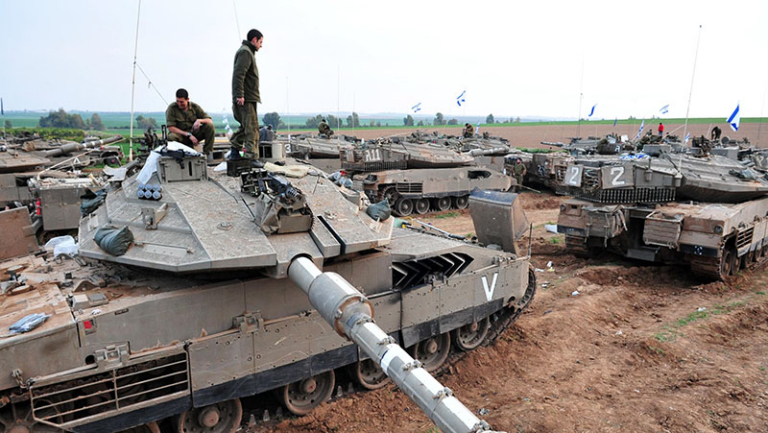
In January 2025, after conducting a series of large-scale operations in the West Bank following the October 2023 Hamas attack across its border, Israel launched Operation Iron Wall against the Gaza Strip that—despite several ceasefires and truces since—continues today and has resulted in the near-total destruction of the Strip and the displacement of its inhabitants. In May 2026, Prime Minister Benjamin Netanyahu declared that he had ordered the Israeli army to seize 70 percent of the Strip to further pressure Hamas, and today, the Israeli government is in total military control of the enclave. Before his announcement, Israel had already established what it called a buffer zone inside the Gaza Strip that covered almost 60 percent of the territory. No consideration was given as to where Gaza’s population of two million might live.
Israel’s rightwing politicians and religious nationalists have clearly declared their intention to re-establish settlements in the Strip. Indeed, Netanyahu’s hold on the prime minister’s office remains tied to the support of ultranationalists such as Minister of Finance Bezalel Smotrich and Minister of National Security Itamar Ben-Gvir, both proponents of settlements, which helps to explain his permissive attitude toward resettling Gaza. Needless to say, in an election year in which the governing coalition is battling a strong challenge from anti-Netanyahu politicians, it is logical for the premier to be accommodating. At any rate, Israel is not far from the point of controlling such a large proportion of the Strip that a sizeable settlement enterprise is thought to be needed to secure the territory there.
In the occupied West Bank, a clear policy of ethnic cleansing of Palestinians is underway. Messianic and ultranationalist settlers, aided by the Israeli Army, have been on a rampage for years in the territory, burning homes and crops, ethnically cleansing villages, destroying infrastructure and buildings, committing acts of sexual violence, and killing civilians. While the Israeli government has not officially and publicly annexed the West Bank, its policies and practices point to a de facto annexation of at least Area C, which constitutes some 60 percent of the territory. The rest of the West Bank is sure to follow as Tel Aviv rejects the idea of a neighboring Palestinian state with recognized sovereignty.
Israel’s rightwing politicians and religious nationalists have clearly declared their intention to re-establish settlements in the Strip.
In Syria, following the December 2024 collapse of the Assad regime in Damascus, Netanyahu effectively abrogated the 1974 Disengagement Agreement on the Golan Heights that created a buffer zone between the two countries and kept the peace there for more than 50 years. The Israeli army has occupied the buffer zone and has conducted military operations in Syrian sovereign territory beyond the zone, in addition to its ongoing occupation of the Golan, which it illegally annexed in December 1981.
In Lebanon, since October 2023 when Hezbollah declared a war of support for Hamas following the start of the Israeli war on Gaza, Israel has conducted a war of expulsion, destruction, and occupation deep into Lebanese territory. Israel has militarily occupied some 2,000 square kilometers (about 20 percent of Lebanon’s total area) and has crossed the Litani River, which had for decades been an informal border for Israel’s maximalist security concerns. Israeli forces are now venturing beyond the Zahrani River, 10 kilometers north of the Litani. While recently visiting occupied South Lebanon, Prime Minister Netanyahu ominously conditioned any withdrawal on the Lebanese Army’s ability to disarm Hezbollah, a seemingly impossible feat given the imbalance of power between the army and the militia, as well as the political risk of revived civil strife in Lebanon.
In June 2026, Lebanon and Israel signed a framework agreement that stipulates an Israeli withdrawal from Lebanese territory that is conditional on the Lebanese Armed Forces’ disarmament of Hezbollah. This unlikely condition cements an old policy of holding on to land that Israel deems essential for its security. While the agreement provides for Israeli withdrawal from “pilot zones”—which Lebanese critics dismiss as a mere redeployment—no deadline for that phased withdrawal has yet been announced. The Lebanese government hopes that the United States, which sponsors the agreement, will be able to hold Israel to that promise.
Factors Facilitating Continued Occupation
The post-2023 Israeli assertions that it will hold Lebanese, Palestinian, and Syrian territory without regard to international law or the prospect of building peaceful relations with neighbors are a product of several factors. First is the natural development of the Zionist project of building an exclusive Jewish home in the so-called Land of Israel and its environs, which indirectly benefits from the lack of an Arab strategic vision dedicated to the protection of Arab lands.
Second are the political fervor and expediency necessary for electoral politics as Israel moves to an October 2026 poll that will determine control of the Knesset and the country’s domestic and foreign policies for years to come. But given that Israel’s opposition is disinclined to offer a different program on the occupation from the governing coalition of Benjamin Netanyahu, the elections are unlikely to deliver any fundamental change.
Third is the Trump administration’s near-complete acceptance of Israel’s justifications for maintaining control of Palestinian and Arab territory: namely, the putative need to preserve Israel’s security, even as the country has proved time and again that it is more secure, powerful, and dominant than all its neighbors combined.
The final factor contributing to the occupation is Israeli public opinion, which has become decidedly more rightwing and nationalist, especially among the youth. A February 2026 poll found that 75 percent of new voters aged 18 to 21 identified themselves as rightwing; these are the voters upon whom such ultranationalist politicians as Smotrich and Ben-Gvir depend. Indeed, if the ultranationalists continue to be kingmakers—as they currently are in Netanyahu’s cabinet—it is hard to see how Israel can turn away from illegal occupations and the ethnic cleansing of Lebanese, Palestinians, and Syrians.
The views expressed in this publication are the author’s own and do not necessarily reflect the position of Arab Center Washington DC, its staff, or its Board of Directors.
Featured image credit: ChameleonsEye via Shutterstock