
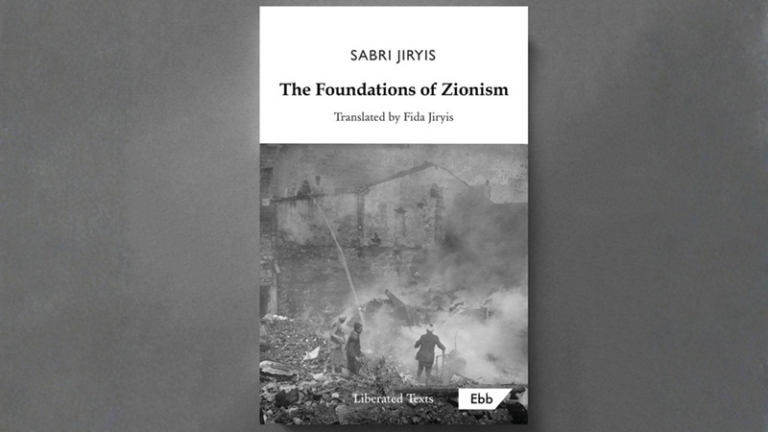
This book is essential reading for anyone seeking to understand the complete story of Zionism. It offers an account of its oldest, most critical elements, from the birth of Zionist ideas to the creation of Israel, the theft of Palestinian lands, and the expulsion of half the indigenous Arabs—not to mention the role that colonial powers and international actors played in enabling Israel’s emergence. Today, this history is more critical than ever before, given Israel’s genocide in Gaza and Zionism’s ongoing legacies of destruction across and beyond Palestine.
His book offers a powerful account of how international actors helped Palestinian erasure to become a historical possibility a hundred years ago
Originally published in two volumes in Arabic in 1977 and 1986, and never before translated into English, Sabri Jiryis’s book focuses on the foundations of the Zionist movement that ultimately created Israel and dismantled much of the indigenous Palestinian society that had flourished there for centuries. It covers developments from the 1830s to the mid-1920s, culminating in Britain’s 1917 Balfour Declaration, which promised the Jews a national home in Palestine, and the 1922 League of Nations Mandate, which gave Britain administrative authority in Palestine. It was in this period that the structural political foundations were laid that allowed Zionism to flourish at the expense of indigenous Palestinians. By focusing on the first century of Zionist thought and action, The Foundations of Zionism does much to clarify subsequent Israeli and Western imperial aggressions, crimes, and cruelties—including Israel’s current genocide in Gaza and scorched-earth assaults in Lebanon. These later policies were not aberrations of a particular moment or a new leadership, Jiryis helps us understand, but were hard-wired into Zionism from its birth.
As Jiryis notes, “This book is essentially the inner story of Zionism, starting from the reasons for its emergence and spread; through its proponents and ideology in its various stages; its organizations, parties and institutions; and ending with its efforts to control Palestine and the region, which culminated, in their first and primary phase, in the establishment of Israel” (preface, p. iii).
Zionism needed European imperial and colonial power to create a Jewish state in Palestine.
Jiryis does much to clarify the European provenance of Zionist ideology. Early Zionists were influenced by two quintessentially European ideas of the nineteenth century: the creation of new states based on the principles of nationalism, and the domination of foreign lands through imperialism and settler colonialism. European pursuit of overseas domination often included the displacement, destruction, and slaughter of indigenous populations across Africa, Asia, and the Americas. From its inception, Zionism needed European imperial and colonial power to create a Jewish state in Palestine; to kill, expel, or subjugate Palestinian Arabs; and—eventually—to forever assert Jewish supremacy in Palestine and Zionism’s dominance in the adjacent lands.
Jiryis usefully explores the international conditions that enabled Zionism to succeed. He starts with the expulsion of Jews from Spain in 1492, a few of whom settled in Palestine in small urban areas as a religious minority that lived in peace. After reviewing the development of various Jewish theological traditions and cultural identities over the next three centuries (including Ashkenazi and Sephardic Judaism, but also Hasidism, Messianism, the Haskalah movement, and Reform Judaism), Jiryis notes that “three main currents—the Rabbinate, Hasidism, and Haskalah—were in conflict within Judaism during the second half of the 18th century, dominating Jewish lives on the threshold of historical developments in Europe” (p. 14).
Revolutions and other seismic historical developments during these years had produced very different situations for Jews in Europe and Russia. Some Jews lived decent lives with basic rights, which prompted them to integrate into their societies, sometimes becoming powerful and influential bankers and industrialists. Elsewhere, especially in Poland, Romania, and Russia, Jews faced antisemitic violence, including pogroms, and severe economic and cultural restrictions: where they could live and work was often restricted, to the point of being forced into ghettos. The 1795–1917 Jewish Pale of Settlement in Poland and Russia “gave Zionism, upon its inception, fertile ground in this region,” Jiryis observes (p. 21).
He devotes the bulk of the book to chronicling a remarkable spectrum of Jewish thinkers and activists who sought a way out of this chronic maltreatment and dehumanization. The earliest public call for a Jewish state in Palestine was an 1839 book by Rabbi Judah al-Kalai, who lived near Belgrade and tried but failed to establish settlements in Palestine. Subsequent writers took up similar arguments, including al-Kalai’s compatriot, Zvi Hirsch Kalischer, who wrote a book titled Seeking Zion in 1862, as well as the better-known Theodor Herzl. Jiryis considers these writings to be “the basic literature of Zionism” (p. 69).
Nevertheless, Jiryis’s account of their meetings, conventions, conferences, articles, books, lectures, and lobbying efforts throughout the late 19th century reveals that these early Zionist intellectuals were a small minority among Western Jews, most of whom sought a better life in the Americas or within Europe rather than emigrate to Palestine. In the late 19th century, for example, British and French Jewish organizations tried to facilitate the emigration of suffering Russian Jews to Argentina (pp. 18–19). But accelerating antisemitic threats such as the 1891 pogroms against Russian Jews (p. 30) or the 1894 Dreyfus case in France (p. 40) helped turn these early musings about Zionism into the beginning of an organized movement for a homeland and a state where Jews could live in safety.
It was in this political context that Herzl’s 1896 book, The Jewish State, would become so influential. But Herzl’s writings were only the tip of the iceberg: he pursued an energetic, almost frantic, quest to seek support for a Zionist state from Britain, France, Italy, the Ottoman Empire, and Russia—anyone, in fact, who could potentially help establish Jewish colonies that might form the nucleus of a Jewish homeland and, eventually, a sovereign state. Herzl was willing to consider founding that community anywhere that was practicable—in East Africa, South America, or West Asia. Only at the First Zionist Congress in 1897 did the movement decide that Palestine alone should be the site for a future Jewish state.
By 1914, only about 2 percent of Jews in Europe (some 50,000) had emigrated to live in agricultural settlements in Palestine.
The political upheavals of the First World War, the Russian Revolution, and the collapse of the Ottoman Empire made the Zionists’ quest for a homeland more achievable. Yet by 1914, only about 2 percent of Jews in Europe (some 50,000) had emigrated to live in agricultural settlements in Palestine—and many of them had done so mainly to escape economic and political hardship, not primarily because of any deep commitment to the Zionist cause. Nevertheless, as Jiryis notes, “these immigrants laid the foundations of the Zionist project in Palestine” (p. 32).
These early Zionists certainly had their differences. The movement was never monolithic; it was extremely diverse and often internally contentious. In the 19th and early 20th centuries, Zionists constantly struggled—as they do today—to accommodate different Jewish understandings of the roles of religion, nationalism, and cultural identity; different preferences regarding political action and the use of violence; and different positions on capitalism, labor rights, and economic activity. These political differences reflected the very different conditions in which Jews had lived for centuries across Europe and Russia. Zionist settlers brought these legacies with them to Palestine.
Today, more than seven million Palestinian Arabs in Israel and the occupied Palestinian territories still resist Zionism’s attempts to expel them or limit their lives via apartheid-like restrictions. Jiryis’s well-evidenced and heavily footnoted account helps us appreciate that this present situation represents the culmination of two recurrent historical dynamics that run throughout his book: Zionism’s desire to exclusively dominate all of Palestine and expel or ignore the indigenous Palestinians—and Palestinian Arabs’ indomitable will to resist this devastating fate. In his conclusion, Jiryis presents a synthetic interpretation of how Zionism and European interests converged in Palestine, through what he describes as “colonial deceit” (p. 522). His book offers a powerful account of how international actors helped Palestinian erasure to become a historical possibility a hundred years ago—and implicitly reminds us of the international community’s culpability in a genocide that seeks to make that possibility a grim reality today.
The views expressed in this publication are the author’s own and do not necessarily reflect the position of Arab Center Washington DC, its staff, or its Board of Directors.