
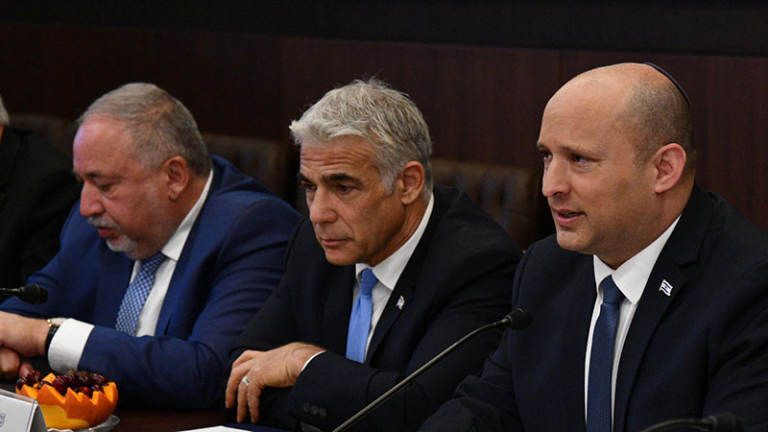
Israel is preparing for new elections, whether they take place on time at the end of October 2026 or are brought forward to an earlier date in September. In recent weeks, there has been a significant escalation in the pace of preparations by Israeli parties, especially those of the opposition, as they seek to reorganize their ranks and internal affairs.
This position paper discusses the opposition parties as they build alliances and compete for leadership, as well as their political programs, and argues that they are running in the upcoming elections on the same topics around which they have run since 2015. They focus on attacking Prime Minister Benjamin Netanyahu personally by bringing up the criminal cases filed against him, on the government’s plan to restrict the judiciary, and on the responsibility for the major failure of October 7, 2023.
The paper also posits that the opposition parties do not present any alternative political projects or visions regarding the core political issues to those proposed by the right-wing parties, especially on the issues of occupation and security, which until the 2013 elections were central to Israeli elections. On the other hand, the paper highlights that the most prominent distinction between the governing coalition and the opposition has become centered on internal issues, especially those related to the relationship between religion and the state, the status of the ultra-Orthodox parties, exempting students of religious seminaries from military service, checks and balances, and the status of the judiciary.
The contest in the upcoming elections will be between the projects of the new religious,
extreme right-wing parties and the traditional center-right opposition.
The paper argues that the opposition believes that Netanyahu can only be defeated by a candidate who comes from the right. This explains the alliance between Yair Lapid, leader of the Yesh Atid (There is a Future) Party, and Naftali Bennett, leader of the Bennett 2026 Party, the rapprochement between former chief of staff of the Israeli army Gadi Eisenkot, founder of the Yashar (Straight) Party, and former minister Avigdor Lieberman, leader of the Yisrael Beiteinu (Israel Is Our Home) Party, as well as the intensifying competition for the leadership of the opposition camp between Bennett and Eisenkot. Arguably, the contest in the upcoming elections will be between the projects of the new religious, extreme right-wing parties and the traditional center-right opposition. This shift has also affected the Democratic Party, which is putting forward a project closer to what the traditional security-hawkish Zionist left proposed in the 1970s and 1980s.
New Alliances Without Alternative Political Projects
The opposition parties are trying to organize their position as the parliamentary elections approach, including by deciding the identity of the largest party within its camp and determining its candidate for prime minister against Benjamin Netanyahu. This is because of the stalemate in the results of public opinion polls that still show generally equal standings between the governing coalition and the opposition camp.1
In this regard, in April 2026, former prime minister Naftali Bennett announced the formation of an electoral alliance named “Together” with current opposition leader, Yair Lapid of the Yesh Atid Party, in order to be the candidate for prime minister.2 On the other hand, Gadi Eisenkot is also seeking to build electoral alliances or establish cooperation with other parties, including that of Avigdor Lieberman, to strengthen his own position and increase his chances of competing for the premiership.3 As for Benny Gantz’s Blue and White-National Unity Party, it seems that it is nearing the end of its political journey as opinion polls show that it will not cross the electoral threshold to enter the Knesset.4 Finally, the Labor Party formed an alliance with the Meretz Party, called the “Democrats,” to represent the rest of the current center-left in Israeli society.5
The new alliance between Bennett and Lapid comes after the latter’s Yesh Atid—the largest party in the current Knesset, founded in 2012 against the backdrop of the socio-economic protest movement—failed to offer a real political alternative or pose a real threat to the continuation of right-wing rule and Netanyahu’s leadership.
The only time Bennett and Lapid succeeded in removing Netanyahu from the prime minister’s office came after the 2021 elections, when they formed a coalition government, the “Government of Change,” with the support of the Palestinian Arab Islamic Movement-Southern Wing, which had won four seats.6 The two agreed to a rotation arrangement according to which Bennett—at the time the head of the Yamina (New Right) Party—would serve as premier for the first two years and three months, followed by Lapid assuming leadership for the remaining two years and three months.7 Their government collapsed in 2022 following its inability to pass legislation.8
Neither Yesh Atid nor the opposition parties in general present a different political program than the Likud Party.
Neither Yesh Atid nor the opposition parties in general present a different political program than the Likud Party on core issues, particularly regarding the Palestinian question and the occupation. They all reject the establishment of a Palestinian state, oppose withdrawal from the territories occupied in 1967 or the dismantling of settlements, support keeping Jerusalem united as the capital of Israel, and reject the right of return.9 Indeed, since the Second Intifada, these positions garner support from a majority of Israeli society.
For example, the secular Yesh Atid Party has asserted since 2013 that “Israel is a democratic, Jewish state in the spirit of the visions of Israel’s prophets and has a right to be a state with a Jewish majority within secure and defensible borders.”10 The party adds that it is the duty of the State of Israel to be “the center of the Jewish people, and to take care of the affairs of every Jew who is persecuted because of their Jewishness anywhere in the world.”11 The main difference between Yesh Atid and Likud has to do with religious matters such as the former’s call for enlisting students from religious institutes in the military, its critical stance on the influence of the ultra-Orthodox parties, and its rejection of what it considers “financial blackmail” by continuing to allocate large budgets to the ultra-Orthodox community.12
Naftali Bennett first entered the Knesset in the 2013 elections, when he headed the right-wing HaBayit HaYehudi (Jewish Home) Party. Since then, he has put forward a political platform that is largely in keeping with other right-wing, religious parties. For example, the party’s platform at the time stated that the State of Israel was “the state of the Jewish people according to the divine promise” and that it was “a Jewish state with a democratic system.”13 The party also stressed that it would work to strengthen and consolidate the Jewish character of the state, and to counter any attempts to redefine it or turn it into a “state for all its citizens.”14
Bennett rejected the establishment of a Palestinian state in the West Bank as a solution to the conflict, arguing that the proposed political solutions—whether through the “two-state solution” or through the annexation of the West Bank and its inhabitants—are impractical and may pose a threat to Israel’s future.15 According to the party’s platform then, “the area between the river and the sea is home to the State of Israel only.”16 Based on this vision, in 2012 Bennett proposed what he described as a “de-escalation” plan that stipulated the annexation of Area C to Israel and granting Palestinians in densely populated areas some form of autonomy or local administration, without establishing an independent state.17 The party also attached great importance to supporting and expanding settlements throughout the so-called “Land of Israel.”18
The new “Together” alliance between Bennett and Lapid does not present an alternative political platform to that of Likud and the ruling right. But it disagrees with the ruling coalition on internal issues such as the status of the judiciary, the meaning of democracy in Israeli society, the status of the ultra-Orthodox parties and community in the political and social systems in the country, and the issues of exempting students at religious seminaries from military service and guaranteeing government budgets for ultra-Orthodox religious institutions.19 On the other hand, the alliance proposes a number of procedural and technical ideas as an electoral program. These include a pledge not to form a government with Netanyahu and Minister of National Security Itamar Ben-Gvir, leader of the Otzma Yehudit (Jewish Power) Party; the establishment of a coalition based solely on Zionist parties (so no Palestinian Arab parties); the adoption of the “seven” system in the distribution of seats so that four would be Bennett’s and three Lapid’s; and the formation of a commission of inquiry into the failure of October 7, 2023.20
Gadi Eisenkot’s Yashar Party also presents a political program that expresses the Israeli consensus and does not offer any substantive alternative to the Likud Party’s proposals. Some of the party’s stated goals include:21
- Ensuring the existence of the State of Israel as the national home of the Jewish people while maintaining its character as a Jewish and democratic state in the spirit of the Declaration of Independence;
- Strengthening national security and consolidating Israel’s position as a strong state with regional standing that seeks to conclude peace and cooperation agreements with all countries in the region based on military and economic strength;
- Consolidating and prioritizing formal education;
- Strengthening the Israeli army and ensuring that every citizen of the state perform military or national service as determined and under the frameworks established in the “Service for All” law;
- Enacting a constitution based on integrating the principles of the Declaration of Independence and the existing Basic Laws, and adding a Basic Law to legislation that regulates the system of checks and balances between governing authorities so that the Knesset is sovereign, the government is able to govern and execute its writ, and the judiciary is strong and independent; and
- Developing peripheral areas and reducing social gaps in a way that ensures equal opportunity and equal rights and duties for all Israelis.
The Bennett-Lapid alliance and Eisenkot’s program indicate an implicit acknowledgment by the opposition that the chances of competing with and defeating Benjamin Netanyahu remain limited unless a right-wing candidate is put forward.
The Bennett-Lapid alliance and Eisenkot’s program indicate an implicit acknowledgment by the opposition that the chances of competing with and defeating Benjamin Netanyahu remain limited unless a right-wing candidate is put forward, at least on the issue of the Palestinian question, the nature of the State of Israel, and economic policies. Bennett made this conviction clear in a June 1, 2026, interview with Yedioth Ahronoth and Ynet: “I will say this very clearly: the only way to victory is to form a united bloc led by someone from the right. My political positions are right-wing. The electorate has turned to the right. They will not choose someone from the left or from the left of center. They tried it with Tzipi Livni and Yitzhak Herzog and failed.”22
This conviction comes in the context of the profound transformations that Israeli society has witnessed since 2009 with the return of Benjamin Netanyahu to power, especially in the wake of the events of October 7, 2023, where the majority has tended to adopt the positions of the right and the extreme right, especially with regard to the Palestinian issue and the ongoing occupation.23
An Illusory Left
The shift in the political approach in favor of the right-wing project has also affected the parties of the so-called new Zionist left in the form of the Democrats, an alliance formed in 2024 between the Labor Party and the remnants of the Meretz (Vigor) Party, which is headed by General Yair Golan. According to the party’s initial political program published on its official website, the party defined itself as a Zionist, liberal, and democratic party, and its main principles are as follows:24
- In the field of governance and democracy: strengthening the Basic Law of Legislation, strengthening the “gatekeepers of the judicial system” (institutions and supervisory bodies), amending the Nation-State Law in line with the spirit of the Declaration of Independence, protecting the free media, and strengthening local governance.
- In the political-security sphere: overthrowing Hamas in Gaza, achieving full equality in army recruitment, strengthening alliances with moderate Palestinian Arab parties in the face of the so-called “axis of evil” (extreme right parties), and halting the annexation process.
- In the area of the relationship between religion and state: the operation of public transportation on the Sabbath in a limited form in predominantly secular towns, the promotion of civil marriage, and the recognition of Jewish conversions that are not limited to those conducted under the supervision of the official rabbinate.
- In the socio-economic field: combating the cost of living, improving social welfare services, and rehabilitating public services.
- In the field of education: making the teaching of the values of democracy mandatory, enhancing the status of teachers and educational staff, and encouraging academic education and scientific research among all segments of society.
In this early version of the Democrats’ program, there was no mention of the occupation, the settlements, and negotiations with the Palestinian Authority, nor the status and rights of Palestinian Arab citizens in Israel. In fact, the socio-economic proposition about which the Meretz Party had previously boasted was reduced to fighting the high cost of living and improving social services. Although the Democrats later updated their campaign to oppose the annexation of the West Bank and support the establishment of a demilitarized future Palestinian state, their program nevertheless largely reflects the ideas of the traditional right in the political, security, and economic aspects.
Inconclusive Public Opinion Polls
The Likud Party and the governing coalition expected that the current war on Iran and Hezbollah would lead to a favorable shift in the political and electoral positions of Israel. Instead, there was no fundamental change in the early stages of the war, which led to disillusionment, especially following the ceasefire with Iran that accompanied the resumption of fighting on the northern front with Lebanon.
On March 5, 2026, less than a week after the outbreak of the war, the Times of Israel reported that there was a significant increase in the level of support for the Likud Party, with a poll predicting that it would win 31 seats, compared to 15 for the party of Naftali Bennett, Netanyahu’s most prominent rival.25 On the other hand, the poll estimated that a Netanyahu coalition would get 53 seats, compared to 57 seats for the opposition alliance, while the Palestinian Arab parties would win 10 seats. It was thus clear that despite increased support at the beginning of the war, Likud’s fortunes did not change fundamentally compared to those of the opposition.26
On March 10, Channel 13 reported that it conducted a poll that showed Likud in first place with 25 seats and Bennett in second with 17 seats, down by 5 seats from the same poll conducted three weeks prior.27 In the poll, the Joint List (Palestinian Arab parties) came in third with 16 seats, Eisenkot’s Yashar had 13 seats, Shas had 10, Otzma Yehudit had 9, Yesh Atid and Yisrael Beiteinu had 8 each, and the Democrats and United Torah Judaism had 7 each. Gantz’s Blue and White, Religious Zionism, and the Reservists each polled under the electoral threshold. The current governing coalition received a total of 51 seats, the opposition won 53, and the Palestinian Arab parties polled at 16.
According to the results of an April 16 poll by News 12, before the ceasefire in Lebanon, the Likud Party received 25 seats. Bennett’s list dropped to 20 seats (two fewer seats than in the previous poll). But as for the camps, the governing coalition won 51 seats, compared to 69 for the opposition, including 10 for Palestinian Arab parties.28
On April 17, 2026, about a week and a half after the ceasefire with Iran, and before the announcement of a ceasefire with Lebanon, the results of an opinion poll published by the newspaper Maariv showed that the ceasefire with Iran negatively affected the status of the governing coalition, while the opposition camp continued to consolidate its position, achieving a majority of 61 seats, not counting those of the Palestinian Arab parties. The governing coalition camp has not been able to recover since the outbreak of the war, remaining at just 49 seats.29
On the other hand, a News 12 poll on April 23, 2026, showed that if the election were held then, the Zionist opposition parties, without the Palestinian Arabs, would win 60 seats, the governing coalition would take 50, and the Palestinian Arabs would win 10.30
In a News 12 poll published on May 28, 2026, Likud remained the largest party, although it continued to decline with 23 seats, while the Together list led by Naftali Bennett and Yair Lapid dropped one seat to 22. Gadi Eisenkot’s Yashar Party continued to consolidate its strength and would win 17 seats. In that poll, the governing coalition parties would get 51 seats, the opposition camp 59, and the Palestinian Arab parties would get 10.31
The wars on Iran and Hezbollah have not fundamentally changed the status of the governing coalition parties.
Overall, according to a review of all polls, the wars on Iran and Hezbollah have not fundamentally changed the status of the governing coalition parties thus far, even when Israel believed that it had achieved significant military accomplishments. However, there was a relative improvement in the share of the Likud Party, which probably came at the expense of parties within the governing camp rather than from a shift in voters’ attitudes and a defection between political camps.
Following the ceasefire in Iran and Lebanon, there was a slight decline in the share of the Likud Party, while the opposition improved its position, but this did not lead to a decisive outcome for the election. The share of the governing coalition remains in the range of 52 to 53 seats, compared to about 57 to 60 seats for the opposition, as the Palestinian Arab parties maintain representation of about 10 seats if they run in the elections on separate slates instead of a joint list. This means that the opposition in its current composition will be unable to form a coalition government on its own without either the support of at least one Palestinian Arab party or the defection of one of the partners in the current ruling coalition to the opposition after the elections.32
Conclusion
The Bennett-Lapid alliance and Eisenkot’s steps have multiple implications for the nature of the Israeli political scene. The situation within the opposition camp in particular could have serious repercussions, especially on efforts to rearrange the camp’s ranks, raise morale, try to reduce internal fragmentation, and nominate one central leading figure as a rival to Netanyahu. The internal competition between Bennett and Eisenkot continues to be of central import.
Nevertheless, the opposition’s steps do not present any substantive political alternative to the governing coalition; rather, the opposition offers political programs that are close to the traditional right-wing approach to security and foreign policies, the Palestinian cause, and the economy, in addition to differences on important domestic issues. In essence, over the last several months, there have not been serious differences between the opposition and the governing coalition. It is not clear that public opinion will give the opposition a decisive edge despite the obvious decrease in the chances of the governing coalition (which currently holds a 68-seat majority) and the decline in support for the Likud party.
This paper was first published in Arabic in June 2026 by Mada al-Carmel, the Arab Center for Applied Social Research in Haifa, Israel. It is one in a series of papers jointly published by Mada al-Carmel and Arab Center Washington DC. It was translated by Imad K. Harb, Senior Non-resident Fellow at Arab Center Washington DC.
The views expressed in this publication are the author’s own and do not necessarily reflect the position of Arab Center Washington DC, its staff, or its Board of Directors.
1 Jack Khoury, “Bennett and Lapid continue to exclude Arabs and may pay a price for it in the elections,” Haaretz, April 28, 2026, (Hebrew), https://www.haaretz.co.il/news/elections/2026-04-28/ty-article/.premium/0000019d-d297-d623-ad9f-fed7e9b30000;”First polls after the union between Bennett and Lapid: Still no majority for the opposition bloc without the Arab parties, “ Haaretz, April 27, 2026, (Hebrew), https://www.haaretz.co.il/news/elections/2026-04-27/ty-article/0000019d-cffc-d623-ad9f-ffff4b220000.
2 Shalon Yerushalmi, “The alliance of interests between Bennett and Lapid,” Zman Israel, April 27, 2026, (Hebrew), https://www.zman.co.il/682734/.
3 Yuval Karni, “Who will lead? Eisenkot and Lieberman in initial talks for unification,” Ynet Global, May 3, 2026, (Hebrew), https://www.ynet.co.il/news/article/yokra14758306.
4 “Gantz’s party is falling apart: Fourth MK abandons Blue and White,” Makor Rishon, May 5, 2026, (Hebrew), https://www.makorrishon.co.il/news/politcal/article/329810.
5 Sam Sokol, “Left-wing Democrats party ratifies merger of Labor and Meretz factions at party conference,” Times of Israel, May 31, 2026, https://www.timesofisrael.com/liveblog_entry/left-wing-democrats-party-ratifies-merger-of-labor-and-meretz-factions-at-party-conference/.
6 Ghaida Rinawie Zoabi and Avraham Spraragen, “Arab Israeli Politics and Society Ahead of the 2026 Israeli Election,” J Street, March 10, 2026, https://jstreet.org/arab-israeli-politics-and-society-ahead-of-the-2026-israeli-election/.
7 “Report: Bennett, Lapid Reach Agreement on Forming Coalition to Oust Netanyahu,” Times of Israel, May 28, 2021, https://www.timesofisrael.com/report-bennett-lapid-reach-agreement-on-forming-coalition-to-oust-netanyahu/.
8 Carrie Keller-Lynn, “Bennett Announces Coalition’s Demise, New Elections: ‘We Did Our Utmost to Continue,’“ Times of Israel, June 20, 2022, https://www.timesofisrael.com/bennett-we-made-a-tough-decision-but-it-was-the-best-for-the-country/.
9 Mtanes Shihadeh, Patterns of Voting in Israel and Shifts in the Positions of Israeli Society: The 2013 Elections as a Case Study, Transformations in the Israeli Political and Party Scene, Issue No. 5, ed. Mtanes Shihadeh and Nadim Rouhana (2015), 6, (Arabic), https://mada-research.org/storage/uploads/2014/11/metanes-3-1.pdf.
10 Shihadeh, Patterns of Voting in Israel, 6.
11 Ibid.
12 Lucy Williamson, “Crisis looms in Israel over ultra-Orthodox conscription bill,” BBC, December 3, 2025, https://www.bbc.com/news/articles/cly580gkd9ro; Netael Bandel, Shilo Freid, and Moran Azulay, “Supreme Court freezes one billion shekels for ultra-Orthodox education institutions,” YNet Global, December 31, 2025, https://www.ynetnews.com/article/rktmnj7nzx.
13 Shihadeh, Patterns of Voting in Israel, 6.
14 Ibid., 6; One notable example of the party pushing back against attempts to turn Israel into a “state for all its citizens,” was in the July 2018 passage of Israel’s “Nation-State Law.” See, Azmi Bishara, “What does the “Jewish Nation” basic law mean?” Arab Center Washington DC, July 24, 2018, https://arabcenterdc.org/resource/what-does-the-jewish-nation-basic-law-mean.
15 Shihadeh, Patterns of Voting in Israel, 7.
16 Ibid.
17 Ibid.
18 Ibid.
19 Mtanes Shihadeh, “Election Year in Israel: Portents of the Coming Political Battle,” Arab Center Washington DC, February 6, 2026, https://arabcenterdc.org/resource/election-year-in-israel-portends-of-the-coming-political-battle/.
20 Keshet Neev, “Naftali Bennett Unveils ‘Israeli Renaissance’ Plan, Says Alliance Will Replace Benjamin Netanyahu,” Jerusalem Post, April 26, 2026, https://www.jpost.com/israel-news/politics-and-diplomacy/article-894629; Zvi Zarchia, “Political explosion or technical block: What Bennett and Lapid didn’t say at the party launch “ Calcalist, April 26, 2026, (Hebrew), https://www.calcalist.co.il/local_news/article/bju5nci6we; Aaron T. Walter, What the Bennett-Lapid Merger Really Means, The Times of Israel, Apr 28, 2026, https://blogs.timesofisrael.com/what-the-bennett-lapid-merger-really-means/; “Bennett and Lapid launch unified ‘Together’ party, vow October 7 inquiry,” i24NEWS, April 26, 2026, https://www.i24news.tv/en/news/israel/politics/artc-bennett-and-lapid-announce-joint-run-vow-inquiry-into-october-7.
21 “Party Goals,” Yashar! with Eisenkot, (Hebrew), https://yasharwitheisenkot.com/topic/missions/.
22 Moran Azoulay, “Bennett: I will deprive budgets from those who do not enlist. Eisenkot? We will not win with a leftist,” Ynet, June 1, 2026, (Hebrew) https://www.ynet.co.il/news/article/rj00itc9gzx.
23 Antoine Shalhat, “The Israeli political scene in an election year ,” Arab 48, April 8, 2026, (Arabic), https://edgs.co/1v4pt.
24 The Democrats, (Hebrew). https://democrats.org.il/.
25 Yossi Tatika, “‘Harry’s Roar’ Strengthens Netanyahu – But Doesn’t Change the Blocs,” Zman Israel, March 5, 2026, (Hebrew), https://www.zman.co.il/669052/.
26 Tatika, “Harry’s Roar,” https://www.zman.co.il/669052/.
27 Lior Keenan, “First poll in the war: Who is soaring, who is crashing – and is Netanyahu getting stronger?,” Channel 13, March 10, 2026, (Hebrew), https://13tv.co.il/item/news/politics/politics/whyz3-905014972/?pid=98577.
28 Ofer Hadad, “News 12 poll Likud and Eisenkot’s Right are getting stronger, Bennett is getting weaker,” News 12, April 16, 2026, (Hebrew), https://www.mako.co.il/news-israel-elections/2026/Article-675e05b95f69d91027.htm.
29 Moshe Cohen, “Between Iran and Lebanon – the coalition is not recovering and this is good news for Bennett | Maariv Poll,” Maariv, April 17, 2026, (Hebrew), https://www.maariv.co.il/news/politics/article-1310919.
30 Amit Siegel, “News 12 poll: Bennett beats Eisenkot to lead the bloc and narrows the gap with Netanyahu ,” News 12, April 23, 2026, (Hebrew), https://www.mako.co.il/news-israel-elections/2026/Article-0a686d0cffabd91027.htm.
31 Amit Siegel, “News 12 poll: Eisenkot continues to strengthen, Likud weakens,” News 12, May 28, 2026, (Hebrew), https://www.mako.co.il/news-israel-elections/2026/Article-ea5ad1f6e4f6e91027.htm.
32 Ofer Hadad and Daphne Liel, “For the first time a tie between Likud and Eisenkot’s Right | News 12 Poll,” News 12, July 6, 2026, (Hebrew), https://www.mako.co.il/news-israel-elections/2026/Article-773dc6853083f91027.htm.