
On July 30, 2026, Nickolay Mladenov, the Board of Peace (BoP) High Representative for Gaza and the plan’s lead architect, announced a 15-point framework for a phased Gaza disarmament and Israeli withdrawal from the war-ravaged Strip. The plan, officially titled “A Roadmap for Completing the Implementation of President Trump’s Comprehensive Peace Plan in Gaza,” is a product of months of delicate negotiations involving Israel, Hamas, and other Palestinian political factions. The roadmap managed to translate two key demands from each side—Israel’s withdrawal from Gaza and Palestinian disarmament—into reciprocal, verifiable steps. Hamas accepted the plan—a significant development on its own; Palestinian Islamic Jihad, the second-largest militant group in Gaza, voiced its reservations; then, on August 5, Israel rejected the roadmap, demanding complete disarmament prior to withdrawal.
Although the 15-point plan has the potential to end the war in Gaza, the deadlock over the sequencing of disarmament and withdrawal means that its future is now uncertain. The future of the Gaza Strip, as a consequence, is equally unsure.
The Context
The 15-point roadmap is designed to implement “phase two” of the US-brokered 20-point plan, which led to a ceasefire between Israel and Hamas on October 8, 2025, and was endorsed on November 17, 2025, by United Nations (UN) Security Council Resolution 2803. The previous phase of Trump’s three-stage plan had left Israel in control of 53 percent of the Gaza Strip, dividing the besieged territory along what came to be known as a “yellow line,” cramming 2.1 million Palestinians into a vastly ruined coastal terrain in worn-out tents and overcrowded displacement centers, in increasingly squalid and inhumane conditions.
None of Israel’s obligations under phase one of the ceasefire agreement were fully met.
None of Israel’s obligations under phase one of the ceasefire agreement were fully met. These obligations included the unimpeded entry of humanitarian aid, medical supplies, shelter and housing materials; the opening of the Rafah crossing for the evacuation of terminally ill patients in need of medical treatment abroad; and, most importantly, the cessation of all Israeli military operations in the Gaza Strip.
Yet, despite the ceasefire, Israeli airstrikes and ground bombardment have continued on a near-daily basis, albeit at a lower intensity, as has the continued demolition of whatever Palestinian properties and agricultural facilities remained standing in the Israeli-controlled areas of Gaza. A new assessment by the UN Satellite Centre shows a 9 percent increase in the number of destroyed structures across Gaza since the October 2025 ceasefire. The Israeli military also continued to push west of the yellow line, deep into Hamas-controlled areas, seizing more than two-thirds of the land, displacing more Palestinians and driving them into an ever-shrinking space. “We did not find a place in western Gaza. . . . The stadiums are full, the schools are full, the streets are full. We do not know where to go,” one recently displaced person told journalists.
As of August 5, ten months after the October 2025 ceasefire, more than 1,250 Palestinians, mostly civilians, including women and children, have been killed, and more than 4,120 injured. Nearly 70 percent of the Gaza Strip is now effectively under full Israeli military control, entirely depopulated of its former Palestinian residents.
The 15-point roadmap presented by Mladenov on July 30, 2026, represented an attempt to change this situation.
The Roadmap
At its core, the Board of Peace’s proposed plan is intended to address four crucial questions for the future of post-war Gaza: how Hamas will be disarmed; when the Israeli military will withdraw; who will govern Gaza; and how they will govern the Strip.
In his May 21, 2026 briefing to the UN Security Council, Mladenov outlined the “15 principles” that were to constitute a roadmap for Hamas disarmament and Israeli withdrawal from the Gaza Strip. Sequencing, reciprocity, and verification were the main implementation tools. “Each step by one side triggers a step by the other […] Each step is confirmed by an independent committee before the next is taken,” Mladenov said. “Withdrawal must move in lockstep with decommissioning,” he later added.
Upon the roadmap’s acceptance by the two sides, Israel was supposed to halt its attacks against Hamas-controlled areas, pull back its forces to the yellow line, and implement all its outstanding commitments under phase one of the October 2025 ceasefire plan. Furthermore, Israel would allow into Gaza the National Committee for the Administration of Gaza (NCAG)—the technocratic interim body of Palestinian professionals that was formed in January 2026 under the BoP 20-point plan, but that continued to work from Cairo after Israel refused its entry to the Strip—to assume its governing duties during the transition from Hamas to civilian rule.
NCAG is expected to play a crucial role in the decommissioning process. According to the roadmap, all heavy weapons owned by Hamas and other militant groups would be gradually handed over to, and stored by, the NCAG. Military production sites and tunnels would be dismantled. Personal weapons would be the prerogative of the NCAG to register and license according to Palestinian law. Internal security and rule of law would be maintained and enforced by a yet-to-be-formed and trained Palestinian police force, which may include members of Hamas civil police. All would undergo “security vetting” and be working under NCAG.
The process would be monitored and verified by the yet-to-be-established International Verification Committee (IVC), with membership from the US-led BoP, representatives from the four mediating countries (Egypt, Qatar, Turkey, and the United States), and from the yet-to-be-deployed International Stabilization Force (ISF). According to the proposed roadmap, the ISF is expected to act as a buffer between the NCAG-run areas and Israel. The entire decommissioning process would be closely linked to the phased Israeli withdrawal from Gaza.
Upon acceptance by Israel and Hamas, the plan proposes a 14-day period for the parties to prepare a workable implementation mechanism and timetable for the phased decommissioning and phased withdrawal.
It is difficult to see how all this would work in practical terms given the long-standing mistrust between the two sides and the huge imbalance of military power between them. Add to that the expected logistical difficulties that are certain to surface during the implementation of the plan’s various components and phases—if and when implementation takes place—and the whole picture becomes even more complicated.
Israeli Objection and the Breakdown of Sequencing
The phased sequencing and reciprocity approach adopted by the BoP’s roadmap came as a solution to the dilemma created by two diametrically different positions: Hamas’s demand that full Israeli withdrawal must precede disarmament, and Israel’s insistence that no withdrawal will take place before total disarmament.
A sudden turnabout in the BoP’s position on its own roadmap, so quickly, leaves the implementation of the plan in question.
In its rejection of the roadmap, Israel said that Hamas arms should be destroyed, not stored, and objected to the the inclusion of Qatar and Turkey as members of the IVC. Israel also insisted that its withdrawal from Gaza need not be full, and that it retained the right to strike in the future.
Surprisingly, three days after the publication of the Gaza roadmap plan, and a meeting with the Israeli government, the BoP shifted its position and accepted the Israeli demand, amending its position in an August 3 statement on X that says “the withdrawal of the [Israel Defense Forces] beyond the Yellow Line will take place only once decommissioning [of weapons] is complete.”
Such a sudden turnabout in the BoP’s position on its own roadmap, so quickly, leaves the implementation of the plan in question. The Israeli demand for “total disarmament first,” before it leaves Gaza, however, stands on soft ground—and for a good reason. Nearly three years after Israel launched its devastating military assault on Gaza—an offensive that all but drained life from the tiny Palestinian coastal enclave and left Hamas a mere shadow of its former military self—the group is now barely capable of defending its own territory, let alone mounting another attack on the scale of October 7. In its current state, Hamas in Gaza does not, by any stretch of the imagination, pose any meaningful threat to Israel’s vastly superior military power. Why, then, does Israel still insist on total Hamas disarmament as a precondition for accepting the BoP roadmap, even though Hamas has already agreed to decommission what remains of its military stock under international verification?
What Next?
Almost three years after the start of the war in October 2023, Gaza continues to face a devastating humanitarian crisis, marked by mass displacement, widespread destruction of homes and basic infrastructure, and continued shortages of food, clean water, fuel, and critical medical supplies. Its population of 2.1 million people is psychologically traumatized, trapped in one-third of the battered enclave, taking refuge in dilapidated tents amid waste and destroyed buildings, in overcrowded displacement camps infested with rodents and pests, with little to no access to basic necessities or a dignified life.
As things stand now, the fate of the BoP roadmap—and with it the future of the Palestinian coastal enclave itself—hangs in the balance. Instead of accommodating Israel’s unreasonable demands, regional and international diplomacy should work intensely to rescue the plan in its original form.
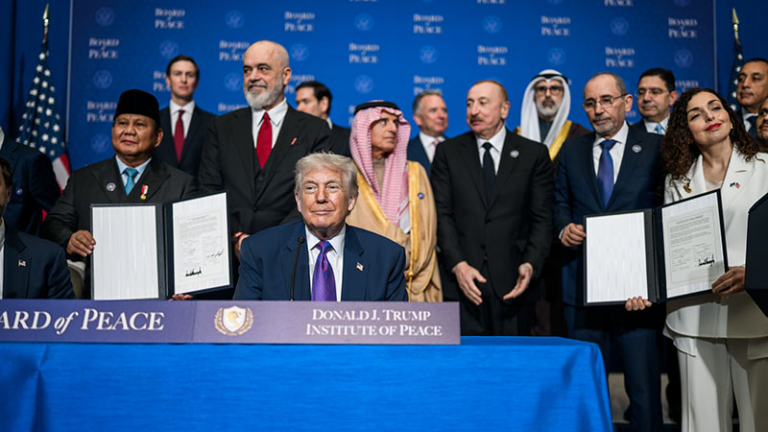
On October 13, 2025, leaders from 27 countries attended the Sharm Al-Sheikh Peace Summit in Egypt to witness the signing ceremony of the US-brokered Gaza ceasefire agreement. Four months later, on February 19, 2026, officials from more than 50 countries attended the inaugural BoP meeting in Washington, DC. Such a large group of countries, some with considerable financial and economic leverage, could very well translate the interest they have shown in Gaza and in regional peace and stability into tangible diplomatic pressure to prevent the proposed decommissioning and withdrawal process from being derailed, potentially giving Gaza hope for a new lease on life.
Israel’s far-right politicians are already contemplating new settlements in Gaza. The 15-point BoP roadmap, if faithfully implemented in its original July 30 form, could eventually put war-ravaged Gaza on the path to a different future.
The views expressed in this publication are the author’s own and do not necessarily reflect the position of Arab Center Washington DC, its staff, or its Board of Directors.
Featured image credit: The White House via Flickr