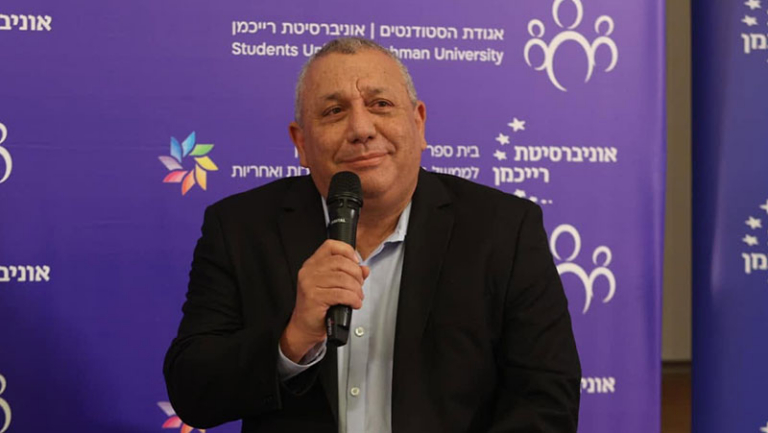
Israelis are set to head to the polls on October 27, 2026, for what some have touted as the most consequential election in the country’s history. Gadi Eisenkot, the former Israel Defense Forces (IDF) chief of staff and leader of the Yashar (Straight) Party, has surged in the polls, overtaking Beyachad (Together), the opposition alliance of Naftali Bennett and Yair Lapid. In an average of all mainstream polls, Yashar is now level with Prime Minister Benjamin Netanyahu’s Likud party at 22 seats, making Eisenkot’s party not only the largest opposition grouping, but potentially the party with the most support nationwide.
Although Eisenkot’s surge has made him the opposition frontrunner, he is on an inevitable collision course with an electoral reality that no challenger to Netanyahu has been able to resolve. In any mainstream poll, neither Netanyahu’s coalition nor Eisenkot’s opposition has yet reached the 61 Knesset seats required to form a government. The path to a majority, therefore, runs through the country’s Arab-majority political parties. For Eisenkot, the dilemma is stark: He needs the Arab seats but bringing them into his coalition risks losing the centrist and right-wing voters he needs to win.
The Surge Is Real
Eisenkot’s voter appeal is not difficult to understand. He served as IDF chief of staff from 2015 to 2019, building a reputation for strategic seriousness and institutional discipline. He has no corruption scandals. He speaks with the measured authority of someone who has commanded armies. He is also considered to have made a personal sacrifice for Israel after losing a son and two nephews in the Gaza war. In a political environment defined by the chaos of the Netanyahu era, Eisenkot offers competence and credibility.
To many Israelis, Eisenkot represents not just a change of government but a change of direction. The policy contrast with Netanyahu is real on several fronts: Eisenkot supports a state commission of inquiry into October 7; mandatory universal military or national service, including for ultra-Orthodox men and Palestinian citizens; limiting the prime minister to two terms; and genuine judicial independence.
The Path to Electoral Victory
The average of all mainstream polls awards the broader opposition, including Yashar, Beyachad, the Democrats, Yisrael Beiteinu (Israel Is Our Home), and smaller parties, around 58 Knesset seats to the Netanyahu coalition’s 52. In practice, it is not a government. Even fully united, Jewish-dominated opposition parties fall short of the 61 seats required for a Knesset majority.
Palestinian citizens of Israel make up more than 20 percent of the country’s population. Together, the Arab parties that represent them are projected to receive between 10 and 11 seats, depending on whether the four parties run individually or, less likely now, as a single joint list. These seats are indispensable to any opposition majority. It is for this reason that Arab parties have come to be known as kingmakers.
The most likely kingmaker is once again Mansour Abbas, leader of Ra’am, or the United Arab List, a religious Arab party associated with the Islamic Movement in Israel that focuses primarily on socioeconomic issues affecting Palestinian citizens. In June 2021, Ra’am made history by becoming the first Arab party in Israeli history to join a governing coalition, the so-called “Government of Change” co-led by Bennett and Lapid. That government collapsed in December 2022. This time around, Bennett has explicitly ruled out any such arrangement, stating that “the Arab parties are not Zionist, and therefore we will not rely on them.”
Seventy percent of Jewish Israelis oppose the inclusion of an Arab party in the government.
The problem for Eisenkot is that 70 percent of Jewish Israelis oppose the inclusion of an Arab party in the government. Thus far, he has stopped short of ruling out Arab party support entirely, being careful not to close any doors. When asked recently about an Arab party joining his coalition, he outlined three principles any coalition partner must accept: recognition of Israel as a Jewish and democratic state, endorsement of the values of the Declaration of Independence, and a commitment to military or national service.
Those requirements technically exclude three Arab parties, but leave room for Ra’am, whose leader, Mansour Abbas, has publicly accepted Israel as a Jewish and democratic state and expressed openness to forms of voluntary national service for Arab citizens in civil society initiatives independent from the state. Abbas has long taken a pragmatic approach to Israeli politics. Arab citizens, he argues, are better served by participating in government and securing tangible benefits in housing, infrastructure, and public safety than by opposing it. It is a controversial position within Arab society, with some critics viewing it as opportunistic, but it is one that has earned Ra’am a unique role in Israeli coalition politics.
In April 2026, Eisenkot called for a “Zionist majority” and convened opposition leaders without inviting Arab party heads. Abbas, for his part, appears to have read between the lines. In May 2026, he said publicly that he is confident he will eventually “reach agreements” with Bennett, Eisenkot, and Liberman. Ra’am sees a path. Whether Eisenkot will take it, publicly, before the election, and risk losing Jewish centrist, center-right, and right-wing voters, is the question.
Netanyahu and his coalition have wasted no time exploiting Eisenkot’s reluctance to explicitly exclude Arab parties from a future governing coalition. They have flooded media feeds with attack ads pushing slogans like: “Eisenkot has no government without the Arab parties,” and “There is no Gadi without Tibi,“ a reference to Ahmad Tibi, leader of the Ta’al (Arab Movement for Renewal) Party. The goal is to convince Jewish voters that Eisenkot will be at the mercy of Arab politicians.
What Comes Next
Eisenkot’s ambiguity is strategic. Committing to Arab party support before the election would hand Netanyahu exactly the attack line he is looking for, and could push center voters away from Yashar, shrinking the very bloc Eisenkot needs to lead. As it stands, the math is clear: Eisenkot can win, but he cannot govern without an Arab party in his coalition. But that is a political calculation that he has so far refused to make.
The views expressed in this publication are the author’s own and do not necessarily reflect the position of Arab Center Washington DC, its staff, or its Board of Directors.
Featured image credit: Gadi Eisenkot via FB