
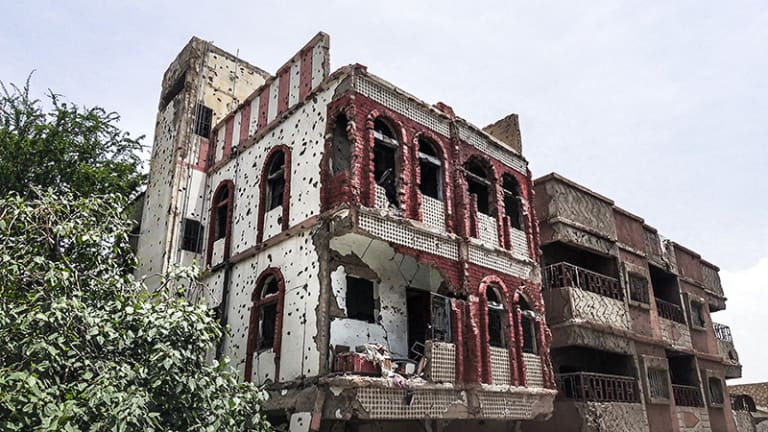
More than a decade into Yemen’s civil war, no end to the conflict is in sight. The lines of control between the two main belligerents have barely changed, and conditions for the Yemeni people continue to be dire. The internationally recognized government is led by the Presidential Leadership Council (PLC), a loose-knit coalition of Yemeni political and military factions backed variously by Saudi Arabia or the United Arab Emirates (UAE) and opposed to the Iran-aligned Houthis (also known as Ansar Allah), who control the most populous regions of the country including the capital Sanaa. The fragmented PLC has been unable to prevail over the Houthi insurgency, to provide basic services, or to offer hope of a lasting peace settlement.
Yemen’s population continues to suffer from a shattered economy, a severe humanitarian crisis, and a failed bureaucracy in both Houthi- and PLC-governed regions. Many Yemeni political factions and related armed groups are beholden to different regional sponsors whose rivalries play out in their competition for influence in this strategically located country. United Nations (UN) mediation and humanitarian assistance programs suffer from inadequate international support. Yemen’s fate is held hostage to domestic divisions and geopolitical competition.
The Presidential Leadership Council
Formed in 2022 and led by President Rashad al-Alimi, the PLC is plagued by inefficiency, corruption, and dissension. Despite generous subsidies from Saudi Arabia and the UAE, Yemeni government forces have been unable to push back Houthi fighters from positions that they have held for a decade. Since 2022, violence has generally declined, and fighting has produced only minor changes in territorial control across key fronts, including in the central governorates of Marib and Hodeida on the western coast, both of which are divided between PLC and Houthi control. After so many years of turmoil, war, and power struggles, economic conditions across the entire country are terrible. The World Bank says that half the population—more than 17 million Yemenis—face food insecurity and that 18 million have no access to safe drinking water or sanitation.
After years of turmoil, war, and power struggles, economic conditions across the entire country are terrible.
Riyadh-backed al-Alimi, a former interior minister, has been unable to turn the economy around in the south. The PLC’s de facto capital, Aden, has seen frequent protests against poor economic conditions and a lack of essential public services. Government corruption is rampant, from the hugely inflated salaries of ministers and other high-level officials to the vital sectors of electricity, water, sanitation, and public health. In May 2025, PLC Prime Minister Ahmed Ben Mubarak resigned after a power struggle with al-Alimi, citing his inability to govern with only limited powers. Ben Mubarak’s successor, Salem Bin Breik, has not yet succeeded in improving living conditions either. Most of the PLC leadership has remained in exile in Riyadh, and al-Alimi himself has had trouble working out of the presidential palace in Aden due to internal PLC tensions with Aidarous al-Zubaidi, who heads the UAE-backed secessionist Southern Transitional Council and aspires to lead southern Yemen.
The US Department of State’s annual human rights report has regularly blamed the internationally recognized Yemeni government, as well as the Houthis, for corruption, lack of respect for human rights, and a failure to follow proper judicial procedures in arrests and detentions. The independent Yemeni human rights organization Muwatana has documented rampant human rights abuses, including forced disappearances and the use of torture, child labor, and child soldiers, by various parties to the conflict, including PLC-aligned groups.
Houthi Governance
After taking Sanaa by force in 2014, the Houthis quickly came into direct conflict with other political parties in Yemen, especially in the south, and with tribes from regions outside Saada governorate, the movement’s stronghold. By 2015, the Houthis (also known as Ansar Allah, or ‘partisans of God’) had captured more territory and came to rule an estimated 70 to 80 percent of Yemen’s population living in the areas controlled by the group, which consolidated its power through alliances with tribes and parties in the north of Yemen. The war has made for some strange bedfellows. The Houthis’ alliance with their previous bitter enemy, President Ali Abdallah Saleh (who ruled from 1978 until 2012), was initially helpful after he was forced from power, but the partnership proved temporary and ended with their killing him in 2017. A large part of Saleh’s extended family and followers then supported various anti-Houthi factions.
Yemeni and international human rights organizations have documented Ansar Allah’s repression of civilians. Citing “shrinking space for activism and dissent,” the armed conflict watchdog ACLED has described the Houthis’ campaign of disappearances, imprisonment without due process, and the confiscation of land and property, while the Associated Press and others have reported on the Houthi’s use of torture. In the case of the PLC, corruption and divisiveness are key obstacles to reform. What makes Houthi authoritarianism perhaps distinctive in the Yemeni context is its leadership’s mix of religion and politics and the group’s trend of empowering religiously hardline leaders over more secular pragmatists.
Regional Impact
Complicating Yemen’s internal power struggle is Ansar Allah’s war of support for the Palestinians, which the group calls an “ethical, humanitarian, and religious duty.” The Houthis’ attacks on Red Sea shipping and then on Israel following the start of the Gaza war in October 2023 have placed Sanaa in direct opposition to Israel and the United States, which have responded with repeated airstrikes.
Since December 2023, Israel has carried out numerous airstrikes in Yemen in retaliation for the missiles fired by Ansar Allah at Israeli targets including the port and resort city of Eilat and Ben-Gurion International Airport. The Israeli strikes have hit power plants, oil storage facilities, and ports in Hodeida, Ras Issa, and Salif, as well as Houthi leaders. Perhaps most notoriously, on August 28, 2025, Israel struck a government facility in Sanaa, killing the group’s appointed prime minister, Ahmed al-Rahawi, and several other ministers. On September 10, 2025, Israel struck military and civilian targets in Sanaa and al-Jawf governorate, reportedly killing 35 people, including media workers, and wounding dozens.
The Israeli strikes have hit power plants, oil storage facilities, ports, and Houthi leaders.
As for US strikes against the Houthis since the 2023 Gaza war, the Biden administration began a bombing campaign in early 2024 in retaliation for the group’s attacks on Red Sea vessels and on Israel. In March 2025, the Trump administration launched its own air attacks against Houthi targets. April 2025 saw further US attacks on Hodeida, Sanaa, and Saada. A US strike on April 28, 2025, hit a refugee center, killing nearly 70 African migrants and prompting Amnesty International to demand an investigation into potential war crimes.
Following Omani mediation, on May 6, 2025, the United States and the Houthis agreed to halt firing on each other’s facilities and assets. That deal did not include Israel, but Houthi missiles against Israeli targets halted in October 2025 after Ansar Allah indicated that they would pause their attacks in recognition of the Gaza ceasefire. The fragile nature of that ceasefire and the Houthis’ stated intent to resume attacks should the Gaza war restart suggests that the pause may be short-lived indeed.
UN Mediation
In May 2025, the UN Special Envoy for Yemen, Hans Grundberg, expressed his frustration with Yemen’s peace process, which remains stalled despite a 2022 ceasefire and a 2023 peace roadmap to which the Houthis and the PLC initially agreed in principle. Negotiated with support from Saudi Arabia and Oman, the roadmap promised a permanent ceasefire, the sharing of Yemen’s oil revenues to pay salaries, and a general framework to arrive at a permanent political accord between warring factions. These goals have yet to be achieved, however, as any potentially reconcilable differences between the warring parties remain entangled in regional competition and conflicts, including Gaza.
Grundberg’s work is made even more difficult by Ansar Allah’s repeated detentions of UN employees in Yemen based on unsubstantiated accusations of espionage and involvement in Israeli and American air attacks on Houthi positions. On October 20, 2025, the Houthis released five Yemeni staffers from the UN compound in Sanaa while keeping 15 international staffers detained on the premises—but at least 53 UN employees remain imprisoned by the Houthis.
Military Balance Unchanged?
As of today, the objectives of the Israeli and US bombing campaigns in Yemen are not clear enough to allow for a full assessment of their success or failure. If the goal was regime change in Sanaa by toppling the Houthis, this was never realistic, as months of powerful airstrikes could not accomplish such an outcome. If the goal was to weaken or remove the Houthis from the regional chessboard, then the relative quiet at present, even if temporary, could be termed a partial success. Yet this relative quiet is a result of the Gaza ceasefire and the Trump administration’s earlier decision to pause US airstrikes on Yemen, not a result of a resolution of the Yemen conflict itself. Ansar Allah attributed the lull in hostilities with Israel and the United States to their own successful resistance and ability to limit the damage that their enemies could inflict on them.
There is currently no accurate way of calculating whether the Houthis’ military capabilities have been sufficiently degraded to allow the United States and Israel to conclude that their attacks were worth the cost. The attacks do not seem to have made any difference in Yemen’s internal balance of power. In fact, PLC leaders have expressed their disappointment at the limited effectiveness of the US and the Israel strikes, which did not change the military frontlines between anti-Houthi forces and Ansar Allah.
Conclusion
Yemen’s tragic descent into chaos, poverty, and humanitarian disaster can be laid at the doors of all parties, foreign and domestic, that have been involved in its devastating war. The struggle for power between Ansar Allah and the political and regional leaders loosely allied in the PLC cannot be separated from the ongoing rivalry for influence between Saudi Arabia and the UAE, each of which is supporting their own preferred groups and leaders to the detriment of a unified front. The Houthis’ staunch backing of the Palestinian cause has also become an integral part of Yemen’s complexity. Despite this complexity, there is no alternative to creative international mediation trying to weave a coherent tapestry out of the snarled ball of yarn that is Yemen and the broader Middle East.
The views expressed in this publication are the author’s own and do not necessarily reflect the position of Arab Center Washington DC, its staff, or its Board of Directors.
Featured image credit: Shutterstock/Anas Alhajj