Turkey-Iraq relations have undergone a significant transformation over the past two years. For much of the post-2003 period, relations between Ankara and Baghdad were dominated by disputes over security, sovereignty, and Turkey’s relations with the Kurdistan Regional Government (KRG). Turkey conducted military operations against the Kurdistan Workers’ Party (PKK) in northern Iraq largely unilaterally, while Baghdad protested violations of Iraqi sovereignty but had little ability to prevent them. Economic relations expanded significantly, but security disputes continued to dominate the relationship. By 2024, however, the relationship had begun to acquire a different character. This shift reflected changes on each side. Former Iraqi Prime Minister Mohammed Shia’ al-Sudani came to office in 2022 with a pragmatic, development-oriented agenda, and made the Development Road—a planned transport corridor connecting Iraq’s Grand Faw Port to Turkey and ultimately Europe—one of his government’s central projects. This new orientation increased Baghdad’s interest in improving relations with Turkey, as cooperation from Ankara was essential for the project to succeed. In response, Turkey also began to put its security demands in a broader context of economic and political cooperation.
In 2026, the US war with Iran has made Turkey even more important to Iraq. The disruption of shipping through the Strait of Hormuz has exposed Iraq’s dependence on Gulf export routes and increased the strategic value of alternative routes through Turkey. The Iran war has also made Baghdad’s longstanding effort to balance between Iran and the United States more difficult, making its relationship with Turkey more valuable. At the same time, Turkish and American interests in Iraq have moved closer together, as both increasingly favor a stronger central government capable of exercising greater control over armed groups.
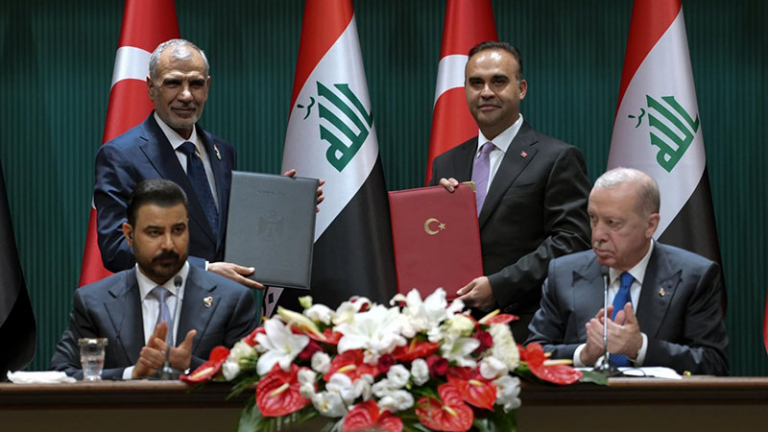
Baghdad’s effort to maintain this balance was visible in the first foreign visits of Iraq’s new prime minister, Ali al-Zaidi. In July 2026, he travelled first to Washington and then Tehran, before visiting Ankara on July 28. The Ankara visit also reaffirmed the bilateral agenda developed under Sudani, indicating continuity in Iraq’s approach to Turkey despite the change of government. Together, these developments have produced a markedly deeper Turkey-Iraq partnership, one that increasingly aligns with US priorities in Iraq as well. How far it can go, however, will depend heavily on politics inside Iraq, where competing centers of power continue to constrain Baghdad’s ability to implement the deals it makes with Turkey.
From Security Disputes to Security Cooperation
The change in Iraqi–Turkish relations has been particularly visible in the security relationship. For two decades, Turkey’s military presence in northern Iraq was one of the principal sources of tension between Ankara and Baghdad. Turkey had long pressed Baghdad to take a stronger position against the PKK, but under Sudani’s premiership the Iraqi government had become more responsive to these demands. In March 2024, Iraq’s National Security Council designated the PKK a banned organization, and in August the two governments signed a security and counterterrorism memorandum establishing a joint coordination center and a high-level committee.
The PKK’s May 2025 decision to dissolve and disarm could deepen this shift. The process raises questions that Turkey cannot address alone, including the future of disarmed fighters, security arrangements in areas the PKK leaves, and the future of PKK-linked structures in the Makhmour refugee camp and Sinjar. For years, Baghdad largely treated the PKK as a problem between Turkey and the Kurds and left its management to Erbil, the capital of Iraqi Kurdistan, but disarmament makes its direct involvement increasingly important.
The Development Road and a New Logic of Interdependence
The Development Road has begun to change the nature of the Turkey-Iraq relationship itself. The planned 1,200-kilometer road and rail corridor would connect the Grand Faw Port in southern Iraq to Turkey and onward to European markets. For Baghdad, the project promises to transform Iraq from a country heavily dependent on oil exports into an integral part of a broader transit and logistics network. For Ankara, it complements Turkey’s longstanding ambition to position itself at the center of regional trade and connectivity networks.
An overland connection to Europe through Turkey has acquired much greater strategic value.
The project also demonstrates why the current rapprochement goes beyond a temporary political accommodation. Iraq provides the port to the Gulf, while Turkey offers a connection to European markets as well as construction and logistics capacity. This form of interdependence was largely absent from the older security-centered relationship.
Nevertheless, turning this ambition into a functioning corridor has proved difficult. Financing remains the main challenge, with the first phase alone estimated to cost around $20 billion. Qatar and the United Arab Emirates joined Iraq and Turkey in the original 2024 memorandum, but a full financing package has yet to emerge. A new framework allowing Turkish companies to build infrastructure in return for Iraqi natural resources could finance part of the construction but falls well short of settling the corridor’s overall needs.
The war with Iran has made the Development Road project more than a long-term economic ambition. With shipping through the Strait of Hormuz disrupted, an overland connection to Europe through Turkey has acquired much greater strategic value.
An Unequal Partnership
Despite the growing interdependence between Turkey and Iraq, the relationship is not one of equals. The balance varies across different issues, but in several important areas Ankara retains a significant advantage.
Turkey’s dominance is clearest in security. Turkey retains troops on Iraqi soil and keeps the military initiative. Baghdad does not formally accept the Turkish presence but lacks the leverage to end it, leaving it with limited influence over Turkey’s military activities even as the two governments cooperate more closely against the PKK.
Water is where the imbalance is starkest. Iraq lies downstream on both the Tigris and the Euphrates, while deteriorating infrastructure and recurring drought have made water shortages an increasingly serious problem. Turkey sits upstream and controls much of the flow, giving Ankara considerable leverage. Baghdad has long pressed Turkey for larger and more predictable releases, while Ankara has argued that Iraq’s water problems also stem from inefficient irrigation and poor water management.
The framework agreed during al-Zaidi’s July 2026 visit allows Turkish companies to undertake water infrastructure projects in Iraq financed through Iraqi oil revenues, moving the discussion closer to Ankara’s emphasis on water management. It produced no new commitment, however, on the volume of water Turkey would release. Critics in Baghdad argue that the arrangement deepens dependence tying oil revenues to Turkish-built projects while leaving the water-flow dispute unresolved.
Unlike security and water, energy involves greater mutual dependence. The Kirkuk-Ceyhan oil pipeline provides Iraq with an export route to the Mediterranean that bypasses the Gulf, while Iraqi oil is important to Turkey both as a source of crude and as part of its ambition to become a regional energy hub. Ankara and Baghdad are now working toward a comprehensive energy agreement that would expand cooperation beyond the existing pipeline relationship. The recent decision to bring Turkish Petroleum into production in Kirkuk also extends Turkey’s role beyond trade and transit, making it a direct investor in Iraq’s energy sector.
Internal and External Constraints on the Rapprochement
Although the convergence between Ankara and Baghdad is real, the two governments are not the only actors shaping developments. Their growing cooperation affects the interests of other regional and domestic actors, while the weakness of Iraq’s central government limits its ability to implement some of the policies it agrees with Turkey. The Development Road provides the clearest example of both problems.
The Development Road would bypass the Strait of Hormuz, reducing Iranian regional and global leverage
The project is part of a wider competition over regional trade routes. The most immediate competition comes from Iran, whose International North-South Transport Corridor seeks to channel trade through Iranian territory. The Development Road would provide an alternative through Iraq and Turkey while allowing Gulf trade to bypass the Strait of Hormuz, reducing an important source of Iranian regional and global leverage. Iran-aligned groups in Iraq may oppose a project that could weaken Tehran’s regional influence.
The route will also create winners and losers inside Iraq itself, depending on where infrastructure is built and who controls contracts, transit revenues, and security along the corridor. These unevenly distributed benefits give political factions, ministries, and regional authorities their own reasons to influence or obstruct the project. In Iraq’s fragmented political system, where the central government shares power with multiple political and armed actors, competing interests can become serious obstacles to implementation.
These tensions surfaced during al-Zaidi’s Ankara visit, when Iraq’s transport minister initially declined, in front of the cameras, to sign a memorandum on the Development Road. The reasons were not made public. His reported ties to an Iran-aligned faction offered one possible explanation, although other domestic interests may also have been involved. He signed only after al-Zaidi intervened, illustrating the resistance that agreements reached by the prime minister can encounter elsewhere within the Iraqi state.
The Kurdistan Region has reasons of its own for concern. The Fishkhabur-Ovaköy connection, planned as the Development Road’s crossing into Turkey, lies outside the Kurdistan Region and would create an alternative to the existing Habur-Ibrahim Khalil crossing under KRG control. A second crossing under federal control would reduce some of Erbil’s leverage over trade between Iraq and Turkey. More broadly, Ankara’s rapprochement with Baghdad reduces the privileged position that Erbil once occupied in Turkey’s Iraq policy.
Iraq Between Iran, Turkey, and the United States
Iraq’s fragmented political system and the weakness of the Iraqi state have long worked to Iran’s advantage. Tehran built much of its influence in post-2003 Iraq not only through its relations with governments in Baghdad, but through political parties and armed groups that retained considerable autonomy from the central state. The war has put this system under greater pressure. With Iran itself under sustained military pressure, Tehran has fewer resources to devote to its regional networks, while Washington is pushing more openly to curb the power of Iran-aligned armed groups.
Ankara’s preference for a stronger central government [in Iraq] overlaps with US priorities.
This brings American and Turkish priorities in Iraq closer together. Washington wants to strengthen the authority of the central government by bringing Iran-aligned militias more firmly under the state’s effective control. Ankara has its own reasons for wanting a stronger government in Baghdad: a central state capable of controlling its territory would be a more effective partner against the PKK, better able to implement the Development Road and other bilateral agreements, and less vulnerable to actors that can obstruct cooperation with Turkey.
The recent expansion of the portfolio of Tom Barrack, the US ambassador to Turkey, to include Iraq is significant in this context. Already serving as US envoy for Syria, Barrack has worked closely with Ankara in support of a centralized Syrian state, opposing continued autonomous rule in the Kurdish-led northeast and pressing for the integration of the Syrian Democratic Forces (SDF) into the national army. Adding Iraq to his portfolio suggests that Washington increasingly views these theaters as interconnected, raising the prospect of extending this US-Turkish convergence to Iraq.
Washington therefore has reason to welcome Turkey’s growing role in Iraq, particularly as Ankara’s preference for a stronger central government overlaps with US priorities. For Baghdad, closer relations with Turkey provide an additional source of balance at a time when managing relations with Iran and the United States has become increasingly difficult. Turkey cannot replace either power, but stronger ties with Ankara give Baghdad greater room for maneuver between them.
Conclusion
Taken together, these changes have made Turkey a more important partner for Baghdad and given both sides a stronger interest in sustaining the rapprochement. The war has reinforced this shift, increasing Turkey’s strategic value to Baghdad while bringing Turkish and American interests in a stronger Iraqi state closer together. This does not, however, amount to an Iraqi realignment toward Turkey and away from Iran.
Baghdad cannot afford a rupture with Tehran, whose political, economic, and security influence inside Iraq remains substantial. Iraqi politics also remain fragmented, and efforts to strengthen central state control over armed actors will face substantial resistance. Excessive pressure on Baghdad to move too aggressively against the paramilitary Popular Mobilization Forces could therefore prove destabilizing, undermining the stability on which Turkey’s own economic ambitions depend.
Ankara’s interests are consequently more compatible with a gradual strengthening of the Iraqi state than with a sharp geopolitical realignment. A Baghdad government capable of controlling armed groups, securing transport corridors, and implementing long-term agreements would make Iraq a more reliable economic and security partner for Turkey. It would also give Ankara an opportunity to translate its growing partnership with Baghdad into a larger role in the regional order being reshaped by the war.
The views expressed in this publication are the author’s own and do not necessarily reflect the position of Arab Center Washington DC, its staff, or its Board of Directors.
Featured image credit: Iraqi Prime Minister Media Office via X