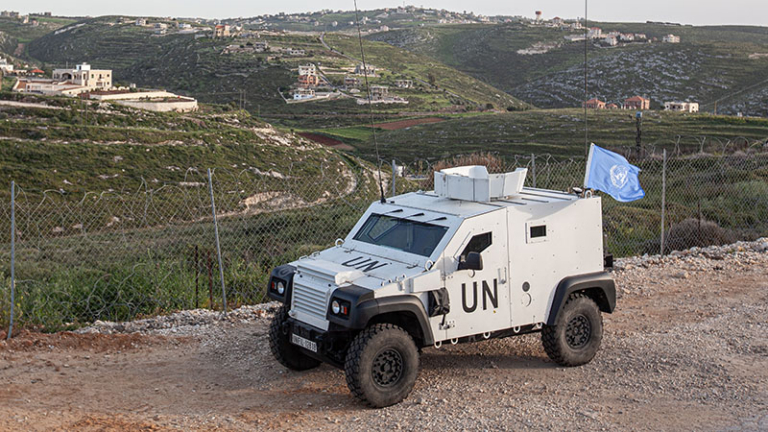
The scheduled end of the mission of the United Nations Interim Force in Lebanon (UNIFIL) on December 31, 2026, presents the Lebanese government with yet another challenge. The United Nations Security Council (UNSC) Resolution 2790, adopted on August 28, 2025, gives UNIFIL one year from the beginning of 2027 to complete a phased withdrawal from southern Lebanon. But to date, no alternative security arrangement has been found to replace the departing force. The gap may exacerbate tensions on the border, hinder the Lebanese state’s efforts to assert its authority over the entire country, and allow the Israeli military to continue violating Lebanon’s sovereignty at will.
The UNSC must therefore devise an alternative solution to deliver peace and security. Such a solution must effectively monitor Israel’s and Hezbollah’s actions on the border, provide protection for all communities in Lebanon, and respect international law. UNIFIL’s failure to prevent Israeli forces from laying waste to southern Lebanon and dispossessing its people over the past three years, as well as its inability to assert control over Hezbollah, does not negate the need for an international border presence. Similarly, Israel and the United States’s insistence that an alternative arrangement must disarm Hezbollah as its primary objective does not remove the need for a border solution after UNIFIL. A new security arrangement must help restore Lebanon’s sovereignty over its territory, end Israel’s occupation of southern Lebanon, and allow the region’s people to return home and rebuild their lives.
Three Scenarios for the Post-UNIFIL Period
Three potential scenarios could follow the end of UNIFIL’s mission in southern Lebanon. The first is that the UNSC fails to provide an alternative international force to monitor the border. While UNIFIL has not been able to stop Israel from violating the border or to act as a deterrent against Israel or Hezbollah, the absence of even a modest international presence on the border is dangerous. It will further enable the Israeli military machine to continue to occupy Lebanese territory and conduct unhindered operations across southern Lebanon.
The second scenario is for UNSC’s five permanent members to replace UNIFIL with another international force with a clearer mandate to disarm Hezbollah and dismantle its infrastructure in southern Lebanon. This option is largely favored by the Israeli government, given that Hezbollah has been the main force resisting its military operations in southern Lebanon and has also threatened northern Israel. But this scenario is unlikely given that China and Russia—two permanent members of the UNSC with close relations with Iran, which is Hezbollah’s main benefactor and ally—will likely oppose this option. The Lebanese government could also reject this plan, preferring to have an international presence on its border with Israel alongside its own armed forces.
The Lebanese government has expressed its support for a plan that would maintain a UN-sanctioned international force.
Thus the third scenario is to increase international support for the Lebanese Armed Forces (LAF) to eventually assume responsibility for securing the border with Israel and assuring Hezbollah’s compliance with the government’s plan to impose a monopoly on arms across the country. Given the dangers and flawed calculations with the first two scenarios, the Lebanese government has expressed its support for a plan that would maintain a UN-sanctioned international force and provide international support to the LAF. It is not hard to imagine the international community supporting this arrangement, as it would help Lebanon reassert its sovereignty, reclaim its occupied territory, rehabilitate the many towns and villages destroyed by Israel, and repatriate the hundreds of thousands displaced by the war.
LAF’s Poor Conditions and Prospects for Assistance
The central concern with this third scenario is the poor condition of the Lebanese army, which currently cannot achieve what the Lebanese government and the international community demand of it: to ensure peace and security on the border and help deter Hezbollah’s attacks on Israel. Lebanon’s financial troubles have exacerbated these concerns. Serious funding limitations for the army have affected its personnel, readiness, and overall mission—problems that need to be immediately addressed.
In February 2026, at a meeting in Cairo, representatives from the LAF outlined many of the army’s challenges and financial shortcomings. They estimated that the LAF would need $3 billion over a five-year period to address these challenges. A follow-up meeting in Paris on September 17, 2026, unfortunately failed to secure much of this funding, as many of the attendees expressed reluctance—if not outright refusal—to commit assistance while Hezbollah remained beyond state control. A month later, French President Emmanuel Macron announced another conference to support the LAF that would wait until after the Israeli parliamentary elections—in effect tying the Lebanese army’s future to Israeli politics. As it stands today, these elections have yet to provide clarity about which direction Israel may take with regards to Lebanon. More importantly, how can a future international meeting ensure Lebanon’s sovereignty if international support for its army is contingent on the demands of the occupier of Lebanese territory?
Serious funding limitations for the army have affected its personnel, readiness, and overall mission.
Despite their reluctance to send funds to the LAF, more than 10 European Union (EU) member states announced in early September their readiness to contribute forces to train and equip the LAF to disarm Hezbollah. While the decision to disarm the party should remain under the purview of the Lebanese government, the proposition to help strengthen Lebanon’s military would be welcomed if it also secures a necessary international presence on the border with Israel. With this plan, the EU states—primarily France, Germany, and Italy—can prioritize Lebanon’s needs in its conflict with Israel without having to succumb to Israeli and US pressures to first disarm Hezbollah. Disarming the party is a task that should be left to the Lebanese state in a way that does not jeopardize the country’s internal security.
Regional states have also been playing an important role. Jordan has been spearheading an international effort to help the LAF with training and equipment. Qatar has similarly reaffirmed its support for the Lebanese army, and Lebanese President Joseph Aoun has visited Turkey to secure diplomatic support for the LAF. In addition, Lebanon has asked for assistance from the United States. But helping Lebanon’s military achieve its mission to secure the border with Israel and assert its sovereignty depends on reaching an acceptable political compromise with Hezbollah in Beirut and seeing a fundamental change in Israel’s approach to Lebanon.
The Conundrum of an Uncompromising Hezbollah
If Lebanon’s domestic political dynamics since the end of the 2006 Israeli-Hezbollah war have revealed anything, it is the difficulty of forcing Hezbollah to surrender its weapons to the Lebanese state or to partially submit to state control. Hezbollah considers itself the main resistance force against Israeli aggression in southern Lebanon, the protector of the country’s Shia communal interests, and an indispensable member of the Iranian-led Axis of Resistance. Any discussions about Hezbollah’s future must consider the party’s security claims and the difficulties they pose for the Lebanese government.
The party has been undoubtedly weakened over three years of direct confrontation with Israel, which has resulted in the assassination of its leaders, the devastation of its military infrastructure, the depletion of its arms, and the suspension of new arms deliveries from Iran. Nevertheless, the party retains some military capabilities and behaves as if it is ready to resume war with Israel. The party still rejects any discussion of disarmament so long as Israel continues to occupy areas of southern Lebanon. In the past, its leaders have expressed a willingness to accept a diplomatic solution with Tel Aviv, but only after Israel’s withdrawal. Hezbollah is vehemently opposed to the US-brokered trilateral framework agreement of June 2026 that made Israel’s withdrawal contingent upon the Lebanese government disarming the party.
Attempting to dismantle elements of Hezbollah by force will only expose the fragility of Lebanese politics.
For these reasons, any plan is reckless if it requires the disarmament of Hezbollah without giving the Lebanese government the time to find a compromise with the party and without demanding commitments from Israel to withdraw. Attempting to dismantle elements of the party by force—a proposition championed by US Secretary of State Marco Rubio earlier this year—will only expose the fragility of Lebanese politics and threaten to open civil strife that could collapse the Lebanese state. The LAF is currently unwilling to coordinate with Israel’s military to dismantle Hezbollah’s military capabilities, as such a move would be tantamount to becoming Israel’s vassal.
In September 2025, the Lebanese government approved a five-stage plan by the army to disarm Hezbollah, which initially appeared to have support from Nabih Berri, the speaker of parliament, leader of the Amal Movement, and a longtime Hezbollah ally. However, during the cabinet meeting, all five Shia ministers—two from Amal, two from Hezbollah, and one independent—walked out in protest. Since then, Israeli military operations and US political and diplomatic pressure have put the army’s phased plan on the backburner in favor of an alternative US-Israeli plan that demands the Lebanese military quickly confront Hezbollah. The result of these competing plans has been a stalemate.
No Hope for Change in Israel
Hezbollah’s refusal to disarm is made even more difficult by Israel’s ongoing military operations in southern Lebanon, which violate international law. Israeli forces continue to destroy the region’s villages and displace their inhabitants, while crossing the “blue line” established by the United Nations in 2000. Israel’s leaders offer no hope that Lebanon’s rightful demand for their country’s military forces to be withdrawn will be met any time soon. Prime Minister Benjamin Netanyahu has declared that Israel will not withdraw from the security zone it has established in southern Lebanon. Defense Minister Israel Katz has threatened to expand this security zone at Lebanon’s expense, while Finance Minister Bezalel Smotrich has called for extending Israel’s borders northward to the Litani River. In this political climate, it is difficult to see how Hezbollah could accept disarmament—or how Israel might come to respect international law in Lebanon.
There are few Israeli politicians who object to how Israel has conducted its war in Lebanon.
Israel’s October 2026 Knesset elections provided little clarity about the country’s political future. However, it is unlikely that any governing coalition would deviate from Netanyahu’s security policies upon taking power. Even if the so-called opposition bloc, headed by Gadi Eisenkot, forms a government, Lebanon will likely not fare much better. When he served as commander of Israel’s Northern Command, General Eisenkot devised the infamous Dahieh Doctrine, the cruel and violent military strategy named after Beirut’s southern suburbs. The doctrine calls on Israel to use overwhelming force against civilian areas to force Hezbollah’s hand in the war. Eisenkot’s partners in the opposition are no better. Naftali Bennett, for example, has criticized Netanyahu’s government for its supposed restrictions on soldiers’ activities in southern Lebanon. In short, there are few Israeli politicians who object to how Israel has conducted its war in Lebanon.
Lebanon Needs an Auxiliary International Force
The stalemate created by Hezbollah’s rejection of disarmament while Israel occupies southern Lebanon and Israel’s refusal to withdraw from the region make it difficult for the Lebanese government to move forward. The UNSC must therefore devise a hybrid plan that augments the capabilities of the LAF alongside an international force provided by the EU and other countries. For this plan to work, the United States must also pressure Israel to withdraw completely from southern Lebanon—a move that would facilitate Hezbollah’s disarmament.
The UNSC should not prioritize disarming Hezbollah over forcing an Israeli withdrawal from Lebanon. Despite challenging the Lebanese state’s authority and acting like a state within a state, Hezbollah is also using its arms to resist Israel’s illegal occupation. If the international community wants to protect the essential tenets of international law, it must work to address Israel’s many violations of this law. Indeed, if an auxiliary international force is to assist the LAF in policing southern Lebanon, it should pay as much attention to Israeli violations in Lebanon as it would to Hezbollah’s actions.
The views expressed in this publication are the author’s own and do not necessarily reflect the position of Arab Center Washington DC, its staff, or its Board of Directors.
Featured image credit: Sebastian Castelier via Shutterstock