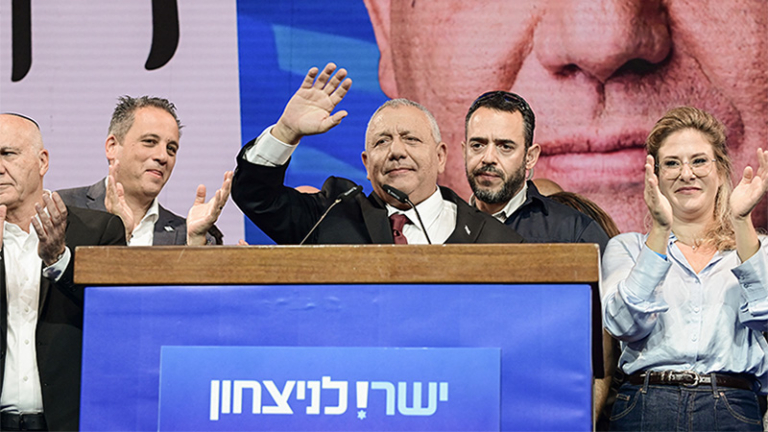
For the first time since October 7, 2023, and since a judicial coup attempt by the far-right government of Israeli Prime Minister Benjamin Netanyahu, Israelis have had an opportunity to vote in Knesset elections that will determine the shape of the next Israeli government.
The results of the vote, however, bring several key questions to the fore and produce many others we cannot yet answer.
1. Is Israeli Politics at a Dead End?
Like a broken GPS system that somehow always brings you right back to the same cul-de-sac instead of taking you forward, Israeli politics have once again arrived at a familiar dead end. For the eighth time in 13 years, an Israeli election that effectively served as a referendum on Israeli Prime Minister Benjamin Netanyahu has yielded a similar result: a divided Jewish electorate that may well leave Netanyahu in power.
Time and again, challengers to Netanyahu have framed their campaigns around bringing an end to his rule, which they have characterized as detrimental to the interests of the State of Israel—including its very existence. Time and again, these challengers—including Issac Herzog, Yair Lapid, Benny Gantz, Naftali Bennett, and newcomer Gadi Eisenkot—have failed to defeat Netanyahu and his allies decisively. The one exception was the 2021 election, which resulted in a Bennett-Lapid government. Even then, this victory was hardly a complete evisceration of Netanyahu. It succeeded only through the support of a party of Palestinian citizens of Israel and lasted one year before collapsing, only to usher in a far-right Netanyahu government in the next election. Israeli politics appears not only stuck with Netanyahu. It appears stuck in general.
Election after election, this fundamental question about the paralysis of Israeli politics remains unresolved. But there are potential answers. In the October 2026 elections, the parties representing Palestinian citizens of Israel achieved an unprecedented number of seats. Exit polls have estimated that the Joint List, led by Yousef Jabareen, and the Raam party, led by Mansour Abbas, will together win between 16 and 19 seats. Together with the anti-Netanyahu bloc led by Eisenkot, there is a clear majority that could remove Netanyahu and his allies from government. However, this move would require the anti-Netanyahu bloc to enter a political compact with the Palestinian parties. To do so, that bloc would have to decide what is a greater danger: the Prime Minister they characterized as an existential threat to Israel or the Palestinians they swore they would never ally with. Today, this decision has not yet been made—but making it is unavoidable if Israeli politics is going to move forward out of the place where it is stuck. Ignoring Palestinian citizens of Israel may be comfortable for Zionist parties, but—based on these results and recent election patterns—doing so amounts to Einstein’s definition of insanity.
2. What is the Role of Palestinian Citizens of Israel?
Palestinian citizens of Israel make up some 20 percent of the population of Israeli citizens, but while they are citizens, they are not nationals—an important distinction that is crucial in Israel’s tiered system of privileges. It simultaneously places Palestinian citizens of Israel outside the bounds of legitimate politics, especially when national questions around war heavily shape election campaigns and when these communities are at the center of the political debate—albeit as subjects rather than participants—precisely because of their identity. Palestinian citizens of Israel may vote in Israeli elections, but they are effectively shunned by parties across the Zionist spectrum.
Some of the most common reactions thus far to the results of Israel’s elections have been surprise at how well the parties representing Palestinian citizens of Israel did. This surprise, primarily expressed by Zionist observers, reflects ignorance and neglect of this community’s politics. It also challenges poll modeling before elections, which struggles to predict turnout among a community it largely fails to understand.
Ironically, and with a degree of poetic justice, the electoral threshold in Israeli politics—which was raised to 3.25 percent over a decade ago in a widely understood effort to eliminate the small Palestinian parties—had the opposite effect in this election. Years ago, in response to this threshold, the Palestinian parties in Israel created the Joint List to pool their voters. High voter turnout this year not only meant that the Palestinian parties would receive an unprecedented number of seats, but it also meant that the absolute number of votes needed to qualify for the threshold would increase. The result was that two smaller Zionist parties—both of which would have offered Netanyahu a better path to a coalition—failed to reach the threshold.
For those closely following the politics of this community, the energy behind Palestinian mobilization in this election came as no surprise. Between the genocide in Gaza, the eliminationist politics of the current coalition government toward the West Bank, the anti-Arab sadism of National Security Minister Itamar Ben-Gvir, the failure of the Israeli government to address the issue of criminal violence, and—perhaps most importantly—the reunification of the Joint List earlier this year, Palestinian citizens of Israel were primed to express their opposition in great numbers at the polls. Now the question that remains is: what is the best way to use this political capital?
3. Is Replacing Netanyahu Better for Palestinians?
One approach to answering this question is to ask which government may be more likely to advance peace between Israelis and Palestinians. The answer, unfortunately, is that neither Zionist bloc seems to have any interest in advancing peace; the differences between them are marginal. As Israeli society is currently so far from thinking about peace or coexistence with Palestinians, this approach to the question is probably the wrong one. A better approach would be to ask whether it is possible for Israeli society to move in a different direction, toward peace and coexistence, and which government can begin moving the country in that direction. There is no clear answer. Israeli politics has been dominated by a single individual, Benjamin Netanyahu, for so long that it is hard to imagine Israeli politics focusing on anything else until the referendum on Netanyahu is decisively resolved. Netanyahu has also played an outsized role in shaping the US-Israeli relationship and US politics more broadly over his historically prolonged tenure. A reset of Israeli politics and the US-Israeli relationship without Netanyahu will not guarantee Israeli society will move toward peace. However, having seen Netanyahu take Israeli society to the extremes of genocidal violence and eliminationism, the alternative is probably worth a try.
With that said, it is important to understand that the broader political dynamics around an anti-Netanyahu bloc victory will come with significant risks for Palestinians. Even if Netanyahu is no longer leading the government, he and his allies will not disappear from Israeli politics. They will continue to attack the new coalition from the right. His campaign has laid the groundwork for this scenario, framing the choice for Israeli voters as “the Right or Palestine” (a slogan which rhymes in Hebrew). The slogan at once paints the Zionist opposition as national traitors, warns of their potential collaboration with Palestinian parties, and gestures—not so subtly—about Eisenkot’s ethnic background as an Israeli of Moroccan background. These undertones are not lost on Israeli voters, who have never been governed by an Israeli prime minister who was not an Ashkenazi Jew.
For these reasons, if an Eisenkot government does come to power, it would constantly have to prove its anti-Arab bona fides to fend off attacks from the far-right opposition, which, we should assume, would be constant. We witnessed elements of this dynamic play out during the brief Bennett-Lapid government, which decidedly shifted policy toward Gaza in a harsher direction to show a contrast with the preceding Netanyahu government.
In the short term at least, the dangers that an Eisenkot government presents to Palestinians should not be minimized. Opportunities for greater change, however, can only be imagined if an Eisenkot government genuinely produces an end to the Netanyahu political era and not a mere respite before the far-right returns in an even more fanatical version. If Eisenkot manages to cobble together a coalition to dislodge Netanyahu, how long can it stay together?
4. Can an Anti-Netanyahu Coalition Last?
The biggest challenge facing an anti-Netanyahu coalition comes after it achieves its common purpose: removing Netanyahu. After swearing in, this coalition must find a way to govern with a fractious coalition that does not share a majority consensus on many issues. For example, passing a budget and addressing conscription would be major challenges for the coalition. The last non-Netanyahu government collapsed after a year precisely because of its failure to agree on more than removing Netanyahu. Today, the one thing that such a government—with the backing of Palestinian parties—would be able to agree on and push through is a state commission of investigation into the failures of October 7, 2023. Netanyahu has refused to allow this investigation to happen, as he would be the commission’s key subject.
Beyond this issue, the actual shared agenda among the non-Netanyahu coalition is quite limited. Some social and economic issues could be addressed, but the biggest questions—the existential ones—could not. It is also precisely those issues around war and peace, the rights of Palestinians, the future of Arab territory occupied by Israel, and the nature of the state’s relationship with its Palestinian citizens that will constantly arise.
In the Bennett-Lapid case, the ruling coalition relied on support from Mansour Abbas’s Raam Party, which only had a handful of seats. However, this time, an anti-Netanyahu bloc would require even more support from the Palestinian parties, who may win as many as 19 seats. Even if the only thing such a coalition achieves before collapsing in a year or two is securing a state commission to investigate October 7, its short-lived victory may well be worth it. Such a commission is likely to deeply implicate Netanyahu in the worst security failure in Israeli history, and, as such, permanently remove him from the political field. This move alone would not shift Israeli politics immediately toward peace, eliminate far-right voices like Ben Gvir or Smotrich, or end settlement building. But it could force a reset in Israeli politics that recenters these vital questions, which have been set aside as Netanyahu’s larger-than-life persona has stood in the way.
5. What Will this Election Mean for Gaza and the West Bank and Israel’s Relations with the World?
In the short term, especially in the period of coalition formation, there is an increased risk that the Israeli government led by Netanyahu could escalate violence against Palestinians in the West Bank and Gaza in order to distract or interrupt the coalition formation process. Doing so may put more pressure on the anti-Netanyahu bloc to keep the Palestinian parties out of the coalition. Netanyahu may also be willing to restart strikes on Iran and create a state of emergency to stave off his ouster. Even after such a coalition does form, there could be a risk of increased settler attacks on Palestinians, as a response to the far-right losing power and as a way to put pressure on the new coalition. In the short term, whether a new coalition forms or not, there is no reason to expect less Israeli violence directed at Palestinians in the West Bank and Gaza.
Over time, should the new government remove Netanyahu as prime minister, it will have to reset Israel’s relations with the world. A key agenda item will surely be moving forward with a reconstruction plan for Gaza. Netanyahu has deliberately stalled such plans in large part because his coalition partners continue to call for the ethnic cleansing of Gaza and for Gaza to fall under Israeli sovereignty.
A new Israeli government that includes the Palestinian parties and removes Netanyahu could reset Israel’s relations with the world at a time when Israel is the least popular country around the world, finishing last in a recent poll—even lower than North Korea. But whatever honeymoon period this new government secures would be temporary if it reverts to the same polices of mass violence, war crimes, apartheid, and genocide that led Israel to become a global pariah. Those same policies are much more popular among the Israeli public than Netanyahu himself.
Is there an Israeli leader who can both replace Netanyahu and make the case before Israelis that they must reconsider their policies toward the Palestinians for a chance at a better life and improved relationship with the world? No such leader seems to be on the horizon. However, the rest of the world, and particularly the United States, has an important role to play in making it clear to the Israeli public that a change in their policies toward Palestinians will be a prerequisite for their normal integration into the international community. Such a position from the United States could come after 2028 elections usher in a new administration, though that date seems like an eternity—and perhaps several more Israeli elections—away.
The views expressed in this publication are the author’s own and do not necessarily reflect the position of Arab Center Washington DC, its staff, or its Board of Directors.
Featured image credit: Tomer Neuberg / Middle East Images via AFP