On August 19, 2026, President Donald Trump announced that “ANY country that allows its financial institutions, businesses, airports, or government entities to provide any type of lifeline to Iran will itself face TREMENDOUS Economic Consequences . . . . It all needs to stop NOW. . . . This will be an ECONOMIC D-DAY.”
Far from crippling Iran’s “ability to project terror worldwide,” or ensuring that “Iran will never have a nuclear weapon,” the White House’s new measures will not force Iran’s capitulation. Instead, they will reinforce the resolve of the hardline security officials to entrench their power. But this process of regime securitization is hardly complete. Indeed, it is unfolding even as Iran’s generals allow President Masoud Pezeshkian and his allies in the beleaguered reformist camp some space to pursue diplomacy. Hardliners and their rivals keep their options open. Their tense partnership is sustained by the absence of Iran’s new Supreme Leader, Mojtaba Khamenei. D-Day will not change these calculations, nor the complex domestic political dance between factions that has long animated Iran’s politics. US pressure will help to sustain the one goal that all Iranian leaders share: regime survival.
Iran’s Unfinished Hardline Consolidation
The effort of Iran’s ultra-hardliners to consolidate power began well before the outbreak of “Operation Epic Fury“ on February 28, 2026. Indeed, its tremors were evident in the August 2021 election of President Ebrahim Raisi. A devoted ally of Supreme Leader Ali Khamenei—and apparently groomed to be his chosen successor—Raisi’s election advanced the rising aspirations of a group of hardline security officials in the Islamic Revolutionary Guard Corps (IRGC). They included Ahmad Vahidi, the longtime commander of the IRGC Quds Force whom Raisi appointed as Minister of the Interior. A veteran hardliner, Vahidi presided over the crackdown on “hijab protests” sparked by the murder of Mahsa Amini in September 2022.
Raisi’s sudden death in 2024 disrupted the hardliners’ plans. Their project then suffered a second, if brief, setback when Masoud Pezeshkian, a moderate reformist, was elected president on July 6, 2024. Yet these events only reinforced his rivals’ resolve to close all avenues for political participation, dissent, or protest. The 12-Day War on Iran launched by Israel and the United States on June 13, 2025, accelerated the rising power of the security officials. The shift was underscored by the late December 2025 appointment of Vahidi as Deputy Commander-in-Chief of the IRGC. Vahidi and his allies quickly crushed the uprising that began in Tehran’s bazaar in early December and widened for a few weeks in January 2026.
The upper echelons of Iran’s security apparatus will use whatever means necessary and possible to sustain their power.
These events demonstrated a basic rule-of-thumb: when faced with a perceived threat to the very existence of the Islamic Republic, the upper echelons of Iran’s security apparatus will use whatever means necessary and possible to sustain their power. For these fighters, many of whom fought in the eight-year war with Iraq that began in September 1980, it is war, conflict, and suffering that recharges the batteries of regime survival.
Operation Epic Fury Accelerates Regime Securitization
The February 28, 2026, killing of Supreme Leader Khamenei—who died in US-Israeli airstrikes together with his wife, daughter, and granddaughter—followed by the assassinations of other top officials has proved to be an epic mistake.
Trump’s decapitation strategy has had two main consequences. First, it has provoked an unrelenting quest for revenge by regime hardliners and their supporters, visible in their repression of all domestic forces seen to be in league with the United States, and in the hardliners’ quest to sustain the ongoing conflict. Second, this vengeance-fueled project has transformed the regime. The most visible manifestation of this change was the appointment of Khamenei’s son as Supreme Leader. Unlike his martyred father, Mojtaba is not the chief arbiter of competing political forces. Instead, his power depends on an alliance with the hardliners who supported him to become the new leader. Despite their essential role, these security officials cannot do entirely as they please. They must show—or appear to show—Mojtaba deference in ways that honor his father’s legacy, as well as protect the vast institutional, security, and economic resources that the Office of the Supreme Leader controls.
The hardliners have forged an inner circle of veteran security officials whose average age hovers around 70. All of them fought in the 1980–88 Iran-Iraq War. Their battle-scarred worldview underscores the emotional and ideological impact of a war that was fueled by an enduring desire for vengeance and by an ethos of martyrdom anchored in the traditions of Twelver Shia Islam. Among these officials are Armed Forces General Staff Chief Ali Abdollahi Aliabadi, IRGC Commander-in-Chief Ahmad Vahidi, and Commander of the Basij paramilitary force Hossein Taeb. Appointed by decrees issued in the name of Mojtaba Khamenei, along with several other security officials, they now effectively determine the Islamic Republic’s evolving domestic and foreign policies.
The partnership between Abdollahi and Vahidi is especially important. Over the last six months, they have reorganized the security sector to strengthen coordination between the military and the IRGC, two wings of the security apparatus that have sometimes been at odds. Taeb ran the IRGC’s intelligence services for 13 years and is now again leading the Basij—a vast IRGC-linked volunteer paramilitary force. Having served with Mojtaba in the Habib Battalion during the Iran-Iraq War, he has been charged with strengthening the Basij’s capacity to repress opposition, especially in Tehran and other cities. The reappointment of Gholam-Hossein Mohseni-Ejei as Chief Justice has further strengthened these security officials’ power, underscoring the regime’s view that the battle at home and abroad is one and the same. Mohseni-Ejei has been tasked with pursuing a “judicial transformation” to ensure that Iranians suspected of being in league with the “arrogant powers” will be prosecuted and punished.
The political and strategic impact of these appointments has been dramatic. These hardline leaders are advocates of an aggressive regional deterrence strategy rooted in a revitalized alliance with pro-Iranian militias in Iraq, Lebanon, and Yemen. Over the last few months, they have undercut President Pezeshkian and other pragmatists—the regime’s weakened “political arm”— to keep space open for indirect talks with the United States.
Hardliners Keep Their Options Open
As he has not appeared publicly since the start of the current war, Mojtaba Khamenei’s absence has given hardliners nearly full rein on the domestic and foreign fronts. But their newfound clout comes with potential liabilities. Their unchecked actions will continue to undercut reformists and pragmatic conservatives whose advocacy of diplomacy could prove useful as war-driven shifts in the Middle East and the global order create both new opportunities and dangers for Iran. The hardliners’ task is to widen their domestic space for maneuver while keeping close those true believers in the ruling elite and among the public for whom the ideology of resistance to the United States resonates more strongly than ever.
Mojtaba Khamenei’s absence has given hardliners nearly full rein on the domestic and foreign fronts.
Khamenei’s days-long Tehran funeral, in the first week of July 2026, illustrated these challenges. Intended to project national unity, it instead revealed the extent of Iran’s political divisions. As Pezeshkian and Foreign Minister Araghchi joined the funeral procession, hardline supporters in the crowd shouted “traitor” and even threatened physical violence. Reformists denounced the threats, while hardline politicians and media pundits said Pezeshkian and Araghchi got what they deserved. Mojtaba’s absence at his own father’s burial, attended by some 12 million people, may have allowed this infighting to progress as far as it did. The massive crowds showed the deep support that hardliners retained among a well-organized, ideologically committed social base whose cries for revenge provided ample backing for the hardliners’ defiant opposition to diplomacy.
The political struggle only intensified as the fragile US-Iran ceasefire broke down following Iran’s June 25, 2026, drone strike on shipping in the Strait of Hormuz. Iranian officials did not acknowledge responsibility for the attack. But prior to the assault, the IRGC had claimed that the United States had violated the June 17 Memorandum of Understanding (MOU) by allowing ships to pass along the Omani coast rather than through a corridor along Iran’s coast. “We warn all vessels,” the IRGC stated, “to strictly refrain from any movement outside the designated routes.” This sequence of events showed that the IRGC was ready to exploit ambiguities in the MOU to confront the United States, even if this risked jeopardizing the ceasefire. For his part, Pezeshkian reiterated his support for diplomacy, a position echoed by Foreign Ministry officials. For military leaders, an unraveling truce presented an opening not only to advance a more aggressive regional defense posture, but also to escalate the repression of the opposition. Pezeshkian and his allies believed—or hoped—that sustained diplomacy would reopen the door to Western foreign investment and a process of political dialogue at home. For both sides, domestic and foreign policy were inseparable.
Parliament Speaker Mohammad Bagher Ghalibaf is a key participant in this complex dance, often serving as a bridge between the two sides. A former IRGC air force commander, this pillar of the security establishment nevertheless developed close ties with reformists and served as an intermediary between former President Hassan Rouhani (2013–2021) and his hardline rivals, a voice for dialogue with opposition groups, and Iran’s chief negotiator. Leveraging this multi-faceted background, he has crossed political lines in ways that give him far more leverage than the president and his foreign minister. If his influence accounts for the harsh verbal assaults directed at him by hardliners, these attacks did not deter him. Days after the August 16, 2026, expiration of the MOU, Ghalibaf responded to a similar attack by insisting that the purpose of negotiations is to “consolidate the achievements of resistance.” Pezeshkian repeated this argument, insisting that the late Supreme Leader had backed talks with Washington. If by late August Iran’s political arena remains stalemated, with Mojtaba remaining in the shadows, the hardliners’ best bet is not to close the door to diplomacy. Their implicit greenlighting of talks in Tehran between Qatar’s Prime Minister Sheikh Mohammed bin Abdulrahman Al Thani, Araghchi, and Ghalibaf—held on August 27 to explore a new interim deal for the Strait of Hormuz—telegraphed the hardliners’ hedging strategy.
Trump’s D-Day Sustains Iran’s Leaders—and Exposes His Incoherent Iran Policy
On August 24, 2026, US Secretary of the Treasury Scott Bessent announced that the United States was “launching an economic onslaught against Iran’s financial connections around the globe.” He also appealed to “ordinary soldiers supporting this regime” to “ask whether your commanders are leading your country to triumph or to ruin.” When Bessent noted that the Berlin Wall had fallen when German soldiers “decided not to shoot,” his words seemed to suggest a return by the United States to a policy of regime change via a strangling of Iran’s economy.
Iranian leaders’ responses to the White House D-Day campaign have been telling. Ahead of Bessent’s statement, Iranian hardliners threatened to “retaliate in a seismic manner,” while Araghchi, albeit still defending diplomacy, warned that a return to economic warfare would once again fail. Pezeshkian echoed his position, invoking the Persian proverb that “a knot that can be untied by hand should not be untied with the teeth.” The president offered this advice the day he and Ghalibaf met with Qatar’s Prime Minister to discuss the stalemate in the Gulf—talks Qatari officials claimed had made progress.
The ongoing stalemate is a symptom of a more fundamental problem: the Trump administration’s strategically incoherent Iran policy.
The ongoing stalemate is a symptom of a more fundamental problem: the Trump administration’s strategically incoherent Iran policy. For some 14 months, the White House, and Trump in particular, has bounced back and forth between the quest (or aspiration) to topple Iran’s regime and the desire to see negotiations progress. Iran’s pro-diplomacy camp has survived with the tacit permission of the hardliners, and probably of Mojtaba himself. But so long as the Trump administration believes that it can compel Iran to completely dismantle its nuclear program—by force or through talks—negotiations on the Gulf will remain a tactical exercise with no common strategic goal.
The incoherence of the White House’s position has been on full display in recent days. On August 4, 2026, Trump stated that talks between Iran and Oman over a temporary shipping arrangement were “moving along very nicely.” By August 17, Trump was threatening that the United States would “bomb the s— out of [Oman]” if it reached a deal with Iran. His D-Day announcement, amplified by Bessent’s statement, has emboldened Iranian hardliners and has likely discouraged Iranian pragmatists desperately searching for an exit ramp, only to be sideswiped by a US president recklessly careening in the opposite direction.
Conclusion
The continued, if menacing, stalemate in the Strait of Hormuz between the United States and Iran underscores the enduring belief of each side that it holds the upper hand and thus can tolerate yet another version of “forever war” in the region. Hardliners assume, probably correctly, that the impact of the war on the US economy has compelled Trump to back away from pursuing a full-scale military confrontation. They view his D-Day announcement less as a threat than an implicit acknowledgment of the limits of US power. The August 30–31, 2026, tit-for-tat strikes by the United States and Iran—touched off after the United States attacked two Iranian rocket launchers on Larak Island—will make any resumption of talks even more unlikely. But they will probably not undermine an implicit truce—a dangerous, unstable equilibrium that is likely to endure.
To move beyond it, at least two conditions seem necessary. First, Mojtaba Khamenei must assert the kind of authority and power he has thus far not evinced. As long as he remains out of public view—and as long as his understandable desire for revenge shapes his decision-making—he will have neither the means nor the will to take an effective stand on whether and how to engage with the United States. Second, and more importantly, Trump must accept the principle that a negotiated solution requires real compromises from both sides. As long as Iran’s surrender remains his bottom line, all the sanctions in the world will not help Trump out of the hole that he created and continues to dig. Pezeshkian’s assertion that, despite US failures, diplomacy remains crucial to Iran’s interests, is a telling sign that the clout of the pro-talks camp hinges on two leaders: one in Tehran and the other in Washington.
The views expressed in this publication are the author’s own and do not necessarily reflect the position of Arab Center Washington DC, its staff, or its Board of Directors.
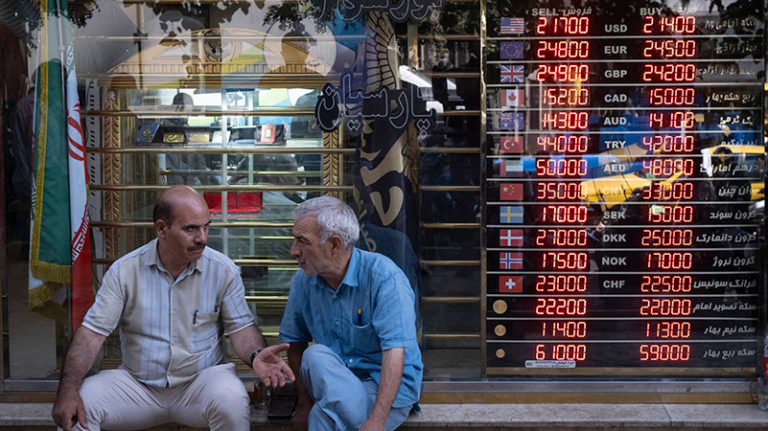
Photo by MORTEZA NIKOUBAZL / NURPHOTO / NURPHOTO VIA AFP