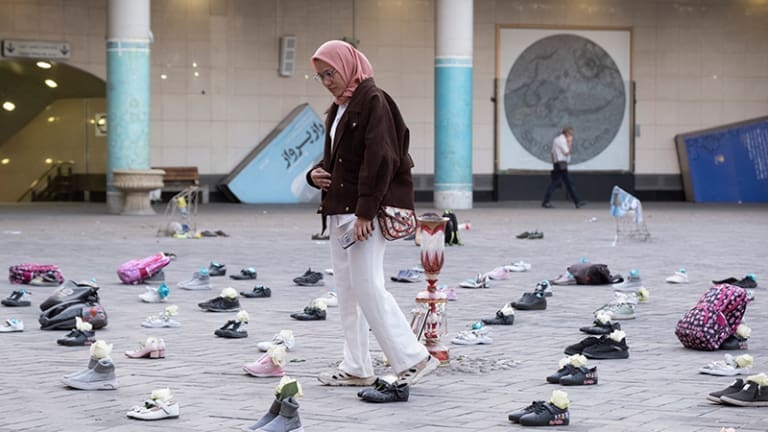
For the hundreds of children that attended the Shajareh Tayyebeh Elementary School in Minab, Iran, Saturday, February 28, 2026, probably began like any other day. But on that morning, shortly after the students’ parents dropped them off, the school hurriedly decided to close due to reports that the United States and Israel were launching strikes against Iran. Families were contacted to return and pick up their children, but it was too late. At some point between 10:23 am and 10:45 am, an airstrike hit the school. At least 150 people—most of them children between the ages of 7 and 12, as well as 26 teachers—were killed.
US President Donald Trump initially claimed that the attack was “done by Iran,” despite the use of a Tomahawk missile, a weapon that is inaccessible to Iran’s military. According to media reports, the Pentagon’s initial review of the incident found that the United States likely was responsible for the strike, due to a mistake caused by outdated targeting information. UNESCO called the attack “a grave violation of humanitarian law.” Despite the Pentagon’s reported preliminary finding of US responsibility, the Trump administration has blamed Iran, claiming that the regime was “using innocent Iranian civilians as human shields.” The strike, about which the Pentagon has still not released any basic information, stands as the deadliest civilian attack of the ongoing war.
The attack on the school, however, was hardly unique. Reports indicate that, by mid-May 2026, US bombings had destroyed 22 schools and 17 healthcare facilities in Iran and had killed more than 1,700 civilians. These attacks seemed in line with Trump’s threat to bomb Iran “back to the stone ages,” and with Secretary of Defense Pete Hegseth’s call for the US military to engage with “maximum lethality, not tepid legality.”
US media coverage of the war has focused largely on President Trump’s bombastic and contradictory pronouncements, as well as the war’s impact on the cost of living for Americans. What is less commonly recognized is the significant toll that the war has taken on ordinary people living in Iran. As talk of more ceasefire negotiations continues, it is vital to reflect on exactly how this war has affected humanitarian conditions for Iranian civilians.
Layers of Humanitarian Struggles
Well before the 2026 war, Iran was facing several intersecting humanitarian challenges, many of which have resulted from or been exacerbated by international sanctions. Washington first imposed sanctions on Iran in 1979, after revolutionary students took diplomats hostage at the US Embassy in Tehran, and five years later designated Iran a state sponsor of terrorism. The US sanctions regime intensified as the decades continued. In 2007, the UN Security Council adopted sanctions, and the European Union introduced its own sanctions in 2010. In 2015-16, some sanctions were temporarily lifted under the Joint Comprehensive Plan of Action (JCPOA) deal with Iran, reached by the Barack Obama administration and five other countries, which sought to restrain Iran’s nuclear capabilities in exchange for sanctions relief. President Trump withdrew the United States from the JCPOA in 2018, however, after which US sanctions, and then UN sanctions, were reimposed.
Decades of harsh sanctions have left Iran’s economy weak and unstable, with high inflation, low wages, and a currency that has lost much of its value. Although the sanctions sought to target Iran’s banking sector, oil exports, and international trade, they also delayed and sometimes completely halted the import of goods and services intended for humanitarian purposes, leading to shortages of medicine and medical equipment, among other items. Sanctions also prevented the import of raw materials that Iran needed to produce its own pharmaceuticals and medical supplies.
Sanctions typically affect the most vulnerable civilians among the targeted population, while the elites rarely suffer in the same way.
Evidence from other sanctions regimes imposed on countries such as Cuba, Libya, and Iraq shows that, while the sanctions’ stated objective of forcing regime behavior change is almost never met, the humanitarian consequences are always widespread. Sanctions typically affect the most vulnerable civilians among the targeted population, while the elites who make decisions about politics and control the economy rarely suffer in the same way.
Iran’s economic difficulties mean that even before this war, many families were struggling to afford food, rent, medical care, and other essentials. National per capita income fell from $8,000 in 2012 to $5,000 in 2024. Although poverty declined after 2020, following an increase in prior years, before the war between 35 and 40 percent of Iran’s citizens were close to poverty (living on less than $10 a day). Iran also has long hosted millions of refugees, especially from nearby Afghanistan, who lived in poverty amid harassment and scapegoating by the Iranian government. In 2025, Iran forced hundreds of thousands of these refugees to return to Afghanistan.
Despite these challenges, Iran has made significant strides in literacy and education in recent decades, including among women. Yet the country’s unemployment rate is very high—and women’s participation in the labor force is only 17 percent. Although sanctions and corruption undoubtedly play a role in the weak economy, a deeply rooted patriarchal culture also limits women’s rights. Iranian women face inequitable norms in the household and workplace, as well as discriminatory laws and limited protections against harassment, wage theft, and other abuse. In 2022, the “Woman, Life, Freedom” movement sprang up after the murder of Mahsa Amini, an Iranian-Kurdish woman arrested by Iran’s ‘morality’ police who was abused in custody and died from her injuries. Iranian forces responded ruthlessly to the uprising, killing hundreds of protestors.
On December 28, 2025, Iranians took to the streets again to protest the dire economic conditions and the lack of human rights. State security agents forcefully quelled the massive three-week-long uprising, shooting at protestors and injuring and killing thousands—possibly tens of thousands. On January 8, 2026, the Iranian government restricted internet access across the country to thwart Iranians from getting information out about the extreme crackdown. Reports indicate that the authorities only began restoring service in late May 2026.
For all these reasons, the people of Iran have been squeezed from all directions for decades. Prior to the 2026 war, living standards were already sharply declining, public frustration was high, and the state was struggling to manage inflation, unemployment, and political dissent. The war has only intensified these vulnerabilities, while creating a host of new problems.
Mortality, Injury, and Displacement
By mid-April 2026, a human rights group estimated that nearly 1,700 civilians in Iran, including at least 254 children (out of a total of some 3,400 people), had been killed in the war so far. As of June 1, 2026, a reported 25,000 people had been injured, including some 4,000 women and 1,600 children. Most of these injuries were reportedly the result of airstrikes and their effects, including shrapnel wounds, falling debris, blast-related trauma, and collapsing structures. The country’s already inadequate health system and the wartime bombing of health facilities mean that the resources to treat the injured are very thinly stretched.
Large numbers of civilians have fled airstrikes and vulnerable areas. Just weeks after the war started, the UN refugee agency UNHCR estimated that 3.2 million Iranians had been internally displaced, most from urban areas.
The war has propelled numerous refugee populations in Iran, including Afghans, into even greater precarity. Many tried to leave Iran when the war began, despite the difficult conditions in their home countries. As the war has enveloped the Middle East, other countries are being affected, including in Lebanon, where Israeli violence has displaced about 20 percent of the population since March 2026. With nearly 18 million people already forcibly displaced across the Middle East before this war, adding millions more worsens the region’s already horrifying humanitarian challenges.
Potential Food Shortages
Modern Iran has a long history of drought, famine, and war. After the 1979 Revolution, self-sufficiency in food, meant to be achieved through the nation’s own agricultural output, became a priority, with the goal even enshrined in the Islamic Republic’s new constitution. However, corruption and inefficiencies in agricultural subsidies, unsustainable water and land maintenance practices (an estimated 92 percent of the nation’s water output is used for agricultural irrigation), and increased dependency on food imports, especially for staples like wheat, rice, and corn, has meant that the modest increase in domestic food production since 1979 has not been enough to meet the demands of a rapidly growing population.
Across Iran, inflation, food waste, extreme weather (often related to climate change), and sanctions have meant that overall food insecurity has increased, with more people on the cusp of lacking sufficient food. The prices of basic food items such as rice, lentils, and vegetable oil were already rising sharply prior to the war; in September 2025, Iran reported a 42 percent increase in retail food prices over the previous year. While there has not been new data on food insecurity in Iran since the war began, recent media reports suggest that more families are struggling to afford food.
Destruction of Civilian Infrastructure
Among the main factors driving Iran’s current humanitarian challenges is the widescale destruction of civilian infrastructure by US and Israeli airstrikes. The United States says that it has hit more than 13,000 targets since February 28, 2026, while Israel says that it has dropped at least 18,000 bombs. Although these attacks purportedly targeted arms production facilities, warships, air defense systems, and other military sites, civilian infrastructure was often damaged or destroyed in the process.
Among the main factors driving Iran’s current humanitarian challenges is the widescale destruction of civilian infrastructure by US and Israeli airstrikes.
The World Health Organization reports that Iran’s health sector has suffered significant damage, with at least 48 hospitals, 218 other health facilities, and 41 ambulances affected. At least eight hospitals were evacuated due to risk of attack. Airstrikes have damaged pharmaceutical manufacturers, such as Tehran’s Tofigh Daru facility, which produced cancer treatment drugs and was directly hit by a missile. With Iran’s limited ability to import pharmaceuticals, especially the expensive ones needed for treatment of ailments like cancer, many patients will be left with no treatment options. The 106-year-old Pasteur Institute, Iran’s oldest public health institution, which provides critical services including vaccine production, disease surveillance, and public health research, was also bombed, causing irreparable ruin to laboratories and samples.
While reporting from within Iran has been limited due to the internet blackout, satellite imagery and intermittent reports from Iranian human rights groups and individuals show other civilian infrastructure that has been damaged, including a vital desalination plant, fuel depots, oil refineries, electricity networks, sports centers, and numerous cultural heritage sites such as Golestan Palace in Tehran (a UNESCO World Heritage Site).
Internal and External Forces Push Iran’s Civilians to the Brink
The humanitarian consequences of the US-Israeli war on Iran should not be understood as isolated incidents of collateral damage, but as the culmination of decades of economic strangulation, authoritarian rule, and military destruction. Even before the 2026 war, Iranian civilians were already burdened by sanctions, inflation, repression, and declining living standards; the conflict has transformed those vulnerabilities into real hazards.
Since the war started, we have seen children killed in their classrooms, hospitals rendered inoperable, millions displaced from their homes, and growing risks of hunger and the collapse of the health system. This impact will likely create a humanitarian crisis that will persist even if a durable ceasefire deal is struck. While Western leaders frame the war through the language of geopolitics, the lived reality for ordinary Iranians has been one of fear, loss, displacement, and survival, due to threats from both the regime under which they live and the countries that seek to punish that regime at seemingly any cost. Any serious discussion of ceasefire or peace negotiations must move beyond military calculations and confront the immense human cost already inflicted on civilians in Iran.
The views expressed in this publication are the author’s own and do not necessarily reflect the position of Arab Center Washington DC, its staff, or its Board of Directors.
Featured image credit: Photo by MORTEZA NIKOUBAZL / NURPHOTO / NURPHOTO VIA AFP