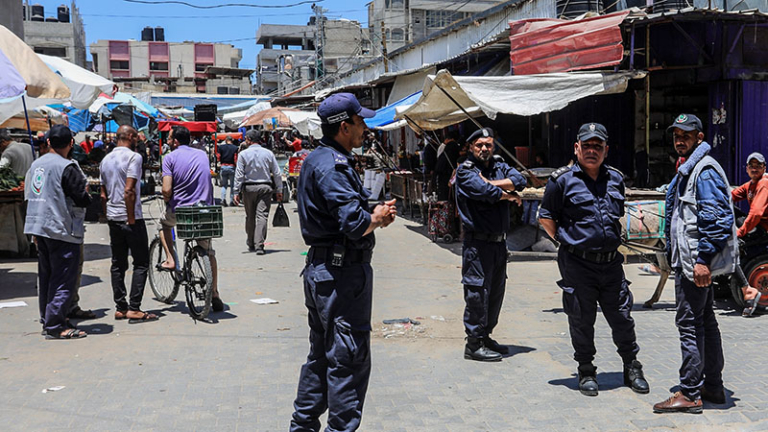
On July 6, 2026, Hamas’s Gaza government announced that it had dissolved its Emergency Committee, the body that has run the enclave since October 2023, and would fully transfer its administrative authority to the National Committee for the Administration of Gaza (NCAG). The NCAG was established in January 2026 under the Board of Peace (BoP) mandate. It consists of 15 unelected Palestinian technocrats chaired by Ali Shaath, and reports directly to the BoP director-general, Nikolay Mladenov. Despite months of preparation, NCAG members have remained unable to enter Gaza, amid Israeli objections to its deployment. Hamas’s Government Media Office said the handover had already been presented to Palestinian factions, clan leaders, and a UN observer, and that only technical staff would remain in place in the interim, calling the move “a new step . . . to remove any pretexts for the occupation.”
The dissolution of its government is in part a maneuver to relieve pressure on Hamas. By conceding ground on day-to-day administration—which it was already struggling to maintain under Israeli restrictions covering more than half of Gaza—Hamas can argue that it has complied with its obligation to hand over governance to NCAG laid down in President Trump’s 20-point peace plan of September 2025.
Hamas’s move comes amid recent pressure from BoP Director General Mladenov, who has consistently blamed the party for the lack of progress in Gaza, more than Israel’s ongoing ceasefire violations or its steady encroachment further into the Strip. Mladenov has insisted, in agreement with the Israeli position, that the disarmament of Hamas must come as a first step in the transition, not the last. Hamas rejects this sequencing, pointing to other post-conflict transitions, among them that of Northern Ireland, where decommissioning followed political guarantees rather than preceding them. Furthermore, the original plan did not make disarmament the first step of continued negotiations, but stated that: “There will be a process of demilitarization of Gaza under the supervision of independent monitors, which will include placing weapons permanently beyond use through an agreed process of decommissioning.”
More than 1,000 Palestinians in Gaza have been killed since the ceasefire was announced.
However, even if Hamas succeeds in shifting that burden, the more durable problem is not the sequencing of disarmament. The Board of Peace itself remains the issue. As previous analysis of the Board’s design has argued, it is an organization that functions to manage conflict rather than resolve it, through the continuation of violence. More than 1,000 Palestinians in Gaza have been killed since the ceasefire was announced. The BoP effectively provides cover for Israel’s continued expansion into and control of Gaza, while the actual demand underlying the conflict—Palestinian self-determination—goes unaddressed.
Examining the Board’s structure shows its failure to address Palestinian aspirations. Palestinians have no representation on the Board, while Israeli Prime Minister Benjamin Netanyahu is a member despite facing an ICC arrest warrant for war crimes and crimes against humanity. The NCAG answers to the Board’s director-general, not to any Palestinian constituency. A permanent Board seat costs $1 billion, a price tag that has drawn in Viktor Orban and Vladimir Putin. The Board’s six-page charter mentions neither Gaza nor human rights, an odd omission for a body created to govern Gaza’s reconstruction, though a less odd one once you register its stated ambition to serve as a template for conflicts well beyond it. The Gaza Executive Board, a smaller body appointed by the main Board, includes the likes of Tony Blair, but again does not include Palestinians.
The Board’s vision of reconstructing Gaza follows commercial logic. In January 2026, Jared Kushner presented the Trump administration’s Gaza “master plan” in Davos, describing a coastline of new towers, industrial parks, and a projected path to $10 billion in GDP by 2035. His vision was closer to a real-estate pitch than a governance plan—one drawn up, as critics have noted, without consulting Palestinians actually living in Gaza. Furthermore, the master plan misidentifies economic underdevelopment as the source of the conflict, not Israel’s continued occupation and ethnic cleansing.
Mladenov’s appointment as director-general is itself revealing. He served as Bulgaria’s foreign minister under a government later toppled by mass anti-corruption protests. Since 2021, he has run an Emirati diplomatic academy where he has become an outspoken champion of the Abraham Accords—a framework many Palestinians view as having formalized their exclusion from any path to statehood.
What is missing is neutral mediation and buy-in from all parties.
What is missing from the entire premise of the BoP is arguably the most fundamental principle of successful conflict resolution: neutral mediation and buy-in from all parties. Absent those factors, Palestinian factions and the Palestinian Authority can offer only muted, at times self-interested responses to the Board’s mission, while ordinary Gazans remain exhausted and unconvinced that anything on the ground has changed. Hamas’s July 2026 announcement should be read in that context.
Even if Hamas’s decision to dissolve its government in Gaza buys it short-term tactical leverage, the Board’s lukewarm response suggests that it may have limited consequences. The Board responded that it had “taken note” of the announcement, but that its assessment “will be guided by actions, not promises,” and that any transition must still see “the consolidation of all weapons under the control of the NCAG.”
More importantly, these developments do nothing to resolve what the BoP actually is: a US-designed architecture for managing Palestinians, not one for facilitating their self-determination. Until that architecture changes, every procedural step that follows—Hamas’s included—will remain trapped within it.
The views expressed in this publication are the author’s own and do not necessarily reflect the position of Arab Center Washington DC, its staff, or its Board of Directors.
Featured image credit: Anas-Mohammed via Shutterstock