
In early May 2026, Saudi Arabia’s Ministry of Finance disclosed that the Kingdom had registered a first-quarter budget deficit of 125.7 billion Saudi riyals (SAR), equivalent to roughly $33.5 billion, its largest quarterly shortfall in nearly eight years and a figure that itself exceeded the entire annual deficit that officials had projected only five months earlier. The International Monetary Fund and World Bank both downgraded their growth projections for the Kingdom in the wake of the shock from the Iran war, although they emphasized that Saudi Arabia continues to absorb the disruption better than most of its Gulf neighbors.
The deficit headline, however, is less a story about a single quarter than a snapshot of a regional order in disintegration. Maritime traffic through the Strait of Hormuz, through which roughly one-fifth of global seaborne oil supply normally transits, has been at a near-standstill for more than two months following Iran’s effective closure of the chokepoint in retaliation for US and Israeli strikes launched on February 28, 2026. If the war continues into the second financial quarter and if Hormuz remains shut, the fiscal picture will deteriorate further. The conflict has unraveled the basic premise on which Saudi foreign policy has rested for the past five years.
Since 2021, Saudi regional posture has been organized around a logic of de-escalation in service of economic transformation. Riyadh froze its expeditionary campaign in Yemen in March 2022, signed a Chinese-brokered détente with Iran in March 2023, and built a vast diplomatic edifice premised on the assumption that the Gulf could be insulated from the wars consuming the Levant. The kingdom’s Vision 2030 required, above all, an environment in which foreign capital, tourists, and skilled labor could flow into Saudi Arabia without anxiety about regional explosion. That premise has now collapsed. Saudi Arabia finds itself in the center of a storm not of its choosing (at least not entirely), and its choices in confronting that storm are narrow and costly.
Saudi Arabia at War
The most striking feature of the Saudi posture during the current Iran war is the visible gap between Riyadh’s official discourse and media reporting on its private behavior. In the weeks before the war began, the Washington Post reported that President Donald Trump’s decision to launch a wide-ranging attack on Iran followed weeks of private lobbying by what the report described as an unusual pair of US allies: Israel and Saudi Arabia. According to the report, Crown Prince Mohammed bin Salman had placed multiple private calls to Trump over the preceding month to advocate military action, even as Riyadh publicly emphasized diplomacy and a commitment to de-escalation. The New York Times subsequently reported that the Crown Prince has remained in regular contact with Trump throughout the war, urging continued military pressure on Tehran and warning against any agreement that would leave the Iranian government and its missile programs substantively intact.
This advocacy, if accurately reported, can be read in several ways. The simplest reading is that the rapprochement between Riyadh and Tehran signed in Beijing in 2023 never overcame the underlying structural antagonism between the two countries. The Chinese-brokered agreement bought time and lowered the political temperature, but it did not redistribute regional power. By early 2026, with Iran’s allies in the Levant—Hezbollah and Bashar al-Assad’s regime—battered or collapsed in the preceding two years, Saudi Arabia appears to have calculated that the moment was opportune for more decisive US action against the Islamic Republic that could reshape the regional balance for a generation. A second, more strategic reading is that Riyadh perceived an opportunity to fill the vacuum left by Iranian retrenchment in Syria and Lebanon, where Saudi diplomacy and capital have already begun to reassert themselves in the post-Assad era. A weakened Tehran offers Riyadh enhanced influence at lower cost.
The rapprochement between Riyadh and Tehran signed in Beijing in 2023 never overcame the underlying structural antagonism between the two countries.
Yet this private lobbying has coexisted with an official Saudi discourse that has been consistently de-escalatory in tone. Ministry of Foreign Affairs statements have called for restraint, have urged a return to negotiations, and have emphasized the Kingdom’s commitment to regional stability. Reports that Saudi Arabia and Kuwait had recently granted the US military access to bases and airspace for the operation against Iran were denied by Saudi officials, who told Al-Arabiya Television in early May 2026 that “[t]he Kingdom did not allow the use of its airspace to support offensive military operations” and complained that some parties are “trying to give a misleading image of Saudi Arabia’s position.”
Bridging these two pictures, private hawkishness and public restraint, are unconfirmed reports of direct, and unpublicized, Saudi military action against Iran. In mid-May 2026, Reuters, citing two Western and two Iranian officials, reported that the Royal Saudi Air Force conducted multiple unpublicized strikes on Iranian territory in late March 2026, in retaliation for Iranian strikes on the kingdom. Another report claimed that Saudi Arabia bombed pro-Iranian Iraqi militias in April 2026, in response to their targeting of Saudi territory with drones. These strikes, if confirmed, would mark the first time in history that Saudi Arabia is known to have conducted direct military operations on Iranian territory.
The choices facing Riyadh in this configuration are constrained on every axis. The April 8, 2026, ceasefire between Washington and Tehran has not held cleanly and the two sides have continued to trade fire across the Strait of Hormuz. A return to full-scale hostilities is a present possibility, not a distant risk. Should Iranian missiles strike Saudi territory at scale once more, Riyadh would face a choice between two damaging paths: visible Iranian retaliation that would draw Saudi Arabia more deeply into a war its economy cannot easily afford, or Saudi restraint that would expose the limits of its deterrence and embolden further Iranian targeting.
Compounding this dilemma is the kingdom’s open rupture with the United Arab Emirates (UAE). Saudi–Emirati frictions had built up gradually over recent years, a result of diverging approaches to Yemen, to the war in Sudan (where Riyadh backs the army and Abu Dhabi backs the Rapid Support Forces), and to the recognition of Somaliland. The war has accelerated rather than masked this rivalry. Abu Dhabi has adopted a posture closer to that of Washington and Tel Aviv than of its Gulf neighbors and reportedly has carried out its own covert strikes against Iranian infrastructure during the war. Most consequentially, on April 28, 2026, the UAE announced its withdrawal from OPEC and OPEC+, a decision that strips the cartel of its third-largest producer and undermines Riyadh’s ability to use the organization as an instrument of oil price discipline. The withdrawal is the latest manifestation of an underlying structural rift, rather than an episodic one, with Yemen and Sudan continuing as the hottest theaters of indirect Saudi–Emirati confrontation. Saudi officials have come to view the Emirati posture as an attempt to displace Riyadh as the leading Arab power, and Riyadh now suspects Abu Dhabi of seeking to leave the Gulf Cooperation Council itself.
The Economic Reset
For Saudi Arabia, the Iran war has accelerated an economic reset that was already underway. The kingdom’s first-quarter deficit was financed entirely through debt issuance, without drawing on its reserves of approximately $107 billion, in line with the Ministry of Finance’s medium-term strategy of preserving buffers while maintaining counter-cyclical spending. Total public debt reached SAR 1.67 trillion (roughly $445 billion) at the end of the first quarter, with the debt-to-GDP ratio still modest by international standards at around 33 percent. Saudi Arabia, in short, retains substantial fiscal room, but the trajectory is unmistakable, and the second-quarter results are expected to be considerably worse if the Strait of Hormuz remains effectively closed.
The pressure has translated most visibly into a recalibration of the Kingdom’s signature mega-projects. In mid-April 2026, the Public Investment Fund (PIF) announced its 2026–2030 strategy, which restructures the giga-project portfolio into six ecosystem pillars and effectively detaches NEOM, the planned massive new region in northwest Saudi Arabia, from the kingdom’s short-term tourism agenda. PIF Governor Yasir Al-Rumayyan stated that completion of The Line, another hugely ambitious new city, by 2030 is “good to have, but it’s not a must-have.” In March 2026, large contracts for tunneling work essential to The Line and to the Trojena ski resort—the kingdom’s first alpine ski resort, to be located in NEOM—were canceled outright, and the 2029 Asian Winter Games slated to take place in Trojena were postponed indefinitely. The Financial Times reported that in 2025 the PIF cut its planned investment in domestic mega-projects, including NEOM, by approximately $8 billion.
Discretionary external commitments have likewise come under the knife. On April 30, 2026, the PIF confirmed that it would terminate its funding of LIV Golf at the end of the 2026 season, after having invested more than $5 billion in the breakaway league since the investment fund launched it in 2022. Other discretionary commitments have followed a similar pattern of downsizing or cancellation.
The Red Sea has emerged, by necessity, as the main alternative to the Strait of Hormuz.
The logic of these cuts is straightforward. Compensation for the kingdom’s public-sector employees consumed roughly 41.8 percent of total government spending in the second quarter of 2025, according to Ministry of Finance data, the largest expenditure category, well ahead of goods and services or capital expenditures. The Saudi government is deeply reluctant to compress that wage bill, which directly underwrites the consumption of millions of Saudi families and constitutes one of the principal mechanisms through which oil wealth is redistributed to citizens. To do otherwise would risk severe social repercussions in the country. Scaling back megaproject expenditure, by contrast, imposes politically diffuse costs that fall primarily on contractors, foreign consultants, and the abstract category of “future ambition”—a much more attractive bill to pay in a fiscal crunch.
On the oil export front, the Red Sea has emerged, by necessity, as the main alternative to the Strait of Hormuz. Aramco’s East-West Pipeline now runs at its maximum capacity of approximately 7 million barrels per day, transferring crude from the Eastern Province fields to the Yanbu terminal on the Red Sea coast. This rerouting has allowed Aramco to post a 25 percent jump in first-quarter profits over the comparable period in 2025, a remarkable figure given the magnitude of the wartime disruption. Yet the Red Sea is no equivalent to Hormuz. Aramco’s normal output is closer to 11–12 million barrels per day, and Asia—principally China, India, Japan, and South Korea—accounts for more than three quarters of the Kingdom’s crude exports, with the longer voyage around the Arabian Peninsula imposing additional costs and time. Furthermore, the Red Sea route is itself contingent on the willingness of Yemen’s Houthi movement to refrain from attacking Saudi-flagged tankers transiting the Bab al-Mandab Strait.
That willingness is conditional and reversible. The Houthis entered the Iran war on March 28, 2026, with ballistic missile strikes on Israel and have warned repeatedly that they will close the Bab al-Mandab if the war on Iran escalates sharply or if Gulf Arab states openly join the conflict. One analysis has estimated that 70 to 75 percent of Yanbu’s exports are directly exposed to potential Houthi disruption, and that simultaneous closure of Hormuz and Bab al-Mandab would place roughly $10 billion per day of global trade at risk and threaten approximately 22 percent of global oil supply.
For Riyadh, this risk is a structural constraint on any temptation to participate openly in the war, since visible Saudi military involvement could be the trigger that activates the Houthi card.
The Kingdom’s Security Partnerships
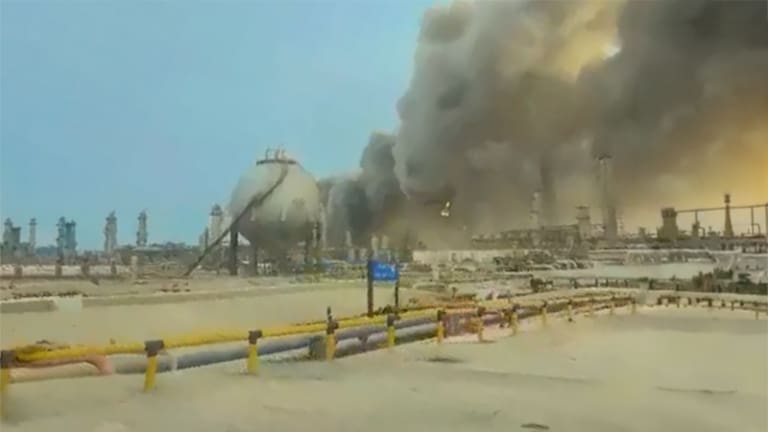
An additional dimension of Saudi concerns is the kingdom’s own security architecture. Official Saudi discourse has consistently sought to reassure the public that the Kingdom’s air-defense systems are capable of repelling Iranian attacks, and the Ministry of Defense has dutifully reported the interception of incoming drones and missiles on a near-daily basis since the first day of the war. However, the Ministry of Defense claimed that it intercepted nearly 900 aerial threats between March 3 and April 5, 2026. Strikes by Iranian and Iraqi factions have damaged the Aramco refinery at Ras Tanura, have struck the SAMREF refinery at Yanbu, and have damaged or have destroyed several American aircraft at Prince Sultan Air Base, including a Boeing E-3 Sentry and at least one KC-135 Strat tanker, while wounding several US servicemembers.
These developments have prompted considerable Saudi unease about the value of the long-standing US security partnership. Iranian capabilities, including drone and ballistic-missile swarms, have routinely penetrated the US-led air-defense umbrella around the kingdom, and Patriot interceptor stocks have run perilously low during periods of intense bombardment. Yet Riyadh is unlikely to abandon the partnership, for the obvious reason that no realistic alternative protector exists. What the war has achieved is to accelerate a long-standing diversification of Saudi security partnerships rather than substitute for the relationship with Washington.
Developments have prompted considerable Saudi unease about the value of the long-standing US security partnership.
The most consequential diversification has been with Pakistan. On April 11, 2026, the Saudi Ministry of Defense announced the arrival of Pakistani military forces at King Abdulaziz Air Base in Dhahran, in the first formal activation of the Saudi–Pakistani Strategic Mutual Defense Agreement signed in September 2025. Reporting on the deployment has cited figures of up to 13,000 Pakistani troops and a contingent of Pakistan Air Force fighter and support aircraft, making this the largest Pakistani military reinforcement of Saudi Arabia since the 1991 Gulf war.
Meanwhile, Ukraine has emerged as a technical defense partner. On March 27, 2026, in Jeddah, Ukrainian President Volodymyr Zelenskyy signed a ten-year defense cooperation agreement with Crown Prince Mohammed bin Salman, drawing explicitly on Ukrainian expertise in countering Iranian-designed Shahed-136 drones, which Russia has used extensively against Ukrainian cities since 2022. Ukraine reportedly has dispatched more than 200 anti-drone specialists to Saudi Arabia, Qatar, and the UAE under what Kyiv has marketed as a “Drone Deal.” The arrangement is mutually instrumental.
In addition, Greek forces, present in Saudi Arabia under a 2021 bilateral agreement to defend Aramco infrastructure from Houthi attacks, have surfaced in operational terms during the war. On March 19, 2026, a Greek-operated Patriot PAC-3 battery deployed at Yanbu intercepted two Iranian ballistic missiles targeting the SAMREF refinery, marking the first announced combat engagement by the Hellenic Force in Saudi Arabia since the mission’s inception.
Each of these arrangements is partial. None replaces the US security umbrella, which alone provides the scale, carrier strike groups, and air defense capabilities that Saudi Arabia ultimately depends upon. What diversification represents is a hedge against the evident permeability of that umbrella—an acknowledgment, hard-won during 10 weeks of war, that even the most expensive American-provided systems have not fully insulated Saudi Arabia from missile and drone attacks.
Conclusion
The contradictions of Saudi Arabia’s posture during this war are sustainable so long as the conflict remains in its current ambiguous phase, neither fully concluded nor fully resumed. They become considerably less so under either of the two trajectories that now appear most plausible. If the United States chooses escalation, reactivating in some form Project Freedom, the short-lived US operation to escort some commercial shipping through Hormuz, striking Iranian infrastructure beyond the limits of the April 8, 2026, ceasefire, or pursuing the regime-change objective that some in Washington and Tel Aviv continue to press, Riyadh likely will face a renewed cycle of Iranian retaliation that its air defenses cannot fully repel, the prospect of Houthi action against Red Sea shipping, and the difficult choice of whether to retaliate openly against Tehran. In such a scenario, Saudi Arabia’s second-quarter deficit could substantially exceed the first quarter’s $33.5 billion, and the cumulative deferral of Vision 2030 projects could reach a point at which the kingdom’s strategic narrative around economic transformation becomes politically unsustainable.
Conversely, if Washington chooses a settlement to end the war, then Riyadh will recover its economic horizon—but at the cost of accepting a regional order in which Iran not only retains its influence but expands it through the control of Hormuz. Neither outcome is fully congenial to the Saudi leadership, and neither lies within its power to determine.
Even a return to the status quo ante of January 2026 will not restore the perception of the Gulf as a safe harbor for global capital and tourism. Hormuz has been closed once, and investors will price the next closure into every long-term commitment to the region.
The views expressed in this publication are the author’s own and do not necessarily reflect the position of Arab Center Washington DC, its staff, or its Board of Directors.
Featured image credit: screencap via X