
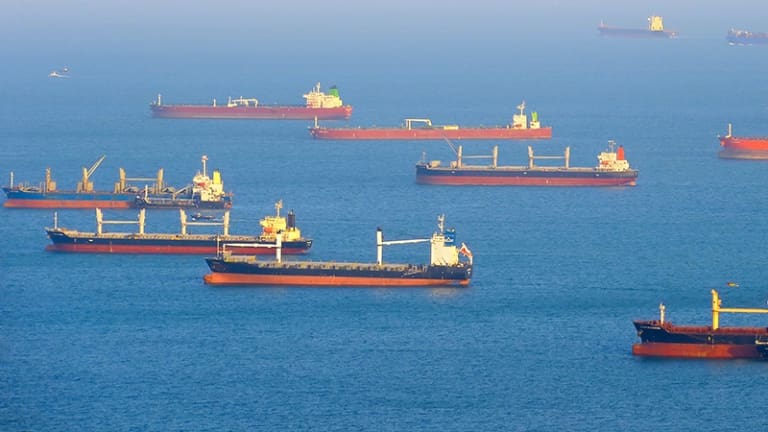
Iran has managed to convert its proximity to the Strait of Hormuz into a strategic deterrent. By blocking maritime trade, Iran has demonstrated that it can imperil the global economy with minimum effort. If the Iranian regime survives the current war, adversaries will think twice before triggering another closure of the world’s most important energy passage.
Tehran’s opportunity to leverage its control of Hormuz to deter attacks, however, is likely to be short-lived. Wars are a primary driver of oil logistics diversification, and the Arab Gulf states are already seeking to build alternative export pathways. A decade from now, the strategic landscape of the Persian Gulf will look very different, with new pipelines, rail linkages, and port infrastructure that offer workarounds for trade entering or exiting the Strait. These multiple options provide a form of insurance against future Strait closures—viable escape routes on a scale that is sorely missing from the Gulf today. Over time, the critical nature of transit via the Strait of Hormuz will likely decline, along with the associated risks to the global economy.
Nevertheless, even in the most optimistic scenarios, pipeline and rail workarounds cannot entirely substitute for an open Strait. Few alternatives are possible for liquefied natural gas (LNG) exports, which means Gulf Arab economies will likely retain some exposure to a future blockage of Hormuz. Further, newly built bypass infrastructure will remain vulnerable to attack. Paradoxically, building workarounds might even encourage future conflict with Iran because alternative trade options reduce the risks to the global economy from another Hormuz blockade. Once the bypasses are in place, going back to war with Iran could become less painful and therefore more likely.
Infrastructure as Insurance
For a region that serves as the world’s energy resource hinterland, the pipeline network on the Arabian Peninsula is surprisingly sparse. It consists mainly of large-diameter pipelines from oilfields to processing centers where impurities are removed and gases separated before transporting fuel to export terminals or refineries. Gulf pipelines can carry huge amounts of oil, gas, and derivatives, but the overall network lacks the density needed to allow operators to shift oil or gas through alternative routes when one is blocked.
By comparison, the ultra-high density pipeline network in the south-central United States facilitates redundant flows in many directions and offers numerous workarounds in the event of an outage. The United States produces around 13.5 million barrels of oil per day (b/d) and in 2025 operated more than 365,000 kilometers of pipelines for crude oil and natural gas liquids. In contrast, Saudi Arabia, which has a production capacity of 12.2 million b/d, operates a network of around 6,200 km—less than two percent of the US network’s length. (The remaining five member states of the Gulf Cooperation Council (GCC) operate a combined network of roughly the same length as Saudi Arabia, at about 4,500 km). The disparity in natural gas transport infrastructure is just as pronounced. The United States has almost 350,000 km of gas pipelines, while Saudi Arabia has fewer than 6,000 km—equivalent to less than two percent of the length of the US network, even though the kingdom occupies an area equivalent to about 70 percent of the US landmass east of the Mississippi River.
The lack of alternative oil and gas transport in the Gulf region has proved economically disastrous for those countries without backup transport.
In 2026, only four operating crude oil pipelines existed to bypass the Strait of Hormuz. These four routes allowed Iran, Iraq, Saudi Arabia, and the United Arab Emirates (UAE) to export about 40-45 percent of the typical crude oil flows of 15 million barrels per day (m b/d) through the Strait. The remaining 8 to 9 m b/d—representing the full oil export capacity of Bahrain, Kuwait, and Qatar, along with most of Iraq’s and some Saudi, Emirati, and Iranian volumes—was stranded. This volume amounted to about 10 percent of global oil consumption.
Figure 1. Oil- and Gas-Producing Countries in the Middle East and Transit Pipelines
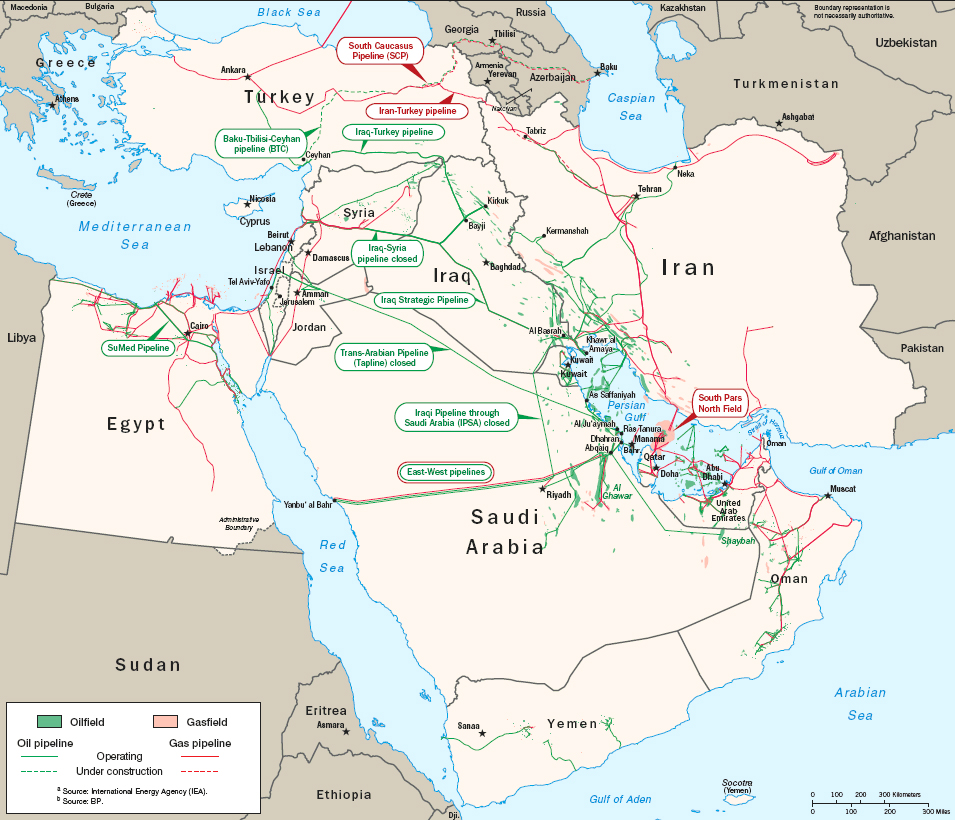 Source: US Energy Information Administration (EIA)
The lack of alternative oil and gas transport in the Gulf region has proved economically disastrous for those countries without backup transport—and for their customers—while allowing Iran to pressure the United States and Israel to end their military campaign. Given the profitability and necessity of energy exports from the Gulf, and the compounding losses from interruptions, the Iran war has injected new urgency into building alternative pipeline routes across the Arabian Peninsula.
Rail as a Strategic Bypass
The Gulf Arab states also have begun to expand the Peninsula’s modest rail network, although some proposals remain in the planning stages. Expanded rail transport would reduce reliance on maritime transport through the Straits of Hormuz and Bab al-Mandab, which is especially important for food imports, industrial goods, and dry bulk commodities. If completed, these networks could move commodities from all six GCC states to ports on the southern and western coasts of the peninsula, where they would connect to global logistics chains.
The most ambitious of these projects is the GCC Railway, an expansion of the UAE’s recently opened Etihad Rail project. Etihad Rail is already moving freight and is expected to begin passenger services in 2026. The expanded GCC Railway route would connect all six Gulf monarchies, from Kuwait City in the north, through Saudi Arabia’s Eastern Province and the UAE to a terminus in Oman, with branches extending to Qatar and Bahrain.
Linking with the GCC Railway is the proposed Saudi Landbridge Railway, which aims to extend the longstanding Dammam-to-Riyadh rail corridor all the way to Jeddah on the Red Sea. Meanwhile, the Hafeet Rail project seeks to connect the Omani port of Sohar—located outside the Strait of Hormuz on the Gulf of Oman—with Abu Dhabi. It was 40 percent complete in April 2026.
LNG and the Limits of Bypass Infrastructure
There are fewer options for Hormuz workarounds for natural gas. The tens of billions of dollars invested in gas liquefaction in Qatar—and to a lesser extent in the UAE—have been sunk into fixed infrastructure that cannot be picked up and moved outside the Strait. Iran’s leverage from controlling Hormuz might be weakened by the construction of new oil pipelines, but the scale and difficulty of building new LNG export terminals means that Iran may retain some of its current influence over parts of the energy trade.
When the Iran war broke out on February 28, 2026, Qatar was already seeking to expand its LNG export capacity from 77 million metric tons per annum (MTPA) to 142 MTPA, an increase of 84 percent. The March 2026 Iranian attacks on Qatar’s Ras Laffan production facilities halted exports, destroyed existing capacity, and delayed the expansion that was underway. The result was huge damage to the Qatari economy. The strikes notably damaged Qatar’s gas-to-liquids operations (jointly owned by Shell) and demolished 12.8 MTPA of liquefaction capacity (jointly owned by Exxon Mobil). Repair will take years.
The enormous cost of building gas liquefaction plants makes it unlikely that Qatar would abandon or move its facilities from Ras Laffan, or that the UAE would do so with its plant on Das Island. In fact, the Abu Dhabi National Oil Company (ADNOC) had planned to build new liquefaction capacity at Fujairah, outside the Strait, but in 2023 decided against the added expense and opted for a plant at Ruwais inside the Gulf.
The immobile nature of gas liquefaction suggests that Iran will retain some leverage to threaten a future Hormuz closure. The LNG trade was under 10 percent of $650 billion oil and gas trade out of Hormuz in 2024, with Qatari LNG exports accounting for just under $50 billion. The loss of those exports—equal to about $4 billion per month—is intolerable for a country whose entire 2026 budget was just $60.5 billion.
The tens of billions of dollars invested in gas liquefaction have been sunk into fixed infrastructure that cannot be picked up and moved.
As a result, Doha could in theory seek to preserve, or perhaps even to strengthen, its long-running working relationship with Iran in the hope of reducing the likelihood that a future crisis will directly target or intentionally disrupt Qatari export flows. This relationship is underpinned by the fact that Qatar and Iran share the world’s largest natural gas field. Iran holds about a third of the reservoir, known on its side as South Pars, while Qatar controls about two-thirds, known as the North Field. A development agreement that facilitates joint Qatari–Iranian exports from this field has the potential to reduce infrastructure costs and to provide economies of scale. Rather than building stand-alone liquefaction capacity inside Iran, with the accompanying technology headaches and risk of sanctions and war, the Islamic Republic could simply finance undersea pipeline connections to Qatar, where LNG could be generated for a fee. This kind of connection between Iran and Qatar might render Doha’s exports and liquefaction facilities less susceptible to Iranian attack. Although the potential benefits of managing shared resources could incentivize future cooperation, in practice the lingering impact of Iran’s attacks on Qatar could outweigh any shared economic interests.
Gulf producers have also sought to hedge exposure to the Strait of Hormuz by investing in LNG capacity outside the region, including in the United States. Qatar has invested in LNG capacity in Texas through a joint venture with ExxonMobil, the Golden Pass LNG terminal. The April 2026 opening of this facility, with 18 MTPA capacity, provides another modest hedge against Doha’s Hormuz exposure. Likewise, UAE companies have increased their US gas investment, including in future LNG export terminals in Louisiana and Texas.
Oman also presents a further intriguing option for LNG. Although Omani gas reserves are modest, its liquefaction trains near Sur on the Arabian Sea—far outside Hormuz—offer an ideal location for further LNG capacity, although pipelines would be required to bring imported gas to the site. Here, too, Iran plausibly could become involved. Discussions in the early 2000s raised the possibility of subsea pipelines bringing Iranian gas to Oman for re-export, potentially making the Sultanate valuable as a potential Hormuz bypass as well as a re-export option for Iranian gas.
The Enduring Lesson of Hormuz
Iran has proved its ability to close the Strait of Hormuz far more easily, and with greater economic damage, than many observers had thought possible. Tehran’s blockade (to which Washington added its own in April 2026) has upended global economic wellbeing and has demonstrated the vital importance of the Gulf region as a resource hinterland for the global economy. Iran’s ability to leverage the closure as a deterrent against future strikes is a major challenge to US and Israeli war planning. The sheer magnitude of the ongoing disruptions also signifies the unacceptable risk of future closures. Supported by Washington, Gulf states are now developing workarounds to diminish their dependence on the Strait. As new networks of pipelines and railroads are built out, probably over the next decade, Iran’s ability to restrain its adversaries through the threat of maritime disruption will gradually weaken.
Nevertheless, Iran’s ability to target infrastructure will not be eliminated. LNG exports remain heavily dependent on fixed infrastructure inside the Gulf, while pipelines, ports, and rail corridors themselves create new targets for attack. Future conflicts in the Gulf may therefore be less economically catastrophic than the 2026 Hormuz crisis, but potentially more frequent and geographically dispersed. The lesson of Hormuz is likely to shape Gulf infrastructure planning long into the future.
The views expressed in this publication are the author’s own and do not necessarily reflect the position of Arab Center Washington DC, its staff, or its Board of Directors.
Featured image credit: joyfull via Shutterstock