In March 2026, a Gulf official told Reuters that three Gulf states were reviewing how to deploy their sovereign wealth fund (SWF) holdings to offset Iran war-related losses, which the United Nations estimates could approach almost $200 billion. The remark was a reminder of just how much is at stake. The six Gulf Cooperation Council (GCC) states manage roughly 11 SWFs in total that hold approximately $6 trillion in assets, accumulated largely through hydrocarbon surpluses, of which an estimated $2 trillion is invested in the United States alone. As the economic effects of the war’s closed shipping lanes and rising energy costs have begun to ripple outward, questions have mounted about what Gulf states will do with those investments—and whether they might withdraw capital from the United States as leverage against a Trump administration that helped draw them into the conflict.
But while GCC member states have built vast funds to serve as buffers against external shocks, it is unlikely that they will need to rapidly draw down from their US investments to do so. Their governments do not yet need the liquidity, and doing so would damage their own portfolios more than it would hurt Washington. Instead, the deeper problem lies elsewhere. Iran’s missile and drone attacks have put the ambitious development models of Gulf states, for which SWFs have been the primary engines, at risk. Meanwhile, the assumption that sovereign wealth translates into political leverage is largely misguided. Gulf states find themselves unable to divest without damaging their own portfolios, too integrated in the global economy to stand apart, and with fewer tools to shape the course of a war that they did not start. It appears that Gulf sovereign wealth is far better suited to weathering crises than to managing them, let alone to ending them.
Business as Usual?
With economic damage from the Iran war possibly surpassing that of the COVID-19 pandemic, governments in the region have already moved to stabilize their economies. Qatar’s central bank allowed borrowers to defer repayments for up to three months, the United Arab Emirates (UAE) rolled out a banking resilience package, and Dubai’s Crown Prince approved a $272 million relief fund for businesses affected by the war.
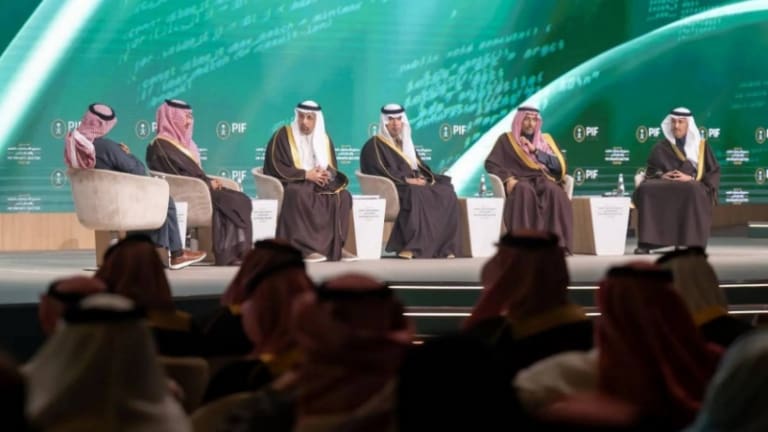
Yet Gulf governments have also gone out of their way to signal publicly that it is business as usual. In a Wall Street Journal op-ed, UAE Ambassador to Washington Yousef al-Otaiba argued unequivocally that the UAE is “committed to our investment plans in the [United States]. Our $1.4 trillion commitment is firm.” At Saudi Arabia’s March 2026 Future Investment Initiative in Miami, the governor of the Public Investment Fund (PIF) told investors that “the Saudi macroeconomic and fiscal position remains strong, stable, and resilient.” While such statements should not necessarily be taken at face value, there is little evidence to suggest that SWFs are turning away from global markets. As long-term investors, whatever damage they have endured to their portfolios will likely be better than disposing of their assets in a fire sale.
Although SWF disclosures remain notoriously opaque, the available evidence suggests that no rapid sell-off is underway. In fact, since the outbreak of the war, Gulf SWFs have announced a slew of new investment deals. The Abu Dhabi Investment Authority (ADIA) has invested in Asian private debt firm Dignari Capital Partners and announced that it is partnering with the international private investment firm Ardian to launch platform investing in existing real estate assets. Abu Dhabi’s Mubadala and the Qatar Investment Authority (QIA) have invested in health device maker Whoop; QIA is in talks to acquire a 10 percent stake in Golden Goose, an Italian sneaker maker; and OpenAI is trying to raise $10 billion from investors that include Abu Dhabi’s MGX. Because SWFs have increased their holdings of illiquid asset classes such as real estate, infrastructure, and private equity over the past 20 years, they cannot simply liquidate their holdings without incurring relatively large losses.
The economic fallout will most likely take the form of slower deal-making in the future, rather than rapid divestment now.
SWFs are not completely immune to the war, of course. But the economic fallout will most likely take the form of slower deal-making in the future, rather than rapid divestment now. Gulf states may also seek to redirect their capital toward rebuilding domestic infrastructure projects damaged in the war or investing in new defense-related ventures. Even though before the Iran war some SWFs had already moved to scale back expensive flagship projects like Saudi Arabia’s futuristic mega-city NEOM, Gulf states may now need to tilt their capital deployment toward domestic investments at the expense of international ones.
In general, Gulf states do not yet need to divest from their assets because they remain able to borrow through global markets at relatively attractive rates. Since the US-Israeli war on Iran began, borrowing costs have risen only modestly, remaining well below levels seen during past global market scares. In March 2026, the UAE issued bonds that were heavily oversubscribed and priced at just 16 basis points above comparable US Treasuries—levels typically associated with the world’s safest borrowers. In fact, S&P Global Ratings affirmed its double A rating for Abu Dhabi, maintaining that “Abu Dhabi’s substantial fiscal, economic, external, and policy flexibility will act as an effective buffer against the impacts of regional conflict.” This matters because it indicates that, on the whole, Gulf governments are not facing an urgent funding squeeze. For now, they can continue to tap debt markets for liquidity, rather than having to rapidly draw down capital from their SWFs.
However, many of these ratings agencies and global markets have been operating under the assumption that the war will be short-lived and that the Strait of Hormuz will be reopened soon. On March 6, 2026, S&P Global’s rating of Abu Dhabi noted that its “current expectations are that regional war—and threats to Abu Dhabi’s key infrastructure—will recede after a few weeks, and a period of recovery will be enabled by the authorities’ strong balance sheet and willingness to resume stability.” Despite the two-week ceasefire announced on April 7, the continued incoherence of US war objectives, Israel’s interest in degrading Iranian state capacity, and Iran’s willingness to inflict pain on the global economy mean that any recovery could still be subject to decisions being made in Washington, Tel Aviv, and Tehran.
Threats to the Gulf Model
While SWFs hold a large share of their portfolios in external investments, it is their domestic investments that are much more likely to be affected by the war. Some of this has already happened. Emirates Global Aluminum (EGA), the largest producer of metal in the Middle East, halted production at its site in al-Taweelah after it was struck by Iranian missiles and drones. EGA is jointly owned by two of the UAE’s largest SWFs, Mubadala and the Investment Corporation of Dubai. And, in response to US-Israeli strikes on Iranian financial institutions, Iran threatened to target financial institutions across the Gulf, making such SWF-held assets a potential target in any escalation.
But more than the physical damage to SWF-owned assets, it is the reputation of the Gulf states as a global hub and as an important fulcrum of the world economy that is under threat. Two decades of concerted diversification and industrial upgrading have made the region much more than an exporter of hydrocarbons. The Gulf states are now globally important producers of helium, urea, critical minerals, plastics, and other chemicals—all of which are critical to the production of everything from agricultural fertilizer to advanced semiconductors.
The reputation of the Gulf states as a global hub and as an important fulcrum of the world economy is under threat.
SWFs have been the primary instrument through which Gulf rulers have executed their ambitious diversification agendas. Aside from oil and petrochemical production, Gulf states have tried to diversify into finance, renewable energy, and artificial intelligence, and SWFs have been crucial to these plans. For example, SWFs have been large investors, helping to create their own AI “national champions,” such as Saudi Arabia’s HUMAIN and Abu Dhabi’s G42. They have also financed the large-scale construction of data centers, with the aim of becoming global providers of computing power. In the realm of finance, Gulf states have sought to leverage the power of their SWFs to become new international hubs. The King Abdullah Financial District is owned and managed by a wholly-owned subsidiary of Saudi Arabia’s PIF. Abu Dhabi’s efforts to make the Abu Dhabi Global Market an international financial center and the emirate’s branding as the “capital of capital” is largely contingent on its vast sovereign wealth. It is precisely this SWF-driven diversification project that is now most at risk.
Since the war broke out, Wall Street banks such as Goldman Sachs, Morgan Stanley, and Citigroup—many of which have come to the region to tap sovereign capital—have given their employees in the Gulf the option to relocate temporarily. The US hedge fund Millennium Management is considering expanding its presence in Jersey, a British Crown Dependency with low taxes, as staff relocate from Dubai and seek other low-tax hubs. Likewise, after three data centers operated by Amazon Web Services (AWS) were struck by Iran, disrupting banking, payments, and delivery apps across the region, AWS told its clients that “we strongly recommend that customers with workloads running in the Middle East take action now to migrate those workloads to alternate AWS regions” such as the United States, Europe, or Asia-Pacific.
There is a bitter irony at the heart of the Gulf states’ predicament. The mobilization of SWFs by Gulf rulers to underpin large-scale domestic projects—and their success in doing so—is part of what has made them an Iranian target. The Gulf’s integration into US-centered technological and financial networks via SWF investments has provided access to exclusive technology and capital flows, the unintended consequence of which has been Iranian hostility. Iran’s current military strategy to impose global economic pain is largely contingent on the centrality of the Gulf states to the global economy. In other words, the SWFs that helped build these global nodes have inadvertently made them into targets.
SWFs as Political Tools?
Beginning in the 2000s, Western governments and financial regulators grew increasingly wary of Gulf SWFs as geopolitical actors, questioning whether their investments were driven by commercial logic or by political calculation. In particular, following the 2008 financial crisis, large SWF stakes in major US financial institutions fed a broader “rise of state capitalism” narrative that framed sovereign capital as a vehicle for geopolitical competition, threatening to undermine the liberal economic order. Many of these fears were more informed by post-9/11 anxieties about external takeover than by hard evidence, but they raise a question that is now relevant. Can Gulf states actually use their SWFs as leverage to influence the war?
The answer, on balance, is no. Withdrawing investments would hurt Gulf funds more than it would the US economy. The continuation of deal-making—alongside public declarations by senior SWF officials that their commitments to the United States still stand—suggests that Gulf states do not wish, or cannot afford, to use their holdings for policy influence. Moreover, prior to the war, the flow of petrodollars had already effectively dried up. Saudi Arabia’s vast domestic expenditure commitments, a shift in SWF portfolios from Treasuries to equities, and relatively constrained oil revenues mean that fewer Gulf surpluses were flowing into US debt markets than before. According to the most recent figures, the Gulf states together hold approximately 2-3 percent of US Treasury securities, compared to Japan’s 13 percent. Whatever leverage Gulf states might once have exerted over US borrowing costs is today negligible.
What Gulf states are left with is quiet diplomacy and the elite networks that their decades of investment have built.
What Gulf states are left with is quiet diplomacy and the elite networks that their decades of investment have built. The Gulf states have mobilized their sovereign wealth to participate in investment opportunities from which President Donald Trump and his associates have personally benefitted. SWF investments have strengthened relationships with Jared Kushner, Steve Witkoff, and Eric Trump, alongside Trump-allied tech moguls such as Sam Altman and Elon Musk. Such investments have helped the Gulf states meet particular policy goals—most notably, obtaining US export licenses for the most advanced semiconductor chips to Saudi Arabia and the UAE.
But it is not clear that such relationships can help bring about an end to war and a return to security in the Gulf—and, in any case, it is not entirely clear that Gulf rulers seek to bring about an immediate ceasefire. Recent reports suggest that Saudi Crown Prince Mohammed bin Salman and UAE President Mohammed bin Zayed have privately encouraged President Trump to intensify attacks on Iran, though such claims warrant serious skepticism. But the very opacity of Gulf intentions illustrates the limits of personalistic ties as a diplomatic instrument. Unlike more institutionalized forms of diplomacy, relationships greased by investment deals operate in the shadows, making it difficult to know not just whether they are working, but what they are even working toward. Relationships may bypass traditional bureaucratic processes, but what they gain in speed, they often lose in policy coherence. If anything, Gulf investments have likely confirmed the Trump administration’s view of the Gulf states as a piggy bank to draw from at will, rather than as equal partners.
The Iran war has begun to reveal the limits of what SWFs can and cannot do. While the funds are intact and provide Gulf states with financial power, the development model that they underwrote is facing immense pressure and the leverage that Gulf rulers may have assumed they had over Washington is likely illusory. Whether they conclude that deeper integration into the US-led order has made them more vulnerable is an open question. But even if so, it is not clear that the alternative—a Gulf less anchored to the United States—would be any more stable. For now, sovereign wealth can absorb the shock, but it cannot control the environment that produced it.
The views expressed in this publication are the author’s own and do not necessarily reflect the position of Arab Center Washington DC, its staff, or its Board of Directors.
Featured image credit: SPA