Oman has been thrust back into the diplomatic spotlight. On May 27, 2026, US President Donald Trump told reporters that Oman, a Gulf state that has maintained its neutrality in the ongoing Iran war, would have to “behave” or the United States would “blow ‘em up.” The remark may have simply been a throwaway line, but it exposed real tensions between Washington and Muscat over the Strait of Hormuz, Oman’s relations with Iran, and the limits of Omani neutrality.
These tensions surfaced soon after the US-Israeli war on Iran began on February 28, 2026. On March 18, 2026, Omani Foreign Minister Sayyid Badr Albusaidi expressed unusual criticism of the United States in an opinion piece published in The Economist. Albusaidi argued that the United States had acted against its own interests by following Israel, which “explicitly seeks the overthrow of the Islamic Republic and probably cares little about how the country is governed.” The foreign minister went even further by claiming that the United States had “lost control of its own foreign policy” and noted that in the “post-carbon future,” there will likely be a regional need for “some basic agreement” on the role of nuclear technologies—a comment clearly at odds with the Trump administration’s position that Iran can never be allowed the capability to enrich uranium. Albusaidi’s comments prompted some analysts—and perhaps some US officials—to believe that Muscat had taken Iran’s side in the confrontation.
Within the Gulf Cooperation Council (GCC), Oman’s response to the war has certainly been an outlier. Not only has Iran targeted Oman much less than other GCC members, but Muscat has maintained cordial relations with Tehran throughout the conflict. Yet Washington should not read too much into this, as Oman’s stance reflects the country’s longstanding independent foreign policy position. Over the years, Oman has successfully sustained its economic and diplomatic ties with Iran alongside its strategic relationship with the United States; today, Muscat does not want to burn its bridges with either country. While the other GCC states may have avoided openly criticizing the Trump administration, they largely share Oman’s desire for a swiftly negotiated settlement to end the war. Oman may be out of step with the GCC consensus—but not as much as Washington might believe.
Oman has Extensive Ties to Both Iran and the West
The relationship between Oman and Iran has deep historical roots. Politically, Oman does not have the same fear of Iran as other GCC members. This is partly because Oman does not have a significant Shia minority, in contrast to Bahrain and Saudi Arabia, which have large Shia populations. It is also partly because the majority of Omanis and their leaders follow the Ibadi sect of Islam that is neither Sunni nor Shia, and hence the population is less susceptible to mobilization by political appeals framed in sectarian language. Oman has long been appreciative of Iran’s help in repressing the Marxist-inspired Dhofar rebellion in its southwest region in the 1970s, even though that occurred during the Shah’s reign.
Trade between Iran and Oman prospered even after the 1979 Iranian Revolution. The two countries not only share the Gulf of Oman but are geographically very close neighbors as the northern tip of Oman on the Musandam Peninsula abuts the Strait of Hormuz. In recent decades, Tehran and Muscat have cooperated on a number of maritime issues such as search and rescue operations, particularly in the Gulf of Oman. Shortly before the current war, Iran offered Oman preferential trade treatment, and in September 2025 pledged to double bilateral trade to $5 billion. Because Oman’s ports lie outside of the Gulf, its exports are not adversely affected by the closure of the Strait of Hormuz. Indeed, since the war began on February 28, 2026, Omani ports have seen a 117 percent increase in exports that they handle from other GCC countries.
Oman has often acted as a mediator between the Islamic Republic and the West.
Because of its relatively benign view of Iran, Oman has often acted as a mediator between the Islamic Republic and the West. Oman played a crucial role in helping to facilitate the contacts between Washington and Tehran that eventually led to the Joint Comprehensive Plan of Action (JCPOA), more commonly known as the Iran nuclear deal, that was signed by the five permanent members of the UN Security Council plus Germany in 2015. In 2023, Oman played a role in helping to bring about a Saudi-Iranian rapprochement. Oman has also mediated several times between the Saudis and the Iran-backed Houthi rebels of Yemen by hosting meetings that have been appreciated by the United Nations and the United States.
Oman’s diplomatic and trade ties with the United States date to 1833, the first such American ties with an Arab country, and its strategic relationship with Washington began decades ago. In 1980, Oman agreed to the prepositioning of US military equipment on the island of Masirah for the Rapid Deployment Joint Task Force, which in the mid-1980s morphed into US CENTCOM. In 2019, the two countries signed a Strategic Framework Agreement that allowed US Navy ships, including large aircraft carriers, formal access to the ports of Duqm and Salalah. Even before this agreement, Oman was already hosting about 80 US Navy port calls a year. In addition, US and Omani forces continue to participate periodically in joint military exercises sponsored by CENTCOM.
Oman also maintains close ties to Britain, its former imperial power. Britain’s Special Air Service (SAS) contributed to the defeat of the 1970s Dhofar rebellion. Well into the 1980s, Oman’s armed forces were staffed by seconded British officers. In 2016, Britain and Oman signed a $110 million agreement to build a naval base near Duqm to establish a permanent British presence in the country. In 2018, the two countries signed a 37-year lease to operate a Joint Logistics Support Base in Oman.
Oman’s success in balancing its ties to Iran and the West has helped forge its own distinct approach to foreign policy. Muscat prides itself on its philosophies of “active neutrality” and “friends to all, enemies to none,” as reflected in its relatively independent approach to relations with its GCC neighbors. Oman notably refused to join the boycott of Qatar by Saudi Arabia, the United Arab Emirates, and Bahrain that lasted from 2017 to early 2021. Muscat also retained ties with Iran when Saudi Arabia and others broke or downgraded diplomatic relations with Tehran in January 2016 following the torching of the Saudi Embassy in Tehran to protest Saudi Arabia’s execution of the Shia cleric Nimr al-Nimr. From this perspective, Oman’s independent approach to the Iran war is a continuation of this trajectory, not a recent shift.
Oman in the Current War
In the early stages of the war, Omani port cities of Duqm, Salalah, and Sohar were attacked by Iranian drones. Whether these cities were targeted by units of Iran’s Revolutionary Guard Corps acting on their own volition, or following a decision from the central leadership in Tehran, is unclear. IRGC wartime decentralization suggests the former interpretation, as do the March 1, 2026, comments from Iranian Foreign Minister Abbas Araghchi that Iran’s armed forces were “independent and somewhat isolated,” and that the Oman attacks were “not our choice.” The drone strikes on Omani port cities, while avoiding the capital Muscat, may have been a warning by Iran to Oman not to give the United States any support in the conflict. Tehran—which acknowledged its strikes on other GCC member states—did not take responsibility for the strikes on Oman; Supreme Leader Mojtaba Khamenei even claimed that Israel was to blame. For their part, Omani authorities refrained from naming Iran as the responsible party. Clearly, both sides wanted to preserve their relationship by playing down the strikes.
This logic was also clear in the Omani Foreign Minister’s March 2026 Economist article. Albusaidi wrote that while Iranian retaliation against the Gulf states was “deeply regrettable and completely unacceptable,” it was “probably the only rational option available to the Iranian leadership.” This comment troubled other GCC states as it appeared to excuse Iran for the thousands of missile and drone attacks that had already targeted them in the conflict. The growing distance between Oman and the rest of the GCC states was apparent when Oman did not send any official to the April 28, 2026, GCC leaders’ meeting in Jeddah hosted by Saudi Crown Prince Mohammed bin Salman to discuss the war.
Drone strikes on Omani port cities may have been a warning by Iran to Oman not to give the US any support in the conflict.
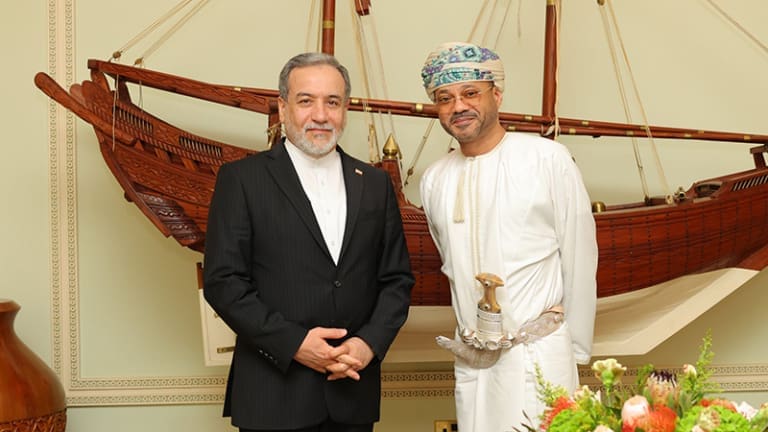
Oman maintained its diplomatic relations with Iran during this time. In late April 2026, Foreign Minister Araghchi visited Muscat and reportedly suggested Iranian–Omani cooperation over the Strait of Hormuz. In subsequent remarks, Araghchi claimed that the Strait was “located in the territorial waters of Iran and Oman” and that there were “no international waters in between.” Iran also suggested that it could impose tolls on ships transiting the Strait, and on May 5, 2026, established a new “Persian Gulf Strait Authority” as a revenue-generating operation. Nearly all affected countries are opposed to the charging of tolls in the Strait, and President Trump deemed the idea “totally unacceptable.” Charging tolls on ships through the Strait would violate the 1982 UN Convention on the Law of the Sea (UNCLOS). Although Iran never ratified the convention (neither has the United States done so), as a signatory Iran may still be legally obliged not to act contrary to its “object and purpose”—though Tehran itself denies that this framework applies. Oman has been publicly silent on the matter, allowing it to maintain a strategic ambiguity.
Although what was actually discussed between Iran and Oman over the issue of “management” of the Strait is unclear, reports suggested that instead of directly charging tolls, Iran had raised the prospect of charging “fees” for services such as ship waste disposal rather than tolls per se. International legal experts have noted that if fees are simply a mask for tolls, such a system would still be a violation of UNCLOS: Harvard University law professor James Kraska, for instance, likened it to a mafia extortion scheme of paying “protection money.”
Implications for US Policy
While US officials may have been taken aback by Oman’s criticism, as Muscat is usually much more tactful in its public pronouncements, they should not jump to conclusions about a shift in Oman’s allegiances. Oman is not in favor of the war against Iran. Further escalation would hurt its economic interests. Muscat likely wanted to express its opposition to protect itself from Iran’s wrath—to avoid the multitude of strikes on cities and infrastructure that other GCC states have suffered—and to signal to Washington, a longstanding friend, that the war is a grave mistake.
Moreover, receiving the Iranian foreign minister and listening to his entreaties on the Strait is not the same as agreeing to Tehran’s plans—which Oman has not done. It is not out of the ordinary that a GCC state would receive Iranian officials. Indeed, just days ago, on May 25, 2026, an Iranian delegation composed of Araghchi, Speaker of Parliament Mohammad Bagher Qalibaf, and Central Bank Governor Abdolnaser Hemmati arrived in Doha to discuss outstanding issues between the United States and Iran. Granted, Qatar’s hosting of Iranian officials was likely done at the behest of Washington, whereas Araghchi’s April 2026 visit to Muscat probably was not. Nevertheless, Saudi Arabia, the UAE, and Qatar want a negotiated settlement between the United States and Iran, which is why they have implored President Trump to maintain the ceasefire and to continue talks with Tehran. In other words, while Oman has been more outspoken than its GCC partners, it is aligned with them on the need to end the war on Iran.
The views expressed in this publication are the author’s own and do not necessarily reflect the position of Arab Center Washington DC, its staff, or its Board of Directors.
Featured image credit: Foreign Ministry of Oman via X