Since March 2, 2026, the most recent bout of Israeli violence in Lebanon has displaced an estimated 1.2 million people—a fifth of the country’s population. Israel has expressly used displacement as a weapon in these attacks. On March 24, Israel’s Defense Minister Israel Katz said that “the return of more than 600,000 residents of southern Lebanon who evacuated northward will be completely prohibited south of the Litani until the safety and security of northern [Israeli] residents are ensured.” He added that all “houses in villages near the border in Lebanon will be destroyed—according to the model of Rafah and Beit Hanoun in Gaza—to remove, once and for all, the threats near the border to northern residents.”
Towns such as Bint Jbeil, where a 400-year-old mosque once stood, have been wiped off the map. Some 3,000 homes in South Lebanon have been destroyed and agricultural lands razed in pursuit of what is euphemistically described as a “buffer zone,” but which masks the reality of Israel’s occupation of Lebanese land. Israel has carried out over 3,500 attacks in Lebanon since the supposed ceasefire was announced on April 16, 2026.
Displacement is an innately political project, conducted with violence by the powerful against those least able to withstand it.
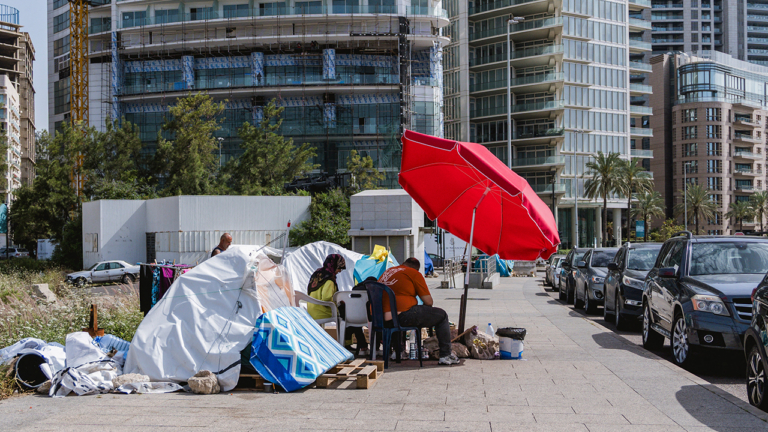
For many in Lebanon displaced by Israel’s attacks, this is not the first but the second or even third time they have been forced to flee their homes. Israel has invaded the country six times in the last fifty years. The 1975-1990 Lebanese Civil War forced an estimated 800,000 people from their homes. Many of those who fled then are now parents and grandparents enduring displacement once again. Displacement in Lebanon has become a multigenerational phenomenon; not a single, exceptional event, but a recurring condition of precarity that affects families across decades. Although commonly framed as a humanitarian crisis, displacement is an innately political project, conducted with violence by the powerful against those least able to withstand it. The human cost of this violence is hard to overstate.
The experience of “multiplied displacements” results in a sense of permanent temporariness with ramifications for people’s mental health, their education and social mobility, and their ability to build a sense of home. In March 2026, around 100,000 people crowded into some 500 shelters in cities such as Tyre and Sidon. NGOs on the ground reported that people arrived with just the clothes on their backs, with children clutching favorite toys, pets, or schoolwork for schools that were no longer standing. Schools across the country have been disrupted, and more than 200 healthcare facilities have been attacked. Psychologists warn that the 400,000 displaced children are experiencing a shattered sense of safety, which could produce lifelong trauma.
Lebanon, like other countries in the Global South, is a destination for people who are displaced within the region. One in five people who live in Lebanon are refugees from elsewhere, mainly Syria and Palestine, many of whom are being displaced yet again. These refugees have made their homes in Lebanon as countries in the Global North increasingly abdicate their responsibility to provide asylum, narrowing legal pathways for accepting refugees and expanding their enforcement efforts with profit-seeking corporations that build surveillance towers and robodogs to police borders.
While funding for border security seems endless, there is little humanitarian aid for people suffering in countries such as Lebanon, Syria, Sudan, and Yemen. The work of the US Agency for International Development has been largely discontinued, impacting the work of humanitarian organizations globally whose ability to provide their services has plummeted. In 2024, the European Union (EU) pledged $1 billion to support Lebanon, but half of that sum was earmarked for securitizing its own borders, with the aim of reducing “irregular” migration from Lebanon through Cyprus. The EU is primarily concerned with preventing refugees from reaching its shores. The United Nations Office for the Coordination of Humanitarian Affairs (OCHA) has asked the international community for an immediate infusion of $640 million, raising alarm about pressure on essential services and people’s limited ability to cope with the strain of repeated displacements. Limited shelter space, and diminishing prospects for safe return, leave those displaced highly vulnerable. Yet this support has not come. In the meantime, since October 2023, the United States has sent Israel $21.7 billion in military aid.
There is little humanitarian aid for people suffering in countries such as Lebanon, Syria, Sudan, and Yemen.
The solutions to this displacement crisis are not hard to identify. Lebanon—like other countries in the region enduring this level of violence—needs more support. The international community should rapidly provide shelters humanitarian aid for those affected by this violence. Lebanon also needs funding to rebuild towns and villages and to make them once again habitable for those who have lived on that land for generations. On April 15, 2026, a UN panel of experts warned that the Israel’s destruction of homes in Lebanon was consistent with patterns that began during the genocide in Gaza.
But most pressingly, Israel’s violence must be stopped. As a first step, the US Congress should pass the Block the Bombs Act, which would prevent funds from being sent to Israel and curb the United States’ active participation in genocide. US institutions must also withdraw their investments from Israel, pursuant to calls for boycott, divestment, and sanctions.
Collectively, we must ensure this violence ends for once and for all. If not, we condemn the residents of Lebanon, Palestine, and elsewhere to more decades of violence.
The views expressed in this publication are the author’s own and do not necessarily reflect the position of Arab Center Washington DC, its staff, or its Board of Directors.
Featured image credit: MANON ROCA / MIDDLE EAST IMAGES / MIDDLE EAST IMAGES VIA AFP