
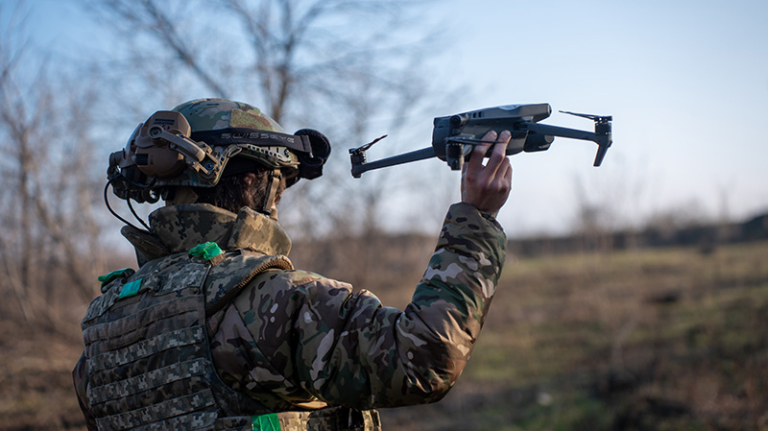
Drone warfare in South-West Asia and North Africa has expanded dramatically in recent years. For many belligerents, drones have become the weapon of choice, not only because they are relatively inexpensive, hit targets with precision, and can terrorize troops and civilians, but also because they can shift power dynamics, giving the weaker party the ability to outlast the stronger one. Drones proved effective in halting shipping traffic through the Strait of Hormuz in the early 2026 US-Iran war, and have also altered the battlefield in Libya, Sudan, Lebanon, and Yemen. Although states and nonstate actors will continue to use and upgrade drone technology to enhance their military capabilities, the international community should clamp down on drone exports to combatants in civil wars such as Sudan, where drone strikes have killed at least 1,000 civilians in the past five months alone.
How Drones Have Altered the Battlefield
Although drones have been used in the region since the early 2000s, they were a prominent feature of Turkey’s 2019 intervention in the Libyan civil war. The Tripoli-based Government of National Accord (GNA) used Bayraktar drones and other military equipment provided by Turkey to halt the military offensive of Libyan strongman and self-anointed Field Marshall Khalifa Haftar. The GNA was able to prevent Haftar and his eastern faction from taking the capital of Tripoli and were able to reclaim the town of Gharyan, which had been Haftar’s forward military base.
Libya is certainly not the only battlefield in the region where drones have been used to shift dynamics. Yemen’s Houthi movement, which took over the capital city of Sanaa and much of northern Yemen in 2014 and 2015, used drones extensively to their strategic advantage to attack Saudi-led coalition forces that supported the internationally recognized Yemeni government. The Houthis then expanded their use of drones to target Israel and ships in the Red Sea and the Gulf of Aden. Between 2018 and 2024, the Houthis conducted an estimated 388 drone attacks on these targets. The effectiveness of drones on the battlefield makes them the weapon of choice for non-state actors.
Drone warfare can turn the tide in a battle because it can halt a conventional offensive, leveling the playing field in conflicts with a clear power imbalance.
Drone warfare can turn the tide in a battle because it can halt a conventional offensive, leveling the playing field in conflicts with a clear power imbalance. If the weaker side has enough drones and can use them effectively, it can inflict enough damage on the stronger side to ensure there will be no decisive winner, prolonging the weaker side’s survival, and turning the conflict into a war of attrition. This has been particularly evident in Sudan, where United Nations Commissioner for Human Rights Volker Türk reported that drone strikes had killed more than 1,000 civilians from January to May 2026 alone.
Both sides in Sudan’s civil war have used drones in recent years. Until 2025, the fighting seemed to be turning in favor of the Sudanese Armed Forces (SAF), led by General Abdel Fattah al-Burhan, against the Rapid Support Forces (RSF), led by Mohamed Hamdan Dagalo, also known as Hemedti. But in October 2025, the RSF mounted a drone-supported offensive in al-Fasher, the capital of North Darfur, committing numerous atrocities against civilians in a campaign that a United Nations (UN) fact-finding mission later said bore the defining characteristics of genocide. The RSF launched Chinese-made CH-95 or FH-95 drones (reportedly supplied by the UAE, though Abu Dhabi denies the claims) from an airbase in South Darfur to target civilians in bomb shelters, mosques, and community centers.
The RSF has also used drones against al-Obeid, a key logistics center for the SAF and the capital of Sudan’s North Kordofan state. In June 2026, the RSF launched numerous drone attacks against the city, terrorizing civilians and SAF troops alike, while destroying or forcing the shutdown of civilian infrastructure. The strikes have killed more than 60 civilians, prompting statements from the United States and the UN Security Council. On June 18, UN High Commissioner for Human Rights Volker Türk warned that “we have seen this playbook before. We cannot allow the repeat of the preventable atrocities we documented in al-Fasher . . . last year.”
But the killing is not one-sided. The SAF has also used drones against RSF targets, reportedly killing many civilians in the process. In February 2026, Türk expressed alarm following reports of SAF drone strikes on February 15 and 16 that killed at least 57 civilians, including 15 children.
Drone use has also been increasing in the conflict between Israel and Hezbollah. Despite Israel’s military superiority, Hezbollah has effectively used fiber-optic drones that have killed or wounded several Israeli soldiers in Lebanon. These drones carry optical fiber cables that allow users to conduct real-time monitoring of the battlefield that bypasses communication barriers like radio waves and electromagnetic interference, making them difficult to thwart. Such drone attacks have reportedly exposed vulnerabilities in Israeli defenses. Anonymous Israeli officials have complained that in 2024 they warned the current leadership that Hezbollah would begin to use fiber-optic drones, but that the top brass did little to prepare for this scenario.
Because Israeli soldiers have little time to shoot down such drones before impact, Hezbollah is using videos of these incidents for propaganda purposes. A Hezbollah spokesperson claimed that their drone attacks have weakened the spirit of Israeli soldiers who live in fear of these attacks. On May 3, 2026, Prime Minister Benjamin Netanyahu said that he had ordered the creation of a special team of experts to address the drone threat in Lebanon. The successful deployment of drones to beat back or harm enemies demonstrates this technology’s effectiveness.
Inexpensive Weapons of Choice
Several countries across the region are currently known to manufacture drones. Iran and Turkey represent very different models of drone production. Despite being under heavy sanctions for many years, Iran has been able to develop an extensive drone-building industry. Iran has supplied Russia with hundreds of drones and has supported the country’s drone production for its war against Ukraine. Iran has also provided drones to its regional proxies, including Hezbollah, the Houthis, and Iraqi Shia militia forces. Although the price tag for Iran’s notorious Shahed-136 drone was initially believed to be between $20,000 to $30,000 each, recent reporting suggests that it could be as low as $7,000, making it an attractive acquisition for Iran’s regional allies.
During the 2026 US-Iran war, Iranian authorities used drones to target US military bases in the Persian Gulf and to attack civilian infrastructure within the Gulf Arab states, causing billions of dollars in damage. More ominously for the world economy, Iran was able to attack oil tankers in the Strait of Hormuz, effectively halting all transit, including the shipment of oil. Because of Iran’s large inventory of rockets and drones, it could withstand continual US strikes and wait out the Trump administration, which was concerned about the political downside of rising gasoline prices in the United States. In a new twist on asymmetrical warfare, Iran was able to parlay this newfound leverage into a June 17, 2026, Memorandum of Understanding (MOU) with the United States that tilts heavily in its favor.
Despite being under heavy sanctions for many years, Iran has been able to develop an extensive drone-building industry.
Nonstate actors have also been able to obtain drones and build drone parts at low cost. In Yemen, the Houthis have proved to be resourceful not only in smuggling drones from Iran but also in manufacturing specific drone components or obtaining parts from civilian drones available online and adapting them for military purposes. Items such as gyroscopes, ignition systems, and small aircraft engines are available on global civilian markets, and even a sanctioned nonstate actor, the Houthis, are able to obtain these components from intermediaries.
Turkey offers a more high-tech example of drone manufacturing. Although Turkey’s Bayraktar TB2 drones are more expensive, selling for $2 million to $5 million each, they are still affordable for a number of African countries with modest military budgets.
Outside Players in the Drone Trade
The drone trade is often characterized by murky transactions, which helps to facilitate delivery to belligerents while affording vendors deniability. The UAE, for example, reportedly uses illicit transportation networks via third-party countries to deliver drones to the RSF. Some of these drones first land by air in Central African Republic, Chad, Libya, or Somalia before being transported by land to the RSF. Other reports have claimed that drones have been transported by cargo planes to Ethiopia and then transported overland to the RSF. Both Abu Dhabi and Addis Ababa have strongly denied such assistance.
Countries with deeper pockets are able to provide their clients with drones, like the UAE, which has reportedly supplied drones to the RSF in Sudan, Haftar’s forces in Libya, and the Southern Transitional Council in Yemen. On the other side of the Sudanese conflict, the SAF has received military assistance and drones from its supporters, such as Turkey, Iran, Egypt, Russia, and Saudi Arabia. Riyadh had agreed to finance a $1.5 billion deal between the SAF and Pakistan for drones and air defense systems, though reportedly withdrew its support in early 2026.
Counter-Drone Technology on the Upswing
It is one thing to obtain drones and use them on the battlefield; it is another to employ effective counter-drone methods against them. While Israel, most Gulf Arab states, and the United States have such capabilities (albeit not entirely effective), other actors are now scrambling for similar countermeasures. In Sudan, for example, Burhan’s SAF forces intercepted about 13 percent of drone engagements, while the RSF only intercepted 2.3 percent. These numbers give plenty of room for improvement.
Because of its need to fend off Russia’s Iranian-made drones, Ukraine is now a major exporter of anti-drone warfare. The country reportedly provided this technology to Jordan to counter Iranian drones launched against it during the early weeks of the 2026 US-Iran war. These counter-drones, which cost roughly $1,000 to $2,000 apiece, are significantly cheaper than US Patriot air defense systems (estimated to cost $4 million per missile) and the THAAD missile defense systems (estimated to cost more than $12 million per interceptor). Ukraine has now emerged as the world’s leading manufacturer of so-called “Shahed Killers.” It is likely that, over time, drone and counter-drone technologies will escalate in the Middle East and North Africa, which will merely prolong the deadly conflicts in the region.
Killing Civilians Needs to End
The recent US-Iran war, which included Iranian strikes on several Gulf Arab states, has shown that these states are vulnerable to drones even though most were intercepted by US defense systems. The infrastructure damage they sustained will likely encourage these countries to look beyond the US to purchase new countermeasures to drone attacks. It is unlikely that there will be any real effort to stop or slow down such purchases, and those selling drones and countermeasures will continue to find a lucrative market.
In light of this situation, the international community needs to act to halt the killings of civilians by drones. The civil war in Sudan has resulted in at least 150,000 deaths, mass displacement, and severe malnutrition for millions of Sudanese civilians. A new initiative is needed to stop outside players providing drones and other weapons to the belligerents, and to bring the two sides together for peace talks. If such an approach is not adopted, the killing will continue—and be made much worse by drone warfare.
The views expressed in this publication are the author’s own and do not necessarily reflect the position of Arab Center Washington DC, its staff, or its Board of Directors.