
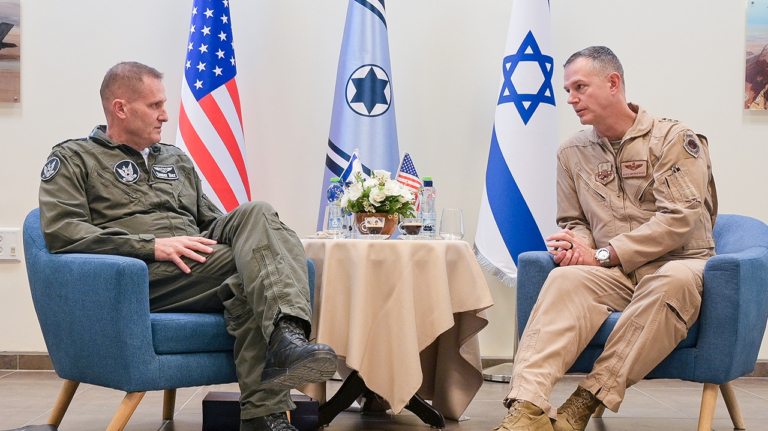
For decades, the US-Israel defense relationship has been one of donor and recipient. True, there is operational collaboration in intelligence sharing and counterterrorism (and now, very visibly, in the war against Iran), and the two countries have partnered on a range of defense technology research and development, most prominently missile defense systems such as Iron Dome. But by and large, the relationship has been defined by the provision of billions of dollars in military aid from the United States, and by the use of (most of) that funding by Israel to procure US weapons and other military items.
The viability of this construct is becoming increasingly precarious, however. After two and half years of exposure to Israel’s ongoing atrocities in Gaza, and in the context of a US administration that has slashed most foreign assistance, the American public has come to oppose the giveaway of taxpayer money to the Israel Defense Forces. The moment is fast approaching when US lawmakers will have to follow public opinion on policy toward Israel.
The framework of the US-Israel defense relationship is set by the executive branch through recurring 10-year Memoranda of Understanding (MOUs), but the annual $3.8 billion in Foreign Military Financing (FMF) funding under the current MOU, signed in 2016 to commit funds for Fiscal Year (FY) 2019 through FY 2028, is a weak point. The MOU represents a presidential commitment to provide a certain level of annual funding, but the funds still must be approved by Congress each year before they can be released for Israel. The typical procedure of Congress rubber-stamping billions in grants for Israel through the appropriations process is likely to only become more unpalatable to many elected representatives as public opinion continues to turn negative toward Israel.
In this context of potential negotiations for a next MOU and rising congressional discomfort with unconditional support for Israel, a “solution” to the increasingly thorny politics of Israel aid has been buried deep in a proposed defense bill. Section 224 of the House version of this year’s National Defense Authorization Act (NDAA), introduced on May 26, 2026, proposes a new mechanism for continued close collaboration between Israel and US military and intelligence agencies, as desired by Israel’s supporters in the US political establishment. Section 224 would not only allow the exceptionally close military relationship to continue, but also would shelter it from the vagaries of regular congressional votes on military aid and make it almost impossible to uproot.
Proposed Defense Integration in the NDAA
The NDAA is the annual “must-pass” bill that lays out the framework for the Department of Defense’s operations. Section 224 of the FY 2027 NDAA creates a new architecture for US-Israel defense collaboration premised on integrating the Israeli and American defense industries, especially in emerging and highly sensitive areas of technology. Section 224 provides for joint military research, promotes integration of Israeli technologies into the US defense supply chain, and appoints an “executive agent” at the Department of Defense to oversee the effort.
Israel’s most fervent supporters in Congress are trying to seize the current window to push through legislation that would cement the relationship.
Why now? As mentioned, one reason is the impending termination of the current MOU at the end of FY 2028, which provides a natural stepping-off point for a reset. But the US political climate is much more difficult for Israel than when the current MOU was negotiated, in 2016. Republicans—whose party maintains stronger support for Israel than the Democrats, among whom pro-Israel sentiment is more rapidly eroding—could lose at least one chamber of Congress in the November 2026 midterm elections; if that happens, passing legislation such as Section 224 may become harder. As such, Israel’s most fervent supporters in Congress are trying to seize the current window of Republican congressional control, and the lame-duck period of pro-Israel Donald Trump’s presidency, to push through legislation that would cement the relationship. But such legislation would be a problem—not only for any future administration or Congress that may seek to unwind the relationship, but, more immediately, for US national security itself.
The Risks of Defense Industrial Integration
The most obvious problem with Section 224 is Israel’s track record with using US weapons and military support, which makes it unsuitable for further such support in any form. Israel’s grievous violations of US and international law and its other human rights violations are well documented, including the use of US-supplied weapons in killing Palestinian civilians, extrajudicial killings by Israeli soldiers, the systemic use of torture and sexual abuse by Israeli security forces, and policies such as the withholding of humanitarian assistance, other forms of collective punishment, ethnic cleansing, apartheid, and genocide. These facts should prevent even the discussion of deepening military ties, especially given the complete inability of the United States to apply existing laws, such as the Leahy Law or the Arms Export Control Act, to US military aid and weapons sales to Israel.
But Section 224, if enacted, also would pose direct challenges for US national security. The two most pressing ones involve information-sharing and political leverage.
First, Section 224 opens the most sensitive areas of emerging US technology to Israel’s national security establishment, which in the past has shown little compunction about utilizing access to pursue economic and defense-related espionage. Among the areas of technology that fall under the proposed legislation are artificial intelligence and quantum technologies—capabilities that, to date, the United States has only shared under the “AUKUS Pillar II” agreement with treaty allies Australia and the United Kingdom. Of particular concern is the listing of “biotechnology, biomanufacturing, and medical defense” as an area for joint research, given Israel’s failure to join the Biological Weapons Convention and longstanding rumors of an active biological weapons program on its part; information-sharing within this domain may breach US commitments under Article III of the Convention. While Section 224 does specify the need to protect sensitive technology, it frames that protection as in the “national security interests of the United States and Israel,” as if the two countries were inseparable. Access to US military research would also give Israel significant insight into US military capabilities, allowing it to develop, and potentially sell, countermeasures to US contingency plans.
Second, Section 224 puts forth an objective of “identifying jointly developed or Israeli-origin technologies with operational utility for potential integration into United States systems and programs of record,” laying the groundwork for US reliance on Israeli technology across US military services. Under the current MOU framework, the United States is, in theory, able to leverage Israel’s dependence on US weapons, such as by withholding arms or funding, to pressure Israel to shift course. But once Israeli technologies are integrated, that calculation flips: Israel will be able to threaten to withhold, or actually withhold, subcomponents or software updates that might be key to the operability of future US weapons systems, essentially holding US military capabilities hostage.
Section 224 would undermine the competitiveness of the American private sector.
Beyond this, Section 224 would undermine the competitiveness of the American private sector. Under the current Foreign Military Financing mechanism, the United States subsidizes Israeli industry to the tune of hundreds of millions of dollars a year. This subsidy has succeeded in the sense that Israel’s defense industry is now a top ten global exporter, and Israeli military products often compete with US-origin systems on the global market. By providing Israel with greater access to cutting-edge technologies and by inviting Israeli co-production on US systems, including in the United States, the legislation would advantage Israeli companies even more, provide them with a means to bypass “Buy America” laws and potentially replace any loss in grant assistance with direct corporate profits.
What May Happen Next?
Should the NDAA pass the House with Section 224, the Senate will need to pass the same language. If Congress enacts the legislation, implementation will be up to the executive branch, although we can anticipate future legislative efforts to strengthen Section 224’s language and to create financial incentives for American industry to participate in the envisioned defense cooperation. Preventing such incentives would be an important part of limiting the program, and it is plausible that future administrations will be less rosy about tight US-Israel ties and will pursue implementation with less vigor than the Section’s proponents envision. Even so, if this legislation passes, it will result in a series of contractual agreements between US and Israeli companies and institutions, and a gradual spreading of Israeli technologies into US military systems that would be very hard to unwind. It is also likely there will be an effort to amend US weapons export control regulations, specifically the International Traffic in Arms Regulations (ITAR), to provide Israel with the same type of access to US military technology currently only enjoyed by Australia, Canada, and the United Kingdom. This, too, will be hard to prevent, and any effort to do so, particularly once trade is flowing under such regulations, may face legal challenges.
The US-Israel defense relationship is at an inflection point. Section 224 raises significant questions about whether there will be, in the foreseeable future, a genuine offramp from support for Israel’s military, or whether the relationship will simply transition to a new, and arguably worse, form. Such an outcome would entrench US military support for and cooperation with Israel in law within a web of classified and commercial enterprises through which the relationship is likely to deepen for decades to come.
The views expressed in this publication are the author’s own and do not necessarily reflect the position of Arab Center Washington DC, its staff, or its Board of Directors.
Featured image credit: US DoD