
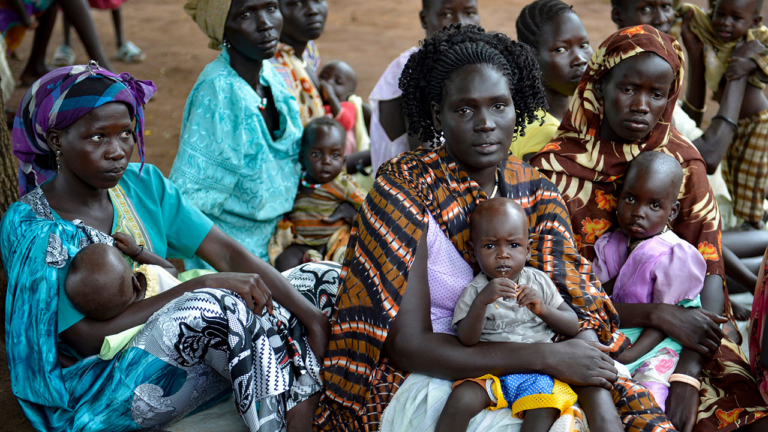
The war in Sudan, which began in April 2023, has entered its fourth year and remains the world’s largest displacement and hunger crisis. The conflict has forced some 14 million people from their homes, including nine million displaced internally and an estimated 4.4 million who have crossed into neighboring countries. Egypt is the single largest recipient of people fleeing Sudan, with around 1.5 million new arrivals since the conflict began. In June 2026, days of drone strikes by the paramilitary Rapid Support Forces on al-Obeid, the capital of Sudan’s North Kordofan state, killed more than 20 people and prompted warnings of mass atrocities that could cause more Sudanese to flee the country.
Egypt also hosts large numbers of refugees from other countries. In April 2026, the UN High Commissioner for Refugees (UNHCR) reported that it had registered more than 1.1 million refugees and asylum seekers of more than 60 nationalities in Egypt. Yet, just as the country potentially faces a new influx of displaced, Egypt has launched a fundamental overhaul of its legal system for processing asylum claims. On June 1, 2026, the Egyptian government issued bylaws for the country’s first asylum legislation, which reassigns responsibility for registering refugees from UNHCR to a new state body, the Permanent Committee for Refugee Affairs (PCRA). The PCRA now has just nine months to assume UNHCR’s role in processing asylum cases domestically. Critics warn that the rushed transfer could leave refugees more vulnerable and without legal protection.
Barriers to Legal Residency
Under the existing system, refugees in Egypt first register with UNHCR and then separately apply for a residency permit from the General Department of Passports, Immigration and Nationality at the Egyptian Ministry of the Interior, which must be renewed annually. But over the last three years securing legal residency in Egypt has become increasingly difficult.
The arrival of large numbers of Sudanese refugees when the war first started created political and financial incentives for the government to impose tighter controls, and Egypt soon introduced stricter residency requirements for foreign nationals. In August 2023, Egyptian Prime Minister Mostafa Madbouly issued Decree No. 3326, requiring foreigners without valid residency to secure an Egyptian host and pay $1,000 to regularize their status. Immigration fees charged in dollars provided the Egyptian government with badly needed foreign currency amid the country’s ongoing economic difficulties.
For many newly arrived Sudanese, the fee was unaffordable, leading them to register with UNHCR instead and adding pressure to an already overstretched asylum system. Even after receiving UNHCR documentation, however, refugees must separately obtain and renew residency permits through the General Department of Passports, Immigration and Nationality. The increase in applications delayed registration and UNHCR card renewals, while severe funding cuts further disrupted the agency’s services. As of April 14, 2026, UNHCR had received only 2 percent of the funding required for its cash assistance program in Egypt and warned that the program could soon come to a complete halt, affecting at least 20,000 refugee families who rely on it to meet their basic needs.
Even those who obtain refugee status face serious obstacles to building a stable life in Egypt.
Refugees must still separately obtain and renew residency through the General Department of Passports, Immigration and Nationality, where severe staff shortages and limited processing capacity have left some waiting up to three years for a renewal appointment. The wait can exceed the validity of their UNHCR cards, and in some cases residency permits may already have expired by the time they are issued. Refugees can therefore be left without valid residency despite holding UNHCR documents or actively seeking renewal, exposing them to arrest, detention, and deportation.
Police have also intensified checks in streets, workplaces, and transportation hubs across several governorates, targeting Syrians as well as Sudanese, South Sudanese, and other African nationals. Amnesty International documented the arbitrary arrest of 22 refugees and asylum seekers, including a child, between late December 2025 and February 5, 2026. Fifteen were registered with UNHCR. Deportations reportedly accelerated after Egypt adopted its first asylum law in November 2024. Even those who obtain refugee status face serious obstacles to building a stable life in Egypt, as access to education, healthcare, and justice often depends on proof of identity or valid residency permits. Many families struggle to meet these requirements after fleeing the war without essential documents. In education, for example, Sudanese children must have valid residency permits to enroll in Egyptian schools, yet authorities have also closed Sudanese-run schools opened to meet the community’s educational needs.
Egypt’s Controversial Asylum Law
Approved by parliament in November 2024 and ratified the following month, Egypt’s first asylum law transfers responsibility for refugee registration, documentation, and status determination from UNHCR, which had largely performed these functions under a 1954 memorandum of understanding, to the newly created Permanent Committee for Refugee Affairs (PCRA). The committee will manage all refugee-related matters, including deciding whether to approve or reject asylum applications and whether to revoke refugee status. The law was enacted after the EU-Egypt Comprehensive Strategic Partnership was signed in March 2024. The partnership allocates €200 million (about $218 million at the time) for migration management and efforts to curb irregular migration to Europe. According to a European diplomat, Egypt rapidly enacted the law under pressure from the EU as part of the partnership. Critics warned that the EU deal risks enabling abuses against refugees and migrants. The approach also appears counterproductive. Reports found that tighter restrictions in Egypt pushed some Sudanese refugees to travel through Libya in search of safety in Europe. During the first five months of 2025, Sudanese arrivals in Europe increased by 134 percent compared with the same period the previous year.
The law penalizes individuals who host or employ asylum seekers without notifying the authorities.
The bylaws published on June 1 must begin to be implemented by September 2026. The PCRA will then have six months to assume UNHCR’s responsibilities, giving the government until March 2027 to complete the transfer. The legislation distinguishes between people who enter Egypt regularly and those who enter irregularly. Anyone who enters irregularly and fails to apply for asylum within 45 days may face imprisonment and a fine. The law also penalizes individuals who host or employ asylum seekers without notifying the authorities. Because the provision is broadly defined, it could potentially apply to Egyptians or foreigners who simply rent housing to an asylum seeker.
The law contains some positive provisions, recognizing refugees’ rights to receive state-provided primary education and healthcare, work, obtain travel documents, and apply for citizenship under Egypt’s existing nationality law. Yet these protections are undermined by provisions allowing the PCRA to revoke refugee status and order deportation on vague national security or public order grounds.
The law also permits authorities to confine refugees to designated areas, bar them from border regions, require permission to travel between governorates or abroad, mandate regular in-person check-ins, and require changes in address or contact information to be reported within 24 hours. After the law passed, UNHCR warned that its national security and public order provisions were “excessively wide in scope” and could endanger the rights guaranteed to refugees under the international conventions Egypt has signed.
A Difficult Transition
The transfer raises serious concerns for the roughly 1.1 million refugees and asylum seekers already registered with UNHCR in Egypt. The bylaws require the committee to receive existing refugee records from UNHCR during the transition. Valid UNHCR cards will remain in effect until they expire, or the committee issues replacement documents, whichever comes first.
Whether the government can manage this transition remains uncertain. A year and a half after the law passed, the only publicly confirmed member of the committee is its head, former State Information Service chair Salah Eddin Abdel Sadeq, and the bylaws themselves were issued nearly a year later than the legislative requirement. It remains unclear how the committee will absorb UNHCR’s entire asylum system during the six-month handover period. One refugee rights lawyer has warned that rushing the process could leave refugees without legal protection. The existing system, even with UNHCR support, is already unable to keep pace, leaving thousands without secure status and exposing them to arrest and deportation.
Amid Sudan’s spiraling conflict and broader regional instability, Egypt should provide those seeking refuge with prompt and safe entry, unrestricted access to fair asylum procedures, and protection from forced return. The international community, for its part, must support refugee-led organizations and human rights defenders assisting refugees through this increasingly restrictive environment. The United States should use its leverage with Egypt to press for fairer asylum policies and an end to forced returns. It should also expand humanitarian assistance for Sudan and countries that host refugees while working to end the war and curb the foreign interventions fueling it. The EU should suspend migration-related funding under its partnership with Egypt until adequate safeguards are established to protect refugees. Yet such protections do not appear to be a priority for the EU, which is itself advancing controversial policies aimed at increasing deportations and establishing offshore detention centers. Without adequate safeguards, Egypt’s new asylum system risks offering further insecurity to refugees who have already fled war, drone strikes, and hunger.
The views expressed in this publication are the author’s own and do not necessarily reflect the position of Arab Center Washington DC, its staff, or its Board of Directors.