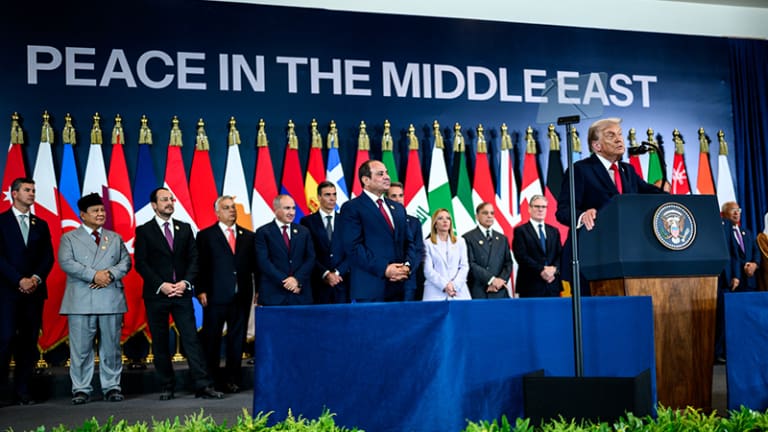
President Donald Trump’s Board of Peace (BoP) and the National Committee for the Administration of Gaza (NCAG) raise several international significant legal issues, most flowing from the BoP that provides the authority for the NCAG.
The BoP’s self-declared global conflict resolution mandate lacks a clear basis in international law beyond the claim that United Nations Security Council (UNSC) Resolution 2803 provides a legal basis for its operation in Gaza. (See here for an analysis of what is missing from UNSC 2803). The Board’s draft governance structure, which could still be changed, concentrates power in one individual (Trump as life-long chair) and ties extended membership to hefty financial contributions ($1 billion for a permanent place on the Board), an arrangement unusual in treaty-based organizations. Questions of legal personality and legitimacy arise, as the BoP was recognized by a UN Security Council resolution in Gaza as a “transitional administration with international legal personality” but operates outside the UN system without clear oversight. Membership is by invitation and consent: states are not bound unless they choose to join, consistent with the Vienna Convention principle that treaties create no obligations for non-consenting states. Finally, the Board’s role in Gaza (an occupied/post-conflict territory) implicates the law of occupation, self-determination, and human rights: the international administration must not entrench external control in violation of the Palestinian people’s rights.
Under the UN Charter, primary responsibility for international peace and security rests with the UNSC (Article 24). Any “global mandate” to resolve conflicts typically requires UNSC authorization or a multilateral treaty among states. In the BoP’s case, Resolution 2803 authorized the Board only for Gaza and only through 2027, as part of the ceasefire’s transitional governance plan. That mandate is narrow—“solely focused on the Gaza conflict”— and time-limited.
By contrast, the BoP charter’s language and Trump’s accompanying invitation letters suggest an intent to expand to other conflicts indefinitely. There is no existing Security Council resolution or treaty conferring a global peacekeeping or governance role on the Board outside Gaza. Thus, any claim of authority to intervene in conflicts worldwide would lack clear legal basis unless new UNSC resolutions or international agreements expressly grant it. Acting without such authority could conflict with the UN Charter’s framework, which does not recognize independent bodies imposing peace settlements globally without UN or host state consent.
Indeed, diplomats have warned that Trump’s Board appears to “ignore the fundamentals of the UN Charter” in its bid for a broad mandate. One core principle at stake is state sovereignty and consent: under international law, outside intervention in a conflict or administration of territory generally requires the affected state’s consent or a binding UNSC Chapter VII decision. In practical terms, the Vienna Convention means the BoP cannot lawfully impose its governance or conflict-resolution services on any state or territory that has not agreed to them. For the Board to operate globally, it would either need voluntary invitations from the states concerned or a UN mandate in each situation. Absent those, its “global mandate” would be aspirational and potentially illegal if it attempted to override state consent or UN authority.
Moreover, the Board’s envisioned role risks encroaching on the UNSC’s authority. The UNSC can lawfully establish peace operations or transitional administrations (as it did for Kosovo and East Timor) or endorse regional arrangements (Chapter VIII) to address conflicts. But here the BoP is neither a UN organ nor a traditional regional agency—it is a sui generis body largely driven by one state and one individual. International law experts note that the UNSC cannot lightly delegate its charter-mandated powers to non-UN entities without retaining oversight. Creating an autonomous body led by a single member state to manage conflicts worldwide will test the limits of the UN Charter’s system. The UN General Assembly President responded to the BoP plan by underscoring that the United Nations remains the only institution with the “moral and legal ability to bring together every nation,” cautioning that questioning that framework could return the world to “very, very dark times.”
In Gaza, UNSC Resolution 2803 explicitly conferred certain functions on the Board, effectively recognizing its international legal personality for that limited purpose. Yet the Council provided no ongoing supervision mechanism. Some UNSC members criticized the resolution for being “vague and unclear” about the Board’s “structure, composition and terms of reference,” and urged more “inclusivity, transparency and good faith” in its operation. The lack of UN oversight is problematic: it undercuts the principle that UNSC-authorized entities should remain answerable to the Council.
The BoP Charter’s own rhetoric implicitly critiques the UN: it calls for “depart[ing] from approaches and institutions that have too often failed” and for a “more nimble and effective international peace-building body.” This veiled reference to the UN’s perceived inefficiencies underscores that the Board is positioned as an alternative. However, any such parallel institution faces a legitimacy gap—universal representation. The UN derives legitimacy from near-universal state membership and the UN Charter’s legal authority. By contrast, Trump’s Board is a selective initiative. While dozens of countries have been invited, only a few have embraced it so far (Hungary gave early acceptance, most others reacted cautiously). Israel has pushed back on the inclusion of Turkey and Qatar in the governing Board.
The Board’s internal governance, as outlined in its Charter, is highly centralized and atypical of international organizations. By design, President Trump would chair the Board for life, and he personally invited leaders to join. This lifetime chairmanship and personal appointment power concentrates decision-making authority in one individual—a stark contrast to most multilateral bodies which have rotating chairs or elected secretariats. The draft Charter provides that member states serve no more than three-year terms unless they make exceptionally large financial contributions. In fact, membership beyond three years is conditioned on paying $1 billion in the first year, effectively buying “permanent” status on the Board. The White House defended this pay-to-play mechanism as simply rewarding those showing “deep commitment to peace, security, and prosperity.” However, tying governance privileges to monetary contributions is nearly unheard-of in treaty law; it raises equity and integrity concerns. It could skew the Board’s decision-making toward the interests of wealthy sponsors, compromising the principle of sovereign equality (UN Charter Article 2(1)) wherein each state’s voice is to be respected regardless of size or wealth.
The Board of Peace’s first test case—governance in Gaza—highlights the complex obligations involved when an international body administers an occupied/post-conflict territory. Gaza remains, in the eyes of international law, occupied territory (part of the occupied Palestinian territory, i.e., the land of the State of Palestine). Under the Fourth Geneva Convention (1949), the Occupying Power (Israel) bears primary responsibility for the welfare of the civilian population and maintaining public order and civil life. Resolution 2803 and the BoP Charter, however, introduce a new actor (the Board) to take up governance and security tasks, which creates ambiguity in legal responsibility. Indeed, Resolution 2803 fragments occupation law accountability: it tasks the BoP with enabling aid delivery and rebuilding, potentially allowing Israel to claim relief from some of its duties as Occupying Power. Yet Israel has not been explicitly absolved of its obligations—under international law it cannot be, unless and until it ends the occupation. The Board must therefore navigate the “law of occupation”: any measures it takes in governing Gaza should respect the conservationist principle (avoiding permanent changes to local law and institutions unless necessary) and ensure the protection of civilians’ rights.
A paramount obligation in such scenarios is the right of self-determination of the people. The Palestinian people’s right to self-determination is inalienable and has been affirmed by the International Court of Justice and UN resolutions. This means any interim international administration must be geared toward empowering Palestinians to govern themselves, not creating open-ended foreign control. Critics argue that the BoP framework fails this test: it “imposes an administration without Palestinian consent” and makes Palestinian statehood a conditional outcome dependent on criteria set by the Board. The UNSC resolution pointedly conditions a “pathway” to statehood on the PA’s successful reforms and Gaza’s redevelopment, omitting reference to the two-state solution.
In practical terms, the Board’s operations in Gaza should adhere to the precedents of past international administrations, but with caution. Unlike UN missions in Kosovo (UNMIK) or East Timor (UNTAET), which had explicit UN mandates and (in East Timor’s case) a clear referendum-based path to independence, the BoP’s mandate lacks Palestinian buy-in and UN oversight. (See analysis of past transitions here.) To avoid legal pitfalls, the Board should incorporate local input (perhaps by empowering the Palestinian technocratic committee that has also been announced, NCAG, and gradually transferring authority to it) and be fully transparent in its rulemaking. It must ensure that any laws or policies that it promulgates respect existing rights and do not exploit Gaza’s resources—thus respecting the occupant’s duty not to permanently alter the territory’s character. Additionally, accountability mechanisms are crucial: affected civilians should have avenues to complain or seek redress for any human rights violations by the Board or the International Stabilization Force for Gaza. In the absence of formal judicial review (since the Board is not under Palestinian jurisdiction or necessarily UN administrative law), creative solutions may be needed (e.g., an ombudsman or the involvement of UN human rights monitors).
Finally, the Gaza experience will set a precedent. If the Board of Peace can facilitate rebuilding and a peaceful transition to legitimate Palestinian governance while respecting international law, it might gain credibility. But if it is seen as entrenching a neo-colonial trusteeship and sidelining the Palestinian quest for statehood, it will not only violate legal norms but also lose political viability.
The views expressed in this publication are the author’s own and do not necessarily reflect the position of Arab Center Washington DC, its staff, or its Board of Directors. This paper was first published on January 19, 2026, by the Britain Palestine Project. Read the original here.
Featured image credit: Flickr/The White House