Two superpowers, the United States and the Soviet Union, dominated the greater Middle East during the days of the Cold War. What happened from the Levant down to Yemen and across North Africa was heavily influenced, if not totally determined, by the clash of interests and the rivalry between these two main international players. The collapse of the Soviet Union and the emergence of regional power centers have led to a more complex picture: What happens on the battlefields of the Middle East is now a function of how Iran, Israel, Turkey, Saudi Arabia, and the United Arab Emirates (UAE) define their national interests and ambitions.
The United States, and despite the Trump administration’s claims of diminishing interest, is still a major player and influencer. The latest developments in south Yemen—when the UAE-supported separatist Southern Transitional Council (STC) expanded its control over the eastern Hadramawt and Mahra governorates—emanate from the aspirations of Yemeni leaders and the struggle for power in both the north and the south of the country. However, these aspirations ultimately move only within the space allowed them by more powerful players, both regional and international. Indeed, the chess pieces on the board can make choices, but only in as much as the chess players outside Yemen will allow.
Local Repercussions
The move by the STC signals an end to the relative calm that has prevailed in south Yemen since the battle for Marib in 2021. The move also appears to have shattered the already fragile governing coalition put together in 2022 via a Saudi-Emirati agreement, with the Presidential Leadership Council (PLC) president Rashad al-Alimi leaving Aden for Riyadh and blaming the STC president, Aidarous al-Zubaidi, for the collapse of the agreement. If STC advances in eastern Yemen hold, in effect placing the entire Yemeni south under its control, it would leave the PLC with literally no ground on which to stand. However the Saudi-supported PLC or indeed Saudi Arabia respond, the STC has drawn first blood, and a conflict is brewing. One way or another this divisiveness will have to be played out or resolved. On Friday, December 26, the STC accused Saudi aircraft of striking its positions and equipment, and declared that its forces are facing ambushes in Hadramawt. Reports of the presence of some 20,000 fighters of the Saudi-supported National Shield forces on the border between the two countries indicate that conflict is a clear possibility in the foreseeable future.
The move by the STC signals an end to the relative calm that has prevailed in south Yemen since 2021.
The STC’s challenges in southern Yemen are not limited to the PLC. Internecine conflicts abound in the region. Tribally, the STC’s leadership comes mostly from Dhaleh Governorate, Zubaidi’s birthplace and power base. Historically, tensions between the Dhaleh-Lahj group (al-Toughmah) and the Abyan-Shabwa group (al-Zumrah) in the former People’s Democratic Republic of Yemen broke out into a bloody civil war in 1986, a short-lived armed conflict that resulted in thousands of casualties and paved the way for the union with the north in 1990. Resentment persists today between the eastern (Hadramawt and Mahra) and western regions (Abyan and Dhaleh) of the south, and tribal leaders in Hadramawt and Mahra do not easily blend into the STC coalition and have objected to its takeover. As this resentment builds, the STC can expect challenges and attacks against its troops from within the region it seeks to represent. For the time being, the Houthis have not reacted, favoring watching the turmoil in the south play out while condemning any secessionist designs on the part of the STC.
The Regional Dimension
The term “frenemies” aptly describes the Saudi Arabia–UAE relationship. Starting off with seemingly similar goals in regional conflicts, from Syria to Sudan to Yemen, the two Gulf Cooperation Council allies ended up supporting rival groups during these countries’ civil wars. In Yemen, the two were partners in the 2015 intervention against the Houthi takeover of Sanaa in 2014, but once the Houthi advance on Aden was halted, the partners took different directions, with the Saudis focused on supporting the internationally recognized government of Abdrabbuh Mansour Hadi and the Islah Party while the Emiratis began forming local militias and supporting the STC. As the Saudis showed an interest in maintaining a secure border with Yemen and their historical connection to the Hadramawt region, the UAE took on a more ambitious strategic approach in seeking to control the ports of southern Yemen and the islands off the coast, primarily the Socotra Archipelago. Moreover, a strategic partnership has emerged between Israel and the UAE (now signatory to the 2020 Abraham Accords), and manifested itself in Yemen in the form of bases and airstrips on the Socotra Archipelago and Yemen’s southern mainland. The strong points of the STC takeover in the south are mostly centered along the coastline, securing therefore the ports and access points to Socotra and the Red Sea for UAE influence.
Rivalry in Yemen, where the interests of the two GCC partners clearly diverge, may be reaching a breaking point, in no small measure due to the proximity of the battlefields to Saudi borders and to what are seen as vital interests for the UAE. Saudi official statements have advocated a return of forces to their original positions, and the UAE has echoed that, albeit not too loudly. On December 25, Saudi Arabia became more forceful in its demands for the STC to withdraw its forces from the area, prompting an outright rejection by the latter. Saudi Crown Prince Mohammed bin Salman Al Saud and the UAE President Mohammed bin Zayed Al Nahyan may yet be able to pull their respective chestnuts out of the fire by arranging a face-saving compromise between the local factions in order to avoid yet another bloody civil war in Yemen.
To that effect, Abdelghani al-Eryani writes, “The STC’s takeover is reversible by peaceful means. The Kingdom has many diplomatic and economic tools to make the STC see the wisdom of withdrawal, and to get the UAE to cooperate in that regard.” While only thinly masking their separatist intentions, STC leaders and spokespeople have framed the justifications of their thrust eastward on security grounds, claiming that their main motive is to plug al-Qaeda in the Arabian Peninsula and Houthi smuggling routes in the south. An obvious omission here is the STC’s takeover of lucrative oil and gas fields in Hadramawt. Ostensibly, a compromise could reinstall official PLC armed forces in areas along known smuggling routes and the STC could be compensated for abandoning energy rich areas with cash subsidies or projects in Aden and surrounding areas that benefit the hard strapped population there.
The International Dimension
Official US statements on the STC-generated tensions in south Yemen have stressed the need for de-escalation and a so-called return to stability. Secretary of State Marco Rubio has been involved in talks with Saudi and Emirati leaders, expressing US interest in stopping any rift between two major American partners, and consequently weakening the anti-Houthi coalition inside Yemen. However, the move to consolidate the influence of the UAE in south Yemen fits in the broader strategic goals of the United States. The UAE influence could help expand the Abraham Accords, assist in blocking smuggling sea routes and secure the entrance to the Red Sea. Israeli media have hinted openly on the benefits that could accrue to Israel should an independent south Yemen emerge under UAE sponsorship. In an obvious appeal for US support, the STC’s Aidarous al-Zubaidi has mentioned in his press interviews the possibility of an independent south Yemen joining the Abraham Accords. Should that happen, Israel would have an official presence in such a strategic location, in addition to the unofficial presence it already enjoys, thanks to its collaboration with the UAE.
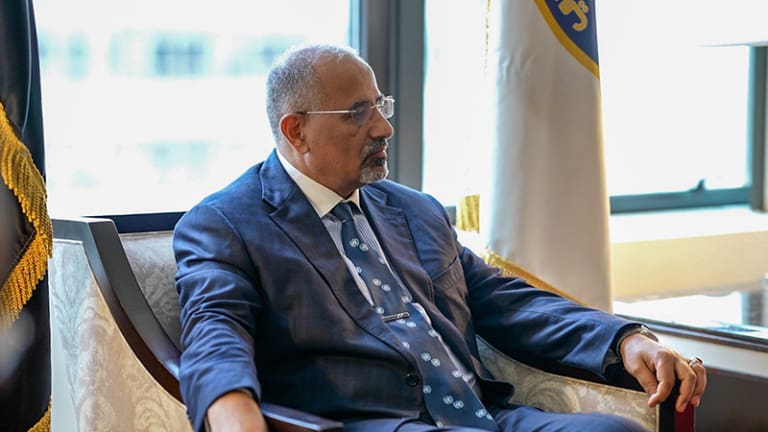
Aidarous al-Zubaidi has mentioned in his press interviews the possibility of an independent south Yemen joining the Abraham Accords.
Turkey has voiced similar concerns to those of Saudi Arabia, namely a call for restraint and de-escalation in Yemen and a concern for the country’s unity and stability in the region. Iran issued a rebuke of the UAE for its support of the STC and warned that the turmoil in south Yemen directly supports Israeli expansionist goals in the region.
While both ostensibly oppose western, and particularly American dominance in the Middle East, Russia and China approach Yemen and the regions somewhat differently, with Russia unabashedly supporting the Houthis while China sounds a more careful tone and offers its support for a more balanced diplomatic approach. China in fact provides diplomatic assistance to UN efforts to peacefully resolve the Yemen conflict and its mediation between Riyadh and Tehran is part of this balanced approach, seeking compromise rather than a victory of one side over the other in the proxy war in Yemen, among others. Both Russia and China abstained on the latest UNSC 2801, extending sanctions on Yemen, critiquing western attempts to put more pressure on the Houthis while hurting Yemen’s population as a whole. China has not specifically commented on the STC takeover of south Yemeni governorates, reiterating its call for a more comprehensive solution to political and humanitarian problems in Yemen. Russia’s rhetorical support for the Houthis has not extended to outright material or military support and has also been cautious not to take sides in the current events in the south, preferring to maintain its relations with all parties involved.
Conclusion
The STC’s military thrust into eastern south Yemen cannot be seen as a purely security-oriented operation but is rather an opportunistic implementation of a long-held desire by the STC, and no doubt a large number of southerners, for an independent republic in south Yemen. Neither can the military takeover, should it take hold, be separated from the broader regional and international strategic picture. For Israel, the two-year war on Gaza, the attacks on Iran (also by the United States), the daily bombardments against Lebanon and the new regime in Syria all add up to a sense of having the military upper hand, which Israel’s right wing leaders have openly expressed is an opportunity to completely defeat their enemies and take over more land in the process. For the United States, especially since Donald Trump’s return to the White House, the vision of a new Middle East goes along with the defeat of Iran and its allied movements in the region and an expansion of the Abraham Accords to other countries in the Arab and broader Muslim worlds.
Yemeni leaders and people have the option, at least theoretically speaking, of rejecting all foreign influences and working out a purely internal deal to build a new state in which all regions and factions could feel comfortable. For that option to become real, the two regional powers of direct impact on Yemen, Saudi Arabia and the UAE, must put aside their own maximalist objectives and work out a compromise that favors harmony over conflict. The United States in turn could put aside a win-lose calculus that sees Yemen as a pawn in the broader regional power struggle and opt for a stronger diplomatic role alongside the United Nations peace envoy Hans Grundberg to help patch up regional schisms and return to a roadmap for comprehensive peace, which would minimize the risks for all concerned. In this complex web, the least difficult option would be for the regional powers to initiate the critically needed compromise, which would then facilitate the local and international players to follow their lead.
The views expressed in this publication are the author’s own and do not necessarily reflect the position of Arab Center Washington DC, its staff, or its Board of Directors.
Featured image credit: X/Aidros Alzubidi