
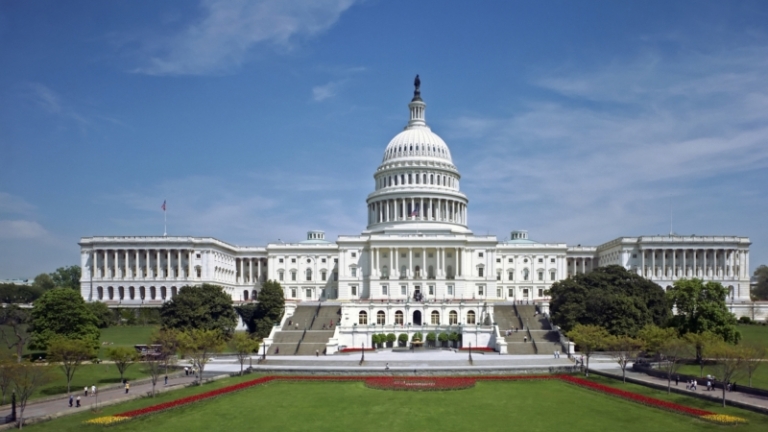
I. Legislative Branch
1) Legislation
Senate Bill Seeks to Advance US Partnerships in the Eastern Mediterranean. On April 29, Sen. Cory Booker (D-NJ) introduced S.4443, which would expand US engagement in the Eastern Mediterranean, including through partnerships with Israel and Egypt, to advance energy, trade, and critical infrastructure, and to support the India-Middle East-Europe Economic Corridor.
House Resolution Commends Pakistan for Mediation Efforts in Iran War. On April 29, Rep. Al Green (D-TX) introduced H.Res.1225, which commends Pakistan “for its efforts to facilitate peace between the United States and Israel with Iran.”
Senate Rejects Iran War Powers Resolution for Sixth Time. On April 30, the Senate rejected a War Powers resolution, the sixth such measure to fail, that would have halted US military operations against Iran without Congressional approval. The resolution, introduced by Sen. Adam Schiff (D-CA), failed in a 50–47 vote, with Sen. Susan Collins (R-ME) joining Democrats in support. The vote came as the war approached a 60-day War Powers Resolution deadline on May 1.
Between April 27 and 30, Democrats in the House and Senate introduced new Iran War Powers legislation, including resolutions led by Reps. Maxine Dexter (D-OR), John Garamendi (D-CA), Seth Moulton (D-MA), Becca Balint (D-VT), and Jesús García (D-IL), alongside bills introduced by Sens. Tim Kaine (D-VA) and Christopher Coons (D-DE).
House Resolution Condemns Alleged Antisemitism. On April 30, Rep. Josh Gottheimer (D-NJ) introduced H.Res.1239, which condemns “antisemitic hate-filled rhetoric and content disseminated by prominent online personalities, and urg[es] social media platforms and public leaders to denounce and address such conduct.” The resolution explicitly targets media personalities Hasan Piker and Candice Owens, stating that Piker “has often used antisemitic rhetoric, including expressing support for Hamas,” and that Owens “has employed rhetoric that has included conspiracy theories accusing Israel of controlling the United States.”
House Bill Targets Iran War Funding. On April 30, Rep. Val Hoyle (D-OR) introduced H.R.8592, which would amend the Congressional Budget and Impoundment Control Act of 1974 to allow Congress to block reconciliation measures that fund unauthorized US military operations against Iran.
House Member Introduces FY27 National Security/Department of State Appropriations Bill. On April 30, Rep. Mario Diaz-Balart (R-FL) introduced H.R.8595, the Fiscal Year (FY) 2027 National Security, Department of State, and Related Programs Appropriations bill.
2) Personnel and Correspondence
HFAC Democrats Press Rubio and Mast for Briefing on Iran Negotiations. On April 29, House Foreign Affairs Committee (HFAC) Ranking Member Gregory Meeks (D-NY) led all Committee Democrats in companion letters to Secretary of State Marco Rubio and Chairman Brian Mast (R-FL), demanding a comprehensive briefing on the status of US negotiations with Iran.
3) Hearings and Briefings
HASC, SASC Hold Hearings on FY27 Department of War Budget Request. On April 29, the House Armed Services Committee (HASC) held a hearing on the administration’s Fiscal Year 2027 (FY27) military budget proposal. Secretary of War Pete Hegseth and Chairman of the Joint Chiefs of Staff Gen. Dan Caine testified on Capitol Hill for the first time since the start of the Iran war. During the hearing, the Pentagon’s acting chief financial officer, Jules Hurst, said that the war in Iran has cost the United States $25 billion to date. Democrats hammered Hegseth over his characterization of the war, its cost, and its objectives.
On April 30, Hegseth and Caine testified before the Senate Armed Services Committee (SASC), where several Democrats challenged the Pentagon’s $25 billion war estimate, arguing that the figure understates the true cost. Hegseth also clashed with Sen. Tim Kaine (D-VA) over the 60-day War Powers Resolution deadline for President Donald Trump to withdraw US forces or seek congressional authorization. Hegseth argued that the clock stopped when Trump announced the ceasefire on April 7. Kaine countered that the law did not support that interpretation and maintained that, by May 1, Trump must have obtained authorization to continue the war, ended it, or requested a 30-day extension to safely withdraw troops.
II. Executive Branch
1) White House
Vance Doubts Pentagon’s Portrayal of Iran War. On April 27, The Atlantic reported that Vance has privately expressed concern that the war is depleting US weapons stockpiles, as well as skepticism about how the Pentagon is portraying the war to President Trump.
Trump Administration Rejects Iranian Proposal to Reopen Strait of Hormuz. On April 27, The Wall Street Journal reported that Trump was unhappy with Iran’s latest proposal because it does not address Iran’s nuclear program, though Trump did not reject it outright. Iran proposed that it would reopen the Strait of Hormuz in exchange for the United States lifting its blockade on Iranian ports and ending the war.
That same day, Secretary of State Rubio told Fox News that Iran’s proposal was unacceptable and ruled out any deal that excludes Iran’s nuclear program.
On April 28, Trump said, without offering evidence, that Iran had told the United States that it is in a “State of Collapse” and wanted Washington to reopen the Strait of Hormuz as soon as possible while Tehran tried to “figure out” its leadership situation. The same day, the Wall Street Journal reported that Trump had told his aides to prepare for an extended blockade of Iran.
The next day, Trump wrote on Truth Social, accompanied by an AI-generated image of him brandishing an automatic weapon, that “Iran can’t get their act together. They don’t know how to sign a nonnuclear deal. They better get smart soon!” He also stressed to Axios that the United States would not lift its blockade of Iranian ports until a nuclear deal is reached, adding that “the blockade is somewhat more effective than the bombing.”
Trump Attacks German Chancellor Merz Over Iran. On April 28, President Trump criticized German Chancellor Friedrich Merz over his lack of enthusiasm for the war, claiming that Merz “thinks it’s OK for Iran to have a Nuclear Weapon.” Trump’s remarks came after Merz said that the United States had been “humiliated by the Iranian leadership.” The next day, Trump said that the United States was “studying and reviewing the possible reduction” of its troops stationed in Germany.
On May 1, the Pentagon confirmed that the United States would withdraw some 5,000 troops from Germany over the next six to 12 months.
Trump Tells Netanyahu to Limit Lebanon Strikes to “Surgical” Operations. On April 29, in an interview with Axios, President Trump said that he had told Israeli Prime Minister Benjamin Netanyahu to limit military action in Lebanon to “surgical” strikes to avoid a full resumption of the war. He added that Netanyahu “must carry out the order more carefully, not destroy the buildings…it is absolutely horrific and harms Israel’s image.”
Trump Congratulates al-Zaidi on Nomination as Iraqi Prime Minister. On April 30, President Trump congratulated Ali al-Zaidi on his nomination as the next prime minister of Iraq, saying that “we look forward to a strong, vibrant, and highly productive new relationship between Iraq and the United States.”
Trump Claims Hostilities in Iran “Terminated” in Letter to Congressional Leaders. On May 1, President Trump said in a letter to House Speaker Mike Johnson (R-LA) and Sen. Chuck Grassley (R-IA) that US hostilities with Iran had “terminated,” citing the April 7 ceasefire, and asserting that the 60-day War Powers Resolution deadline no longer applied.
Senate Foreign Relations Committee Ranking Member Jeanne Shaheen (D-NH) said that Trump’s claim “doesn’t reflect the reality” that US forces remain at risk, that the administration continues to threaten escalation, and that the Strait of Hormuz remains closed.
On the same day, Trump told reporters that he did not plan to seek congressional approval for the Iran war, arguing that “it’s never been sought before” and suggesting that the War Powers Act was “totally unconstitutional.”
Trump Rejects Iran Proposal; Says United States Will “Guide” Stranded Ships from Strait of Hormuz. On May 1, President Trump said that he was not satisfied with Iran’s latest proposal to end the war, blaming the country’s “fractured” leadership. The next day, Trump said that he was reviewing a new Iranian proposal but added that he “can’t imagine that it would be acceptable in that they have not yet paid a big enough price for what they have done to Humanity, and the World, over the last 47 years.”
On May 3, Trump said that the proposal was unacceptable. He added that on May 4 the United States would begin an effort to “guide” ships out of the Strait of Hormuz, calling the process “Project Freedom” and asserting that it was a “humanitarian gesture.”
2) Department of State
Department Approves Military Sale to Tunisia. On April 27, the Department of State approved a possible Foreign Military Sale to Tunisia of equipment to support its Border Security Project Phase III, with an estimated cost of $95 million. The project, launched in 2016, involves the installation of an advanced border surveillance system to strengthen Tunisia’s ability to combat smuggling and terrorism.
Rubio Speaks with British, German Counterparts. On April 29, Secretary Rubio spoke separately with German Foreign Minister Johann Wadephul and British Foreign Secretary Yvette Cooper to discuss Iran and the need to restore freedom of navigation in the Strait of Hormuz.
Department Welcomes Morocco’s Signing of Artemis Accords. On April 29, the Department of State welcomed Morocco’s signing of the Artemis Accords, a US-drafted set of principles guiding international cooperation in peaceful space exploration.
United States Aims to Build Coalition to Restore Shipping Through Hormuz. On April 29, the Wall Street Journal reported, citing an internal Department of State cable, that the Department had instructed US embassies to press foreign governments to join a new US-led international coalition to restore freedom of navigation in the Strait of Hormuz. The effort, dubbed the “Maritime Freedom Construct,” would share information, coordinate diplomatically, and help enforce sanctions.
Department Dedicates New US Consulate General in Casablanca. On April 30, Deputy Secretary of State Christopher Landau joined US Ambassador to Morocco Duke Buchan III and Moroccan officials to dedicate the new US Consulate General in Casablanca.
United States Condemns Global Sumud Flotilla. On April 30, Deputy Spokesperson Tommy Pigott released a statement condemning the Global Sumud Flotilla as a “pro-Hamas initiative and a baseless, counterproductive effort to undermine President Trump’s Peace Plan.” Pigott also urged US allies to take “decisive action” against the flotilla. The flotilla was a peaceful sea convoy that sought to break Israel’s blockade of Gaza to deliver humanitarian aid to the besieged enclave. On April 29, Israel, operating in what activists said were international waters, intercepted the convoy near the Greek island of Crete and detained participants.
Department Approves $8.6 Billion in Arms Sales to Israel, Kuwait, Qatar, and UAE. On May 1, the Department of State approved possible Foreign Military Sales totaling over $8.6 billion to Israel, Kuwait, Qatar, and the United Arab Emirates (UAE). The proposed sales include:
- Qatar — Patriot air and missile defense replenishment services ($4.01 billion) and Advanced Precision Kill Weapon Systems ($992.4 million);
- Kuwait — Integrated Battle Command System ($2.5 billion);
- Israel — Advanced Precision Kill Weapon Systems ($992.4 million);
- UAE — Advanced Precision Kill Weapon Systems ($147.6 million).
This marks the third time that the Trump administration has issued an emergency authorization during the Iran war to bypass congressional review of arms sales.
Following the announcement, Rep. Gregory Meeks (D-NY) criticized the administration for bypassing Congress.
3) Department of War
US Military Begins African Lion 2026 Joint Exercise. On April 28, the US and Moroccan militaries launched African Lion 26, AFRICOM’s largest annual joint military exercise, hosted across Ghana, Morocco, Senegal, and Tunisia. AFRICOM later announced that two US service members taking part in the exercise were reported missing in Morocco on May 2.
CENTCOM Commander to Brief Trump on New Iran Military Options. On April 30, CENTCOM Commander Adm. Brad Cooper was expected to brief President Trump on new plans for potential military action against Iran, Axios reported. Options on the table reportedly include “short and powerful” strikes on Iranian targets and a takeover of parts of the Strait of Hormuz.
Separately, Bloomberg reported that CENTCOM has requested the deployment of the military’s secretive “Dark Eagle” hypersonic missile to the Middle East for possible use against Iran. The request was reportedly based on intelligence that Iran had moved its ballistic missile launchers out of range of the US Precision Strike Missile. If approved, the deployment would mark the first operational use of the long-delayed weapon.
AFRICOM Conducts Strikes in Somalia. On April 30, US forces conducted an airstrike against al-Shabab in Somalia.
Pentagon Claims US Naval Blockade Has Cost Iran $4.8 Billion. On May 1, a Pentagon official told The Hill that the Department of War estimated that the US naval blockade has lost Iran about $4.8 billion in oil revenues.
4) Department of the Treasury
Treasury Targets Iran’s Shadow Banking System. On April 28, the Department of the Treasury’s Office of Foreign Assets Control (OFAC) designated 35 entities and individuals overseeing Iran’s “shadow banking” system, a clandestine financial system set up to evade sanctions.
On May 1, OFAC designated three Iranian foreign currency exchange houses, along with their affiliated individuals and associated companies.
On the same day, the Department of State sanctioned several entities, an individual, and a vessel for their role in facilitating the trade of Iranian petroleum and petroleum products.
Treasury Warns Shippers Not to Pay Hormuz Tolls. On May 1, the Department of the Treasury warned that shippers risk punitive sanctions if they pay tolls to Iran for passage through the Strait of Hormuz, including by making charitable donations to organizations such as the Iranian Red Crescent Society.
III. Judicial Branch
Judge Blocks Administration from Ending Yemenis’ Temporary Protected Status. On May 1, a federal judge blocked the Trump administration from ending Temporary Protected Status for nearly 3,000 Yemeni nationals in the United States, ruling that the protection should be extended.