The latest poll from the Palestinian Center for Policy and Survey Research (PCPSR), carried out in August 2026, shows some surprising results: support for Hamas has plummeted to just 24 percent—down from 35 percent in the previous poll in October 2025, shortly after the ceasefire with Israel in Gaza was announced.
Some observers might argue that the decline in Palestinian support for Hamas is evidence that the Israeli military’s genocidal campaign in Gaza is bearing fruit, and that the victory promised by Israeli leaders may be getting closer. But while the polling data may be eye-catching, interpreting the numbers requires reading Palestinian public sentiment correctly at an unprecedented moment. Misreading that sentiment risks drawing the wrong conclusion from the PCPSR poll.
Support for Hamas has plummeted to just 24 percent—down from 35 percent in the previous poll in October 2025.
Looking at how Palestinian respondents answered questions about all political parties, not just Hamas, is essential for understanding Hamas’s 11 percentage-point decrease in support. Political support for the Fatah Party, Hamas’s most important rival, was notably unchanged between the two polls. This implies that respondents who stopped supporting Hamas did not gravitate to Fatah. Instead, most Palestinians seem alienated by both parties—a trend in Palestinian public opinion that has been on the rise for the better part of the last two decades. Politically, the biggest beneficiary of this shift is likely to be Marwan Barghouti, the Fatah leader imprisoned by Israel, who represents an alternative to both Hamas and the Fatah establishment led by Palestinian Authority President Mahmoud Abbas. Abbas personally continues to poll terribly: only 14 percent of respondents said that they would vote for him, and 79 percent said that they wanted him to resign.
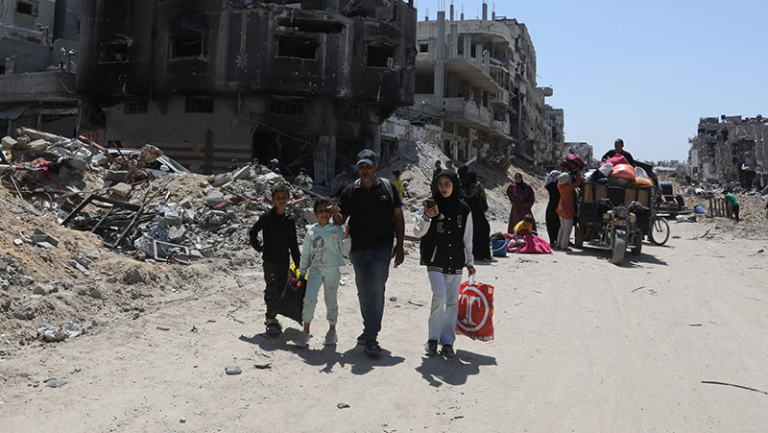
What is it about Hamas that has led to this decrease in support? Some suggest that Palestinians are moving away from Hamas because of the costs of Israel’s genocidal war on the Palestinian people in Gaza after the Hamas assault on October 7, 2023. If that were the case, we would expect the polling data to show that support for Hamas decreased at the height of the genocide. But the last two polls indicate the reverse. By the October 2025 poll, the war on Gaza had reached its peak in terms of casualties per day and sheer destruction. While Israel’s killing has continued since the so-called ceasefire on October 10, 2025, the number of daily casualties is now far lower. Why should support for Hamas fall when the costs imposed on Palestinians by Israel’s war have become less intense?
Two important developments since October 2025 can better explain this shift in public opinion. The first is the change of leadership in Hamas and the election of Khalil al-Hayya rather than Khaled Meshaal as chair of its political bureau. The second—and arguably the more important—is Hamas’s expressed readiness to agree to some form of disarmament.
72 percent of respondents opposed the idea of Hamas disarming before a full Israeli withdrawal from Gaza.
The August 2026 poll shows that 72 percent of respondents opposed the idea of Hamas disarming before a full Israeli withdrawal from Gaza. Equally important, respondents also expressed very little trust in the institutions with which Hamas is negotiating. Only 24 percent of respondents said they trust the Board of Peace, for example. Palestinian respondents also rate the performance of Hezbollah, the Houthis, and Iran—all of whom have been directly engaged in fighting Israel—more positively than Egypt, Saudi Arabia, or Turkey. This response offers further insight into the kind of political approach valued by Palestinians at this time.
The decrease in support for Hamas most likely does not signal declining support for challenging Israel, but rather disappointment in Hamas for appearing to retreat from its commitment to resistance by accepting the principle of disarmament. The polling data reflect a public that is clear about the identity of its oppressor—Israel—and about the need to confront it directly in pursuit of liberation, while becoming increasingly uncertain about which leaders are capable of doing so effectively.
The views expressed in this publication are the author’s own and do not necessarily reflect the position of Arab Center Washington DC, its staff, or its Board of Directors.
Featured image credit: Anas Mohammed via Shutterstock