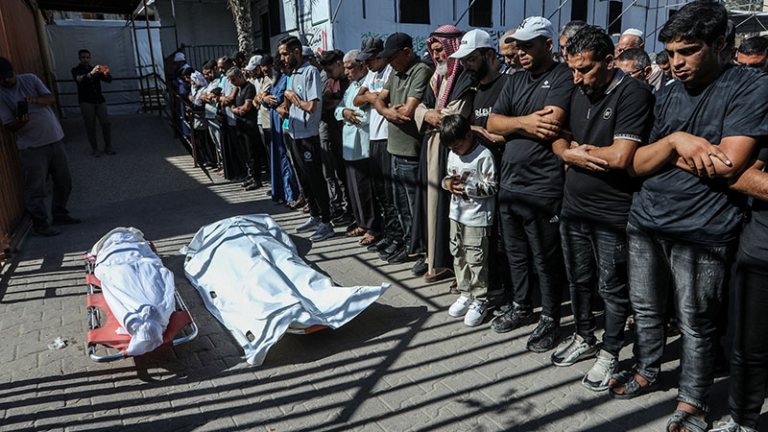
One year after President Donald Trump secured a ceasefire deal between Hamas and Israel in Gaza, Israel continues to kill Palestinians on a near daily basis, while the international demand to stop this violence has waned. The Palestinian Health Ministry in Gaza has reported that, as of October 22, 2026, Israeli forces have killed 1,538 Palestinians and injured 5,498 since the ceasefire was signed. The deal may have been heralded as an end to the conflict, but in reality, it simply redirected global pressure to end the violence against Palestinians in Gaza.
Announced with all the fanfare that has become a hallmark of Trump’s initiatives, the October 9, 2025, ceasefire deal was little more than a choreographed show. The agreement purported to offer a diplomatic solution to the crisis, but the concerns that had driven the global call for a ceasefire—namely the killing and destruction across Gaza—were left unresolved. With a few strokes of the pen in the Egyptian resort city of Sharm el-Sheikh, governments could point to progress without delivering any real security to Palestinians.
It is true that, prior to the ceasefire agreement, Israel was killing Palestinians in Gaza at a much higher rate: over 67,000 Palestinians were killed between October 7, 2023, and October 3, 2025. These killings were wanton, lacked any strategic objective, and came at considerable reputational cost for Israel. The ceasefire was signed long after the strategic utility of Israel’s military campaign had ended, providing the Israelis an opportunity to get back their captives while slowing the damage to their international standing.
With a few strokes of the pen in Sharm el-Sheikh, governments could point to progress without delivering any real security to Palestinians.
What began to change after the ceasefire was the amount of international attention given to the situation in Gaza. It went from being a dominant issue in the media for two consecutive years only to recede quickly into the background. According to national media watch group FAIR, US media coverage of Gaza dropped to less than two-thirds the level before the ceasefire in the three months following the agreement. Global attention had moved on.
This diminished attention also accompanied a shift in the discussion about Gaza itself. Prior to the ceasefire, the key political question was about how to end Israel’s assault and stop the massive bloodshed and destruction that had characterized the previous two years of the war. After the ceasefire, the significantly diminished international discussion on Gaza began to focus on the implementation of the agreement and aid delivery mechanisms. While these are critical issues, they obscure the more fundamental fact that Palestinians are still being subjected to the horrific conditions that the ceasefire was supposed to remedy. The ceasefire agreement effectively transformed demands for action to stop the violence into a technical agenda for managing Gaza’s destruction. The ceasefire agenda led to discussion of who would distribute aid, how reconstruction would be managed, and who would oversee local governance. Though these questions are important, they have effectively replaced such equally crucial questions as who is responsible for the mass killing and destruction in Gaza? Who continues to kill Palestinians? Who controls access to Palestinian land? And what are the consequences of these decisions?
It has never been more important for the international community to shoulder its collective responsibility for the mass violence that has been inflicted on Palestinians.
One year into the so-called ceasefire, it has never been more important for the international community to shoulder its collective responsibility for the mass violence that has been inflicted on Palestinians. Instead, the world has apparently moved on. Israel continues to kill Palestinians in Gaza, while preventing the political and physical reconstruction outlined in the terms of the ceasefire deal. On October 12, 2026, the United Nations Office for Human Rights in the Occupied Palestinian Territory called on “third States to implement their duty to exercise influence over Israel to stop its violations of international law in Gaza, including by ceasing the supply of weapons and munitions facilitating serious violations of international law, and supporting the work of international accountability mechanisms.”
But even if large-scale reconstruction does begin in Gaza, it risks becoming another framework through which responsibility is deflected. Israel has bombarded Gaza time and again, with this latest war proving the most destructive. It should not be lost on anyone that each reconstruction process that has followed Israel’s previous wars on Gaza did not come with accountability for the destruction itself. On the contrary, Israel unleashed greater destruction in the next round. Oxfam estimated that the combined reconstruction costs in Gaza after the wars of 2008-09, 2014, and 2021 reached some $10 billion. After the genocidal war that began in 2023, however, the United Nations estimated the cost to rebuild the strip at over $71 billion. Should reconstruction begin without accountability for the destruction, what will stop Israel from once again devastating Gaza—or indeed elsewhere in the region—in the future?
A year after the ceasefire agreement, the appropriate measure of success should not be whether the world can move on from Gaza, but whether Palestinians can live in Gaza free from violence, suffering, and displacement and begin to rebuild their lives with both their well-being and rights safeguarded. Judged by this measure, the ceasefire agreement has been an abject failure.
Until the international community demands accountability, not only will the ceasefire continue to fail to end Israel’s violence against Palestinians, but it will also act as a smokescreen that makes this violence easier to ignore.
The views expressed in this publication are the author’s own and do not necessarily reflect the position of Arab Center Washington DC, its staff, or its Board of Directors.
Featured image credit: Anas Mohammed via Shutterstock