
On May 24, 2026, three Palestinian Arab parties in Israel announced that they would run on a joint list in the parliamentary elections scheduled to be held by October 27, 2026. After months of political maneuvering, arm-twisting, and speculation, three parties—Hadash, Ta’al, and Balad (as they are commonly referred to in their Hebrew acronyms)—came together and appealed to the fourth major Palestinian Arab party, Ra’am, to join forces with them. Haaretz has reported that Ra’am appears willing to run on the joint slate on condition that it retain its separate platform, freedom of maneuver, and political independence throughout the process, including in any coalition negotiations after the elections.
The idea of a unified Palestinian Arab list is not new. Indeed, similar attempts were made to unify the Arab vote in the 2015 and 2020 parliamentary elections. Today, 82 percent of Arab citizens of Israel favor a unified (or joint) list—a sentiment that party leaders ignore at their peril. The underlying goal of the joint list is to rally Arab political support behind a common electoral agenda of protecting the civic and political rights of Israel’s approximately 2.1 million Arab citizens (21 percent of the population), whose interests, aspirations, and deep sense of alienation are generally ignored or taken for granted by Jewish parties. These Arab citizens are not only part of the struggle against the protracted Israeli occupation of Palestinian territories and the creeping annexation of the West Bank; they are also horrified by the genocide in Gaza and by the epidemic of violent crime in Arab society. The prevalent Palestinian Arab perspective holds that Netanyahu is disastrous for the whole region—including for Israel itself.
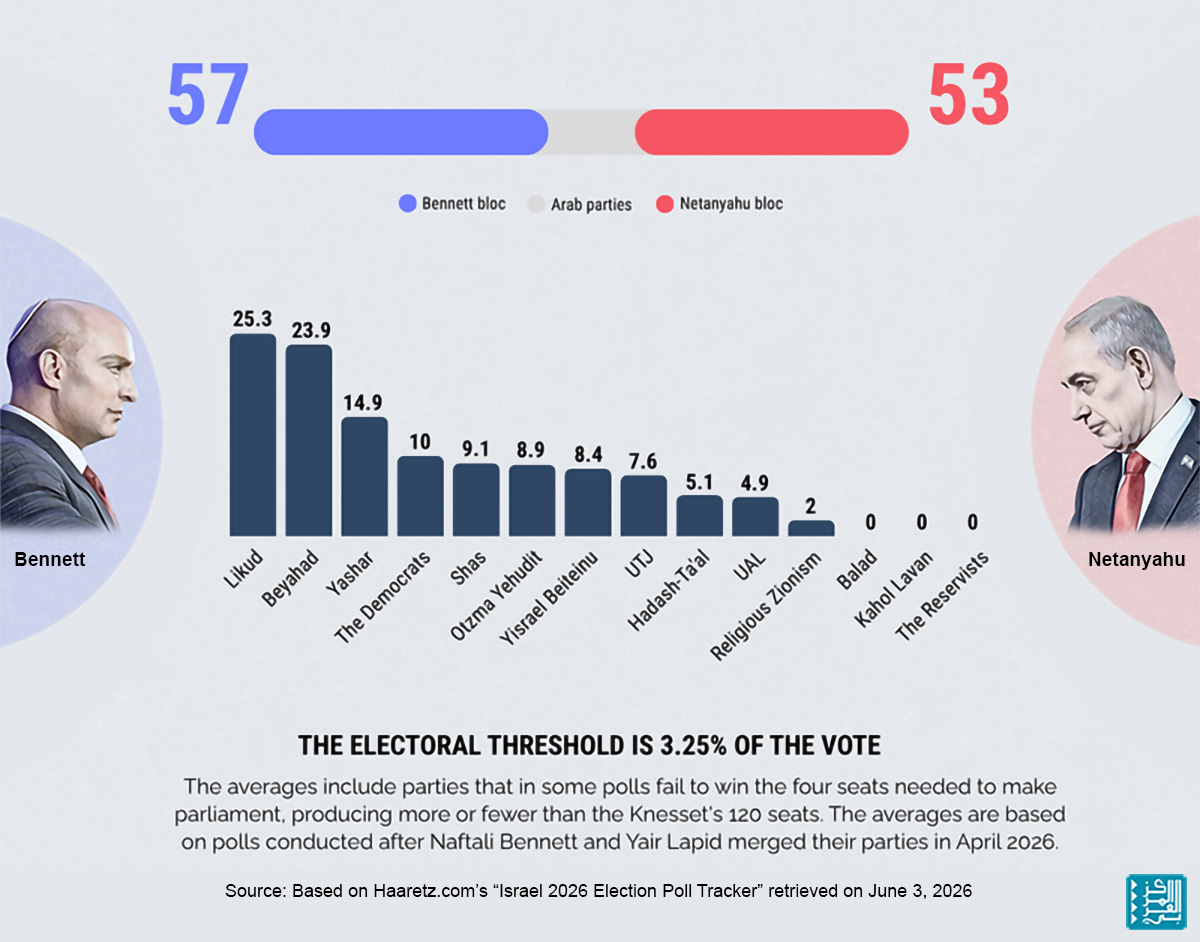
Polls project the parties on the Joint Arab List at least retaining their current 10 seats.
The Arab parties effectively seek to oust Prime Minister Benjamin Netanyahu by depriving him of the Knesset seats needed to form a ruling coalition that will sustain his racist, extremely right-wing, and warmongering policies. Late May 2026 public opinion polls project that the main bloc opposing Netanyahu, headed by the Bennett-Lapid alliance, will likely win only 63 Knesset seats—a slim majority—with the Likud-led bloc keeping 52, and the parties on the joint Arab list at least retaining their current 10 seats and potentially increasing that number to as many as 15. Such gains would make the joint list the third-largest bloc in the Knesset, giving Arab parties in Israel not just a sense of “influence with dignity,” but also a real opportunity to change Israeli policy.
The four most prominent Palestinian Arab parties are:
- Hadash, officially known as the Democratic Front for Peace and Equality, a left-wing political coalition established in 1977 when the Israeli Communist Party (then known as Rakah) merged with far-left Arab and Jewish political groups. The Hadash platform is anti-Zionist and socialist; the party focuses on social justice, Arab-Jewish equality, and labor rights, and is committed to the two-state solution.
- Ta’al, the Arab Movement for Renewal, founded in 1996. Ta’al has been associated with longtime Knesset member Ahmad Tibi. Its platform is generally anti-Zionist and Arab nationalist. The party has consistently run as part of joint lists due to its limited constituency and voting base.
- Balad, the National Democratic Assembly, founded in 1995 and currently headed by Sami Abu Shehadeh. Balad represents the far left of Israeli electoral politics. It champions turning Israel into a “state of all its citizens,” and supports the right of return and a one-state solution to the Israeli–Palestinian conflict.
- Ra’am, the United Arab List, currently headed by Mansour Abbas. Ra’am is a conservative Islamist party historically affiliated with the Southern Branch of the Islamic Movement in Israel.
The four parties have had varying degrees of electoral success. Hadash and Ta’al together currently have five seats in the Knesset, as does Ra’am, which, unlike the other Arab parties, in 2021 joined the Bennett-Lapid government. Balad is not represented in the current Knesset because it failed to pass the 3.25 percent electoral threshold in the 2022 elections.
The idea of a joint list is a step in the right direction, particularly if it manages to unseat Benjamin Netanyahu as prime minister and increases the number of Arab seats in the Knesset. However, its horizons are limited in today’s radicalized Israel, where even so-called centrist Jewish parties—including the newly formed Beyachad, headed by Naftali Bennett and Yair Lapid—have ruled out any cooperation with non-Zionist parties led by Arabs. If the Netanyahu government succeeds in designating the Southern Branch of the Islamic Movement in Israel as a terrorist organization, then its affiliated political party, Ra’am, would be legally prohibited from running in the elections. This move would prevent the Bennett-Lapid camp from receiving Ra’am’s political endorsement after the elections, to the benefit of Netanyahu. As Sami Abu Shehadeh, the leader of Balad, explained, “Netanyahu’s coalition and Bennett’s opposition are both making great efforts to prevent our ability to unite and for Palestinians to support their own political interests.”
The idea of a joint list is a step in the right direction, particularly if it manages to unseat Benjamin Netanyahu.
The final hurdle is for Palestinian-Arab leaders in Israel to overcome their ideological and sometimes personal differences to provide hope for a besieged and demoralized community. As Haaretz columnist Jack Khoury recently observed, the Arab public in Israel “is not interested in the ego battles of the parties, and will not be forgiving if the negotiations fail.”
Previous attempts at unity have been hampered by the perennial gap between political aspirations and the capacity of Arab politicians to realize them. This gap has to be closed. Before the elections, differences over personal agendas, narrow party interests, seat allocation, and leadership positions on the list have to be decisively overcome. If Palestinian-Arab party leaders wish to make a difference this time around, they must rise above petty politics and come together.
The views expressed in this publication are the author’s own and do not necessarily reflect the position of Arab Center Washington DC, its staff, or its Board of Directors.
Featured image credit: screencap via Whatsapp