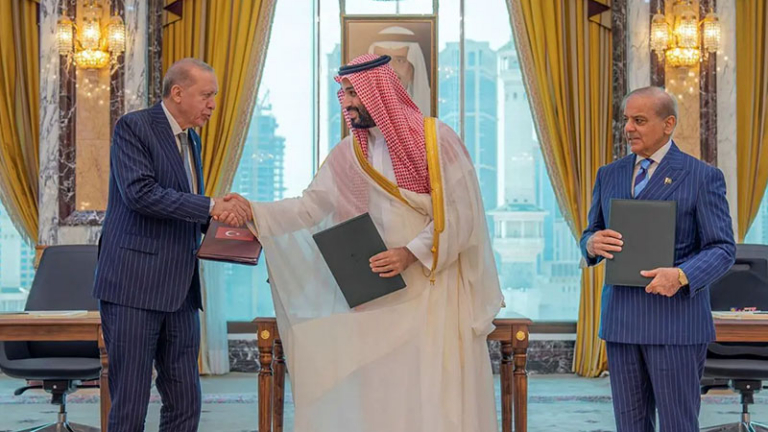
The recent recommencement of the conflict between Saudi Arabia and Yemen’s Ansar Allah movement, commonly known as the Houthis, raises important questions about the practical implications of the Mecca Joint Defense Agreement signed on August 7, 2026, and whether Saudi Arabia’s cosignatories, Pakistan and Turkey, may be asked to help the kingdom defend itself. Islamabad and Ankara have each responded cautiously to the Houthi strikes against Saudi Arabia, seeking to demonstrate unequivocal support for Riyadh without being pulled into the quagmire. Yet analysts may be mistaken in assuming that the primary purpose of the pact is to create a mutual defense alliance. Although the Mecca Agreement has yet to be ratified and much remains to be seen about what the security configuration means in practice, the importance of the agreement potentially lies in how it will improve military coordination among Pakistan, Saudi Arabia, and Turkey, institutionalizing security cooperation, pooling capabilities, and extending interoperability. From this perspective, the real significance of the Mecca Agreement is not its inclusion of a mutual defense clause comparable to the North Atlantic Treaty Organization’s (NATO) Article Five, but the additional depth it lends to the region’s security architecture.
The agreement’s signing could mark an important development in the evolution of regional order. Its implementation could create a more institutionalized framework for trilateral security cooperation, while enabling its signatories to integrate complementary military, industrial, financial, and strategic capabilities. To that end, the three countries have already agreed to establish a ministerial committee and permanent secretariat. In a Middle East that is being reshaped by the US-Israeli war on Iran, the Mecca Agreement could prove influential in defining the new regional order.
From this perspective, even non-signatories are likely to be affected by the defense pact. The smaller Gulf monarchies, in particular, will need to reassess their positions since the regional behemoth, Saudi Arabia, has joined the accord. Although Bahrain, Kuwait, Oman, Qatar, and the United Arab Emirates (UAE) share an interest in de-escalating regional hostilities, they also have very different views of Saudi leadership in the Arab world and consequently different approaches to the developing security environment in the Gulf. While the Mecca Agreement might strengthen Arab Gulf states’ capacity for collective deterrence, it could also exacerbate their differences over threat perceptions and partnerships. The agreement may unite Saudi Arabia with other regional states that share Riyadh’s concerns about Israeli aggression and policies to undermine strong Arab states, as well as its desire to de-escalate hostilities between Iran, Israel, and the United States. Yet the UAE’s alignment with Israel and India represents a competing configuration which may emerge as a more robust geopolitical bloc that challenges the Mecca Agreement, leading to further division within the Gulf at a time in which the Emirati-Saudi rivalry remains a defining fissure within the Gulf Cooperation Council (GCC).
If regional competition intensifies in relation to the Abu Dhabi-Riyadh rivalry, the agreement could evolve from a mechanism for diversification and collective security into a more explicitly defined pillar of a new regional alignment. Conversely, if Saudi Arabia and its partners can preserve the pact’s stated defensive and non-exclusive character, it could become a flexible framework capable of coexisting with the GCC, US security partnerships, and other regional arrangements. The perceptions of the smaller GCC members toward the Mecca Agreement will therefore be consequential for the evolution of the Gulf’s security architecture and broader geopolitical order.
Which Other Gulf States May Seek to Join the Agreement?
Pakistani and Turkish officials have communicated that the agreement must be ratified prior to any enlargement. Nonetheless, Islamabad and Ankara have both signaled that the configuration will have its doors open to additional members in the future. The two GCC states that appear most closely aligned with the strategic objectives of the alliance are Kuwait and Qatar, which analysts identify as potential candidates for any future enlargement of the group (along with other countries in the region, including Azerbaijan, Egypt, Jordan, and Syria).
Kuwait arguably has the strongest institutional foundation for supporting the configuration. The country ratified a bilateral defense agreement with Pakistan in July 2026, and then signed a new, expanded defense pact the following month, further strengthening a longstanding security partnership dating back to the 1980s. Kuwait has also maintained a significant security relationship with Turkey and historically close ties with Saudi Arabia. Kuwait’s accession to the agreement could appear almost a natural progression.
Kuwait and Qatar may prefer to preserve their cooperation with the agreement’s three signatories through bilateral channels.
Qatar also has a strong strategic fit with the Mecca Agreement, potentially making it a serious candidate for future participation. Among all the Gulf Arab states, Qatar has arguably the most institutionalized military relationship with Turkey, anchored by the Turkish military base that opened in April 2016. Doha’s defense ties with Pakistan are also longstanding, encompassing training, air force cooperation, military exercises, security assistance, and defense technology, even if they fall short of a formal alliance. The Israeli attack on Qatar in September 2025 was a traumatic episode that appears to have reinforced concerns in Doha about the reliability of the US security umbrella, even before Iranian attacks on the Gulf country in 2025 and 2026 further exposed its limitations. Against this backdrop, Qatari officials would likely view favorably a security agreement that complements, rather than substitutes for, Doha’s alliance with Washington. Qatar therefore has both the relationships and the strategic incentives that could make membership rational. Nonetheless, Doha may prefer to study the emerging configuration before committing, particularly to ensure that participation would not constrain Qatar’s considerable diplomatic flexibility.
Ultimately, Kuwait and Qatar may prefer to preserve their cooperation with the agreement’s three signatories through bilateral channels while maintaining an association with the broader configuration, rather than assume the obligations of full membership. Both already derive significant benefits from deep defense and defense-industrial ties with Pakistan and Turkey, making the prospective gains and potential costs of formal accession less clear. How Kuwait and Qatar weigh these competing considerations will likely determine whether they opt to join the agreement or maintain a looser association with it.
Cautious Observers
With a foreign policy rooted in neutrality, strategic autonomy, dialogue, and mediation, Oman has traditionally avoided treaty alliances that would place Muscat firmly within one geopolitical bloc and potentially pit the sultanate against states aligned with rival camps. Oman is therefore unlikely to emerge as a candidate for membership in the agreement. Yet Muscat is broadly supportive of what the configuration seeks to represent, as tensions with Washington, greatly exacerbated by President Donald Trump’s threats to “blow up” Oman, have strengthened Oman’s longstanding preference for strategic autonomy. Put simply, Oman would welcome greater regional burden-sharing on security, reduced dependence on the United States, and stronger regional deterrence against both Israeli and Iranian attacks on Arab states. The Mecca Agreement can, at least on paper, advance all three objectives, making Oman more likely to emerge as a political supporter of the configuration than as a formal member.
Abu Dhabi is unlikely to welcome Islamabad assuming a more prominent role in the Gulf’s security architecture.
Although the UAE has been careful to avoid overt criticism of the agreement, Abu Dhabi is probably uneasy about its potential ramifications. Friction in Emirati-Pakistani relations has intensified throughout 2026, with Abu Dhabi increasingly skeptical of Islamabad’s response to Iranian attacks on the UAE and its mediation efforts between Washington and Tehran. At a time when the UAE has elevated India over Pakistan as its principal South Asian partner, Abu Dhabi is unlikely to welcome Islamabad assuming a more prominent role in the Gulf’s security architecture. The pact’s broader implications may also give the UAE cause for concern. Widely perceived as a challenge to the Abraham Accords, the agreement could conflict with Abu Dhabi’s vision of a regional order anchored in a strategic triangle linking India, Israel, and the UAE. Moreover, the US-Iran crisis has done little to resolve the underlying sources of Emirati-Saudi rivalry, with Abu Dhabi remaining in competition with Riyadh for geopolitical influence in the region. The UAE’s decision not to join the July 2026 Saudi-led maritime coalition, established to uphold freedom of navigation in the Red Sea and Gulf of Aden, similarly underscored Abu Dhabi’s reluctance to participate in regional initiatives that strengthen Saudi Arabia’s leadership position in the Arab-Islamic world.
Yet institutional reluctance should not be mistaken for outright opposition to cooperation. Even if the UAE is highly unlikely to join the agreement formally, Abu Dhabi could still find value in cooperating with the alliance and, more importantly, with its individual members on matters where interests converge. The UAE’s approach is therefore likely to be one of selective engagement whereby Abu Dhabi preserves strategic flexibility while avoiding commitments that could strengthen a regional configuration at odds with its own vision for the Middle East.
Bahrain’s exceptionally close ties with both Saudi Arabia and the UAE could complicate Manama’s assessment of the agreement. Given its reliance on Riyadh and Abu Dhabi for security support, Bahrain will likely factor the preferences of both partners heavily into its calculus. Its normalized relationship with Israel may also make Manama cautious about joining a configuration that some observers could interpret, at least in part, as an effort to balance against Israel as well as Iran. Like Egypt, which is also not a signatory, Bahrain must carefully navigate the Saudi-UAE rivalry because the costs of alienating either would be high.
The Agreement’s Future Depends on a Fragmenting Regional Order
The agreement should ultimately be understood as an important but still unsettled development in the Gulf’s rapidly changing security architecture seven months into the US-Israeli war on Iran. Its significance will depend in no small part on Pakistan, Saudi Arabia, and Turkey’s ability to translate their political commitment into sustained military cooperation, interoperability, defense industrial collaboration, and, most importantly, a credible collective deterrent. At the same time, how Saudi Arabia’s fellow GCC states respond to a configuration that potentially offers an additional source of security outside the traditional US-centered framework will contribute to the shaping of this agreement’s future.
The Mecca Agreement has the potential to mature into a flexible and adaptive framework capable of complementing other regional architectures.
The GCC response is unlikely to be uniform. At a time when regional security crises have exposed deeper divisions within the Gulf, the further institutionalization of the Pakistani-Saudi-Turkish configuration could ultimately widen those fractures. With Riyadh joining Ankara in opposing Israeli efforts to further fragment already fragile states in the Arab world and Africa, including Lebanon, Somalia, and Syria, the Mecca Agreement reflects a shared desire to resist the emergence of a regional order defined by Israeli dominance in the absence of any comparable power capable of constraining it. The UAE, by contrast, has frequently aligned with Israel in supporting nonstate and substate actors that challenge the territorial integrity of states across the region, including in Somalia and Yemen. Against this backdrop, growing instability in the Middle East and parts of Africa, compounded by the US-Iran crisis and a new and increasingly dangerous phase in the unresolved Yemeni civil war, is placing greater geopolitical pressure on smaller GCC states as they navigate tensions between the Mecca Agreement’s members, on one side, and the India-Israel-UAE nexus, on the other.
These divergent positions point to a development potentially more consequential than the question of which GCC states eventually join the agreement: the potential emergence of a broader Eurasian geopolitical divide. Pakistan, Saudi Arabia, and Turkey increasingly appear to be developing one strategic axis, while Greece, India, Israel, and the UAE are developing another set of increasingly interconnected relationships. This should not be interpreted as evidence of two formal alliances, nor does it mean that every member of either grouping shares identical interests. Nevertheless, the growing overlap among their security, diplomatic, economic, and defense relationships creates the potential for competing regional configurations to emerge.
Within this geopolitical context, it will be necessary to see how the Mecca Agreement operates in practice following its ratification. If friction heats up between Saudi Arabia and the UAE, the configuration could gradually transcend its original function as a vehicle for security diversification and collective defense, evolving instead into a more clearly delineated pillar of an emerging regional order. However, the Mecca Agreement also has the potential to mature into a flexible and adaptive framework capable of complementing, rather than competing with, other regional architectures. The alliance’s trajectory will therefore depend on the intentions of its members as well as their ability to prevent it from becoming an instrument of geopolitical polarization in the Gulf and the rest of West Asia.
The views expressed in this publication are the author’s own and do not necessarily reflect the position of Arab Center Washington DC, its staff, or its Board of Directors.
Featured image credit: SPA