The US-Israeli war on Iran has spilled over into other countries, including neighboring Iraq. The Kurdistan Region of Iraq has been highly exposed to the conflict, despite its claimed neutral stance in the war. The region hosts an estimated 2,000 US troops, making the region a target for multiple Iranian attacks during the war. Iranian Kurdish opposition groups in the region were also hit by more than 800 Iran-linked drone and missile attacks between the start of the war on February 28 and April 20, 2026. Tehran accuses these groups of engaging in separatist activities against the Islamic Republic and of cooperating with the United States (Washington reportedly considered arming them against Iran early in the war).
Besides the Kurdistan Region of Iraq’s vulnerability to external attack, the war is highlighting, if not intensifying, the internal challenges currently facing the region. The two main Kurdish parties in Iraq, the Erbil-based Kurdistan Democratic Party (KDP) and the Sulaymaniyah-based Patriotic Union of Kurdistan (PUK), are deadlocked over forming a new regional government and revenue-sharing. The Kurdish armed forces, the Peshmerga, continue to be divided along partisan lines. The absence of a single political strategy has complicated coordination within the Kurdistan Regional Government (KRG) itself, as well as with the central government in Baghdad and with the United States and other international actors.
Continued attacks by Iran and Iran-aligned militias may deepen Kurdish reliance on the United States as a security guarantor, particularly among factions that view a continued US military presence as essential to protecting the region from more war spillover. Following the 2025 drawdown of US forces from areas under Baghdad’s direct control, US troops in Erbil now constitute Washington’s main military footprint in the country. Some voices in Washington, however, have questioned whether the United States should withdraw these forces, as well. As a result of the Iran war, the Kurdistan Region of Iraq is becoming simultaneously more vulnerable and more strategically important.
Rather than fostering unity, the war has exposed deep political and institutional weaknesses within the KRG and the federal state, increasing the likelihood of renewed disputes between Erbil and Baghdad. These developments complicate US efforts to assist in building a more coherent political order in Iraq and risk leaving Washington caught between two unsatisfactory options: maintaining a military presence that may itself become a focal point of escalation, or disengaging in ways that could weaken local partners and expose both the KRG and the Iraqi state to greater external pressure.
A Region Under Pressure
The Kurdistan Region of Iraq has long occupied a unique position in the country. Its relative autonomy dates to the aftermath of the 1991 Gulf War, when the imposition of a US-enforced no-fly zone allowed Iraqi Kurdish parties to establish a de facto autonomous administration that was outside Baghdad’s control. Following the 2003 US-led invasion, this autonomous status was recognized in Iraq’s 2004 Transitional Administrative Law and entrenched in the 2005 Constitution, which formally recognized the Kurdistan Region as a federal entity within Iraq and preserved many of its existing governing institutions. The KRG has maintained its own government bureaucracy, parliament, and security forces, while participating in Iraq’s broader federal political system.
Since the US invasion, the Kurdistan Region of Iraq has emerged as one of the country’s most stable and pro-Western regions. The United States invested heavily in training and supporting the Peshmerga, while successive Kurdish governments developed close political, economic, and security ties with Washington. At the same time, the KRG’s relations with Baghdad have frequently been strained by disputes over the allocation of federal budget funds, control over oil exports and revenues, the status of disputed territories in northern Iraq such as oil-rich Kirkuk, and competing interpretations of the powers granted to the KRG under Iraq’s federal system.
Kurdish leaders are finding it increasingly difficult to balance competing pressures at a moment of heightened regional uncertainty.
The KRG has also been vulnerable to regional pressures. The presence of anti-Turkey and anti-Iran Kurdish opposition groups in the region’s mountainous border areas, combined with its close security relationship with the United States, has repeatedly exposed it to cross-border operations by Iran and Turkey, both of which view Kurdish militancy and separatist movements as national security threats. As a result, the KRG has navigated tensions with Baghdad and with neighboring states seeking to shape developments inside its territory.
Internally, Kurdish politics remain dominated by the KDP and PUK, whose power-sharing arrangement helped preserve stability but never fully resolved deeper competition over political authority, economic resources, and relations with external actors. Since 2003, both Kurdish parties have viewed the United States as an important security partner and as a source of political support, particularly through cooperation against the Islamic State and US assistance to the Peshmerga. At the same time, they have maintained different external relationships: the KDP has generally been closer to Turkey and Washington, while the PUK has cultivated stronger ties with Tehran and influential Shia factions in Baghdad. These competing alignments have traditionally been managed through pragmatic accommodation.
The Iran war, however, has placed this balancing strategy under growing strain. Although the KRG has insisted that its territory will not be used to launch attacks against neighboring states, it remains exposed to pressure from multiple directions. Iran and Iran-aligned militias oppose the KRG’s close security relationship with Washington, while Turkey has warned that it could intervene in the Kurdistan Region if Kurdish insurgent activity linked to the Iran war expands. Kurdish leaders are finding it increasingly difficult to balance competing pressures from Washington, Tehran, Ankara, and Baghdad at a moment of heightened regional uncertainty.
Continued US Dependence or Diversification?
Prolonged political deadlock between the KDP and PUK following Kurdistan’s October 2024 elections has weakened the KRG’s institutional cohesion at precisely the moment when greater unity is needed. Disputes over cabinet formation, revenue-sharing, and control over key ministries and security institutions have left the region without a fully functioning government for more than 18 months. The paralysis reflects a deeper competition between the two parties that has complicated decision-making, weakened coordination between rival Peshmerga forces, and limited the KRG’s ability to respond cohesively to mounting security and economic pressures.
In this context, heightened insecurity may push some Kurdish leaders, particularly in the KDP, to seek firmer commitments from Washington and perhaps a continued US military presence as a deterrent. Others may seek to distance themselves from Washington or at least to hedge their bets by deepening engagement with Baghdad or maintaining channels with Tehran. Competition between the KDP and PUK may intensify over how to navigate a more unstable regional order. Rather than producing a unified Kurdish response, the war on Iran risks deepening their differences and further complicating both the KRG’s relationship with Washington and its negotiating position vis-à-vis Baghdad.
Baghdad-Erbil Relations in Transition
The May 14, 2026, appointment of Iraqi Prime Minister Ali al-Zaidi, seen as a compromise candidate acceptable to a broad range of Iraqi factions, is unlikely to alter longstanding disputes between Baghdad and Erbil. Unresolved questions about budget transfers, oil exports, disputed territories, and whether the Peshmerga should be more integrated into the Iraqi army may intensify as the government in Baghdad navigates tensions created by the Iran war as well as budget allocations and questions over the status of Kurdish security forces.
For the KRG, its leverage with the al-Zaidi government will depend less on the identity of the prime minister than on continuing Kurdish (dis)unity itself. Longstanding KDP-PUK rivalry has frequently undermined the Kurdish negotiating position in Baghdad, particularly on the key disputed questions. As the Iran war places additional pressure on Iraq’s political system, the KRG’s ability to defend its interests may depend as much on overcoming its internal fragmentation as on the policies pursued by Baghdad.
Politics Meets Economics
Tensions between Baghdad and Erbil are most apparent when it comes to questions related to oil and the federal budget. While the country’s oil industry is concentrated in the south, northern Iraq—especially Kirkuk—has significant oil resources. Since 2003, Baghdad and Erbil repeatedly have disagreed about the management of oil resources, revenue-sharing, and the extent of the Kurdistan Region’s fiscal autonomy. While the KRG has sought to preserve a degree of independent control over energy exports and revenues, successive governments in Baghdad have insisted that oil policy falls under federal authority and that exports should be managed by national institutions. These disputes are closely linked to broader disagreements over budget transfers, federal oversight, and the constitutional balance between regional autonomy and central authority.
Successive governments in Baghdad have insisted that oil policy falls under federal authority.
These old tensions are still felt today. Under Iraq’s 2023–2025 budget framework, the KRG was supposed to be allocated 12.67 percent of total spending, conditional on transferring 400,000 barrels per day (b/d) of oil to the federal State Oil Marketing Organization and handing over non-oil revenues, such as customs duties, to the central government. Baghdad has repeatedly accused Erbil of failing to comply with these conditions, notably in retaining 120,000 b/d of oil for local use. The diverted oil is then refined at private plants controlled by the KDP and PUK, with the resulting fuel sold consumers at commercial prices. In March 2023, disagreement between Baghdad and Erbil reached a peak when oil exports were suspended through the KRG’s primary export route, the Iraq-Turkey pipeline, following an International Chamber of Commerce finding that Turkey had facilitated flows from the Kurdistan Region of Iraq without Baghdad’s approval. The closure removed roughly 230,000 barrels per day from markets and deprived the KRG of a critical revenue stream. Although exports partially resumed in September 2025 and a budget amendment established compensation arrangements for oil transferred through the federal system, the broader dispute over revenue-sharing and control of energy resources remains unresolved.
The KRG is heavily dependent on transfers of funds from the federal budget to pay public-sector salaries, while Baghdad has used its control over these transfers, plus auditing requirements and oil export rules, as tools to impose federal authority. In 2025, tensions again escalated when Baghdad halted or delayed salary payments, arguing that the KRG had exceeded its legal budget allocation, while Kurdish officials accused the federal government of using salaries as political leverage.
Such rows are likely to become even more politically charged in the aftermath of the Iran war. The KRG may argue that its heightened exposure to Iranian and Iran-linked militia attacks strengthens the case for predictable budget transfers from Baghdad, the continued independence of the Peshmerga, and greater fiscal flexibility. Baghdad is likely to make additional support conditional on fuller KRG compliance with federal revenue-sharing arrangements. Arguments over oil and the budget are not simply technical problems to be solved; they represent a highly political contest between Kurdish autonomy and federal authority.
A Fragmented Security Order
Underlying the tensions over revenue is the absence of a unified monopoly over the use of force in post-2003 Iraq. The country’s security landscape remains divided among state forces, the Kurdish Peshmerga, and Iraqi militias, some of which maintain close ties to Iran and operate with considerable autonomy despite their formal incorporation into the state.
The Iran war has exposed the limits of this fragmented order. Attacks targeting the Kurdistan Region of Iraq have called attention to both Baghdad’s uneven control over Iran-aligned factions and the KRG’s inability to insulate itself from the wider regional confrontation. At the same time, the Peshmerga remain divided along KDP-PUK lines. While this division has complicated coordination and the development of a unified Kurdish security structure, it has also historically functioned as a form of internal balance, preventing either party from monopolizing force and contributing to a degree of political equilibrium.
The result is a hybrid security order in which multiple armed actors operate according to different chains of command and political priorities. The Iran war has demonstrated how quickly wider regional conflict can strain this already fragmented system, blurring the line between domestic and external security and exposing the limits of both Iraqi sovereignty and Kurdish autonomy.
The KRG and the Future of Iraq’s Political Order
The attacks on Kurdish territory by Iran-aligned militias have exposed both the vulnerability of the KRG, one of America’s longest-standing regional partners, and the limits of Iraq’s fragmented security order. This targeting pulls US policy in opposite directions. Continued attacks by Iran-aligned militias may strengthen arguments that a US military presence makes Iraqi Kurdistan a locus of regional escalation. But the proposed solution—US disengagement—could weaken local partners, allow militia influence to increase, and leave both the KRG and the Iraqi state more vulnerable to external pressure.
The challenge for Washington is therefore not whether, but how, to remain in Iraq. As Baghdad and Erbil navigate the drawn-out Iran war, the durability of US influence may depend less on its military footprint than on its ability to support political accommodation, economic stability, and security cooperation between these two centers of power. In that sense, the future of the KRG is becoming a broader test of whether the United States can balance the desire to sustain its influence in Iraq with the goal of reducing its own direct exposure to regional conflict.
The views expressed in this publication are the author’s own and do not necessarily reflect the position of Arab Center Washington DC, its staff, or its Board of Directors.
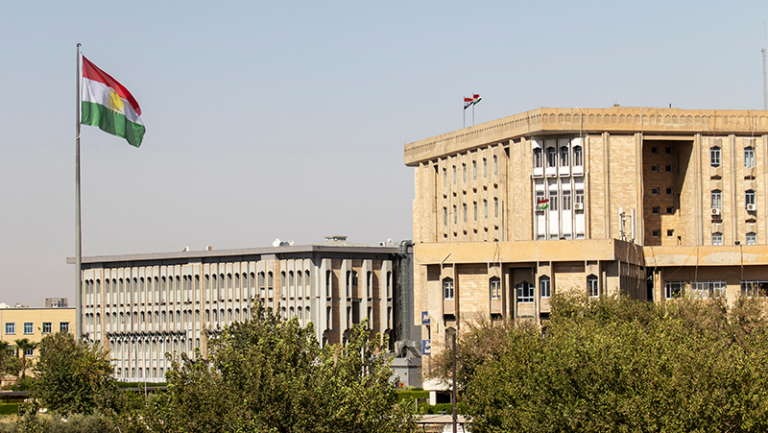
Featured image credit: Serhii Ivashchuk via Shutterstock