In January 2026, clashes between Syrian government forces and the Syrian Democratic Forces (SDF) resulted in Damascus regaining large parts of territory that had been under the control of the Democratic Autonomous Administration of North-East Syria (DAANES). After its creation in 2015, the multi-ethnic SDF enjoyed having the United States as its principal patron in its campaign against remnants of the so-called Islamic State (IS) in Syria. Now, the Trump administration has backed the Syrian government in its efforts to reunify the country under a single political authority. SDF fighters will be integrated into the Syrian army on a unit-by-unit basis rather than as individuals. Former DAANES civil servants will keep their jobs in what is now part of the national bureaucracy. Citizenship has been extended to Syria’s stateless Kurds, and Kurdish has been officially recognized as a national language alongside Arabic. Yet the loss of territory and control over natural resources, along with the withdrawal of US support, mean that the SDF now must rethink its strategy for the future. The prospects look bleak.
The SDF Loses Control
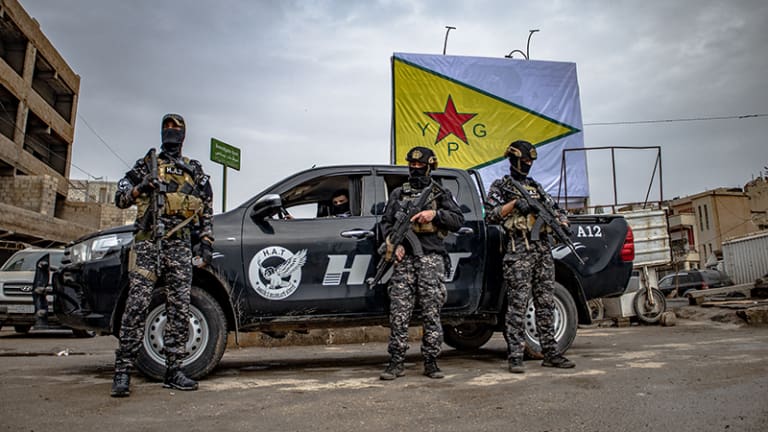
The December 2024 rise to power of Ahmed al-Sharaa, leader of the Islamist militia Hay’at Tahrir al-Sham (HTS), was alarming to the Kurdish-dominated SDF because of the organization’s reported ties to Turkey, which had strongly opposed the autonomous administration in northeast Syria. The SDF’s Kurdish elements are primarily composed of forces from the People’s Protection Units (YPG), a militia attached to the Democratic Union Party (PYD), which is originally an offshoot of the Turkey-based Kurdistan Workers Party (PKK). Ankara consequently regards the SDF’s Kurdish fighters as little more than an extension of the PKK, which it has long designated as a terrorist group.
Al-Sharaa has opposed the principle of regional autonomy in favor of a strong central state
Al-Sharaa, Syria’s interim president, has opposed the principle of regional autonomy in favor of a strong central state. Tensions over the extent of centralization no doubt fueled the July 2025 clashes in the Druze-majority southern governorate of al-Suwayda, which resulted in hundreds of civilian deaths. In March 2025, al-Sharaa and the SDF reached an agreement over re-integrating the north-east with the rest of the country, but ongoing distrust meant that this agreement proved impossible to implement. When SDF leader Mazloum Abdi was unable—or unwilling—to persuade his base of the need to compromise with Damascus, al-Sharaa lost faith in the credibility of the negotiations.
By early January 2026, talks had fallen apart and small-scale exchanges of fire between the two sides had become commonplace. After SDF drones targeted government police vehicles east of Aleppo on January 5, the situation rapidly deteriorated. Clashes spread to Aleppo itself, where SDF fighters held two Kurdish-majority neighborhoods from which they bombarded residential neighborhoods under government control. As many as 148,000 people were displaced before fighting stopped and the SDF withdrew from Aleppo on January 10. The SDF leadership then lost control of the eastern governorates of Deir Ezzor and Raqqa when its Arab units defected to the national government. By January 18, the SDF had lost about 80 percent of the territory that it had held at the start of the year. All that was left were areas of the northeast around the cities of Qamishli and Hasaka and the town of Kobane on Syria’s border with Turkey. These areas have a higher density of Kurds than other parts of the territories formerly held by DAANES and the PYD has controlled them politically over a considerably longer period.
A New Agreement
In late January 2026, new negotiations between the SDF and the Syrian government resulted in a “comprehensive agreement” that has generally been implemented despite some violations. Three SDF brigades will soon be incorporated into the Syrian army as whole units, and an SDF unit in Kobane will be incorporated into a division affiliated to the Aleppo governorate. The Hasaka division of the Syrian army will also include the all-female Kurdish fighting force associated with the YPG. DAANES institutions and civil servants will be integrated into the Syrian state bureaucracy.
In addition, provisions have been made to secure civil and educational rights for the Kurds (such as teaching Kurdish in Kurdish-populated areas of Syria) and to allow displaced Kurdish residents to return to their homes. A government decree has made Kurdish an official national language of the country and the Kurdish holiday of Newroz an official public holiday, and citizenship has been granted to tens of thousands of Kurds who had been effectively stateless since 1962. DAANES officials have pushed for these rights to be incorporated into the Syrian constitution so that they will be binding in the future.
Although the Syrian government reduced what is left of DAANES to a small territory, the SDF was able to maintain its position that its military brigades should be integrated into the army as whole units. It appears that US officials helped to bring about this agreement. On January 30, 2026, after the January 2026 agreement had been signed, the US Ambassador to Turkey and Special Envoy to Syria Thomas Barrack wrote on social media:
[B]y facilitating the phased integration of military, security and administrative structures into unified state institutions – while ensuring senior SDF representatives have opportunities to contribute at high levels – it affirms the principle that Syria’s strength emerges from embracing diversity and addressing the legitimate aspirations of all its peoples.
Waning US Support
Washington’s support for the SDF is not what it once was. The SDF had been the main US proxy in its local campaign against IS in Syria for more than a decade and took heavy casualties in that fighting. Nevertheless, Washington is now clearly favoring the central government in Damascus and putting its stock in al-Sharaa. On February 20, 2026, US President Donald Trump said that al-Sharaa, “who I essentially put there, is doing a phenomenal job. He is a rough guy; he is not a choir boy…[But Syria is] coming together well, and thus far [al-Sharaa] has been very good to the Kurds.” According to Secretary of State Marco Rubio, Trump personally weighed in with al-Sharaa to stop the fighting in January.
In addition to wanting al-Sharaa to succeed as the leader of a unified Syria, the Trump administration is pursuing policies that weaken SDF leverage over Washington. In recent weeks, the US military has transferred thousands of alleged IS members held in SDF detention camps out of Syria and into facilities in Iraq. Most of the remaining prisoners are to be placed under Syrian government control. In addition, the administration is planning to withdraw all US troops from Syria—a Trump ambition that goes back to his first term in office—and has already withdrawn troops from the al-Tanf military base on the Syrian-Iraqi-Jordanian border. US CENTCOM has undertaken scores of air strikes on IS targets in Syria in the past two months; these strikes will likely continue without the cooperation of the SDF on the ground. The United States has encouraged al-Sharaa’s government to officially join its anti-IS coalition, underscoring the heightened importance of the partnership with Damascus relative to Washington’s old alignment with the SDF.
Few Good Options
Once the US military fully withdraws from Syria, the SDF’s ability to hold on to its remaining positions will become more precarious. The presence of US troops in northeastern Syria often acted as a deterrent to a Turkish invasion (although in October 2019, Turkish President Recep Tayyip Erdogan did convince Trump to withdraw troops from a corridor adjacent to the Turkish border to make way for an attack on SDF/YPG forces in which hundreds were killed, causing tens of thousands of people to flee). Although Ankara undoubtedly was happy that the SDF lost territory, Turkey remains wary of any entity that includes the YPG. Erdogan has urged Syrian Kurdish forces that Turkey regards as extensions of the PKK to lay down their arms and disband.
Al-Sharaa may be betting that time is on his side as the central government penetrates the northeast.
Al-Sharaa appears to be in a waiting mode. He may be betting that time is on his side as the institutions of central government penetrate the northeast. Indeed, in early February 2026, Damascus deployed some interior ministry forces to Qamishli and Hasaka as part of the agreement. Over time, such steps will erode the region’s former autonomy. The economic standing of what remains of DAANES has been negatively affected by the loss of the Deir Ezzor oil fields. Some three-quarters of SDF revenues previously came from selling this oil on the black market, generating an estimated $1 billion a year. As the area under DAANES control is now mainly agricultural and pastoral, it is difficult to see how a regional government in the northeast can survive without external backing.
Who Will Come to Help?
Although Syrian Kurds have often been critical of the SDF in the past, the lack of alternative options has reportedly prompted many to rally to its cause since the SDF regrouped in its core territory. The SDF has even made some political gains in recent weeks. At the January 2026 World Economic Forum in Davos, Switzerland, the Prime Minister of Iraq’s Kurdistan Region, Masrour Barzani, publicly declared his support for Syria’s Kurds. Iraq’s Kurdistan Democratic Party (KDP), led by the Barzani family, previously had poor relations with the SDF, but upon the prime minister’s recommendation the Barzani Charity Foundation sent large amounts of humanitarian aid into northeast Syria. The changed position of the KDP may reflect the growing sympathy of Iraqi Kurds for Kurds in Syria. In February 2026, SDF leader Mazloum Abdi was able to travel to the Munich Security Conference and had several meetings with senior Western officials. This was the first time that he had been given such an opportunity outside of Syria, and it placed him and the SDF on the world stage.
Despite these developments, longstanding intra-Kurdish animosities continue to hinder Kurdish unity. While the KDP and other Kurdish factions may have had a change of heart, this does not mean that they will resist pressure from neighboring countries to halt such assistance in the future, much less rush to defend the SDF in the event of an external attack. The SDF thus needs to look elsewhere for support.
Support in Congress: The SDF’s Last Card?
Few issues have bipartisan support in the US Congress, but the Syrian Kurds may be one of them. In late January 2026, Senators Lindsey Graham (R-SC), a main Trump ally, and Richard Blumenthal (D-CT) introduced the “Save the Kurds Act” after the fighting on the ground earlier that month. The legislation proposes placing sanctions on Syrian officials and financial institutions, as well as on foreign individuals who engage in any kind of transactions with Syria’s national government. Several prominent members of the US House of Representatives, including the ranking Democrat on the Committee on Foreign Affairs, Gregory Meeks (D-NY), said that Congress could bring back the Caesar Act (which sanctioned foreign firms doing business with Syria and was repealed in December 2025) if Damascus does not protect the rights of minority groups, among other demands. Pressure from Congress has been credited with helping to sway al-Sharaa into accepting the integration of SDF fighters into the Syrian army as whole brigades, not as individuals.
Congress may exert some influence over US policy in Syria, yet it is the president who directs foreign policy. Trump has declared his preferences: a strong Damascus under al-Sharaa’s leadership and a US troop withdrawal. Hence, it is unlikely that Congress will act to save what is left of the Kurdish project of regional autonomy in northeast Syria. In Syria, as elsewhere, betting on foreign patrons is a losing proposition for the Kurds.
The views expressed in this publication are the author’s own and do not necessarily reflect the position of Arab Center Washington DC, its staff, or its Board of Directors.
Featured image credit: Amjad Kurdo / Middle East Images / Middle East Images via AFP