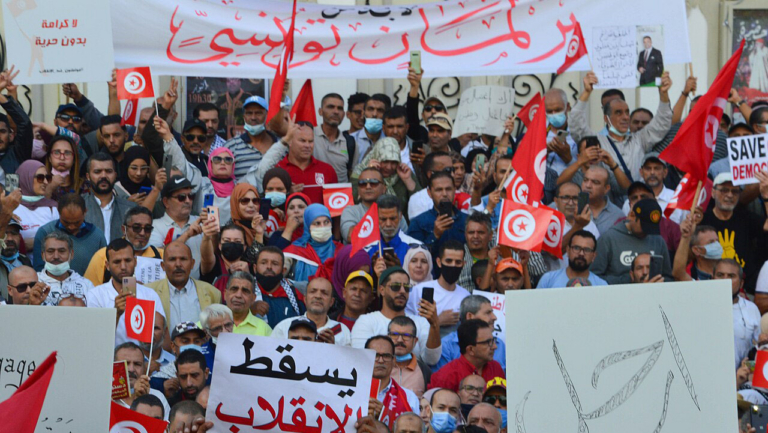
Tunisia’s sudden and unexpected “Revolution of Dignity” in December 2010 triggered political uprisings across the Middle East and North Africa.1 While most of the countries in the region saw either the reimposition of autocracy or the onset of violent civil conflicts in the years that followed, Tunisia was the only country whose leaders negotiated the terms of a transition to a more competitive democracy.2 Although Tunisia’s transition was a remarkable achievement, it depended on a power-sharing arrangement between leaders and parties that was meant to diminish domestic conflicts but instead magnified rivalries among them. As elite and societal polarization and fragmentation set in, the wider populace grew profoundly disillusioned with the country’s increasingly ineffective parties and parliament, thus setting the stage for President Kais Saied to shut down parliament and begin reestablishing an autocracy in July 2021.3
Tunisia’s experience highlights the challenges of democratic transitions centered on negotiation and power sharing. These challenges stem from a fundamental paradox: while democratic transitions often require new political forces to concede to old regime actors and institutions that want to protect their power, such concessions can undermine further democratization. The tricky task for political leaders is to ensure that a successful operation to exit autocracy what is called a “first transition,” does not kill the democratic patient in the process, thereby ending a second transition to a more robust democracy.
Moving to a second transition can be difficult. Indeed, leaders must often choose between two options. On the one hand, they can sustain a power-sharing arrangement that includes all relevant parties but also gives all members of the governing coalition the means to veto or oppose their rivals’ policies. In practice, this negative consensus hinders major political, economic, and legal reforms, inviting governmental paralysis. On the other hand, leaders can pursue broader reforms that consolidate democracy but might also give rivals the means to impose permanent power, raising fears of what is called “democratic shutout.” Such fears often induce some groups to sabotage further democratic reforms. At its essence, the transition dilemma means choosing between two poor options, the second of which can become especially perilous.
Grappling With Complexity: Key Questions
From Revolution to Elite Pact: The Impact of Authoritarian Legacies in Tunisia
In power-sharing transitions, new political forces have a strong impetus to make concessions to ancien régime actors and institutions. This concessionary approach prevailed in Tunisia, where a popular if inchoate revolt—driven by segments of the population that had not benefited from the dramatic economic growth of the previous two decades—sought revolutionary change.4 Leaders from the urban professional class transformed what had started as a popular uprising undertaken in the name of dignity and social justice into a distinct political project, shifting the locus of political mobilization from the countryside to Tunis and the northern coast.5
Understanding how old and new leaders were incorporated into this transition and its future trajectory means paying close attention to the institutional, ideological, social, and cultural legacies produced by more than fifty years of autocratic rule. It was these legacies, reborn in the context of elite power-sharing negotiations—rather than one-dimensional or static notions of “Tunisian exceptionalism”—that both supported and hindered the transition, as leaders drew on old and new institutions to shape it. History matters, but what leaders choose to do with that history matters even more.
Democratic Backsliding vs. Reform Struggles
Tunisia’s rocky transition has often been analyzed as a case of “democratic backsliding.” The concept denotes a process of executive aggrandizement by which the judiciary and legislature are subordinated to an increasingly powerful executive, producing a dynamic that can create a more illiberal or even autocratic system.6 But for Tunisia, the concept is problematic as it presumes a slow, if uneven, forward march toward democracy only to “slide back.” In reality, Tunisia’s transition revolved around an elite pact, which by its very nature created obstacles to broader democratic consolidation. Leaders implemented reforms with conflicting—and sometimes opposing—political, social, and even ideological agendas.7 The result of these reform struggles was less a process of democratic backsliding than one of fractured, disorganized, and paralyzed reforms that reflected the political system’s elite nature, which ultimately failed to create effective mechanisms for democratic accountability, economic growth, and social justice.
The Nature, Evolution, and Impact of Conflicts over State and Religion
Tunisia’s reform struggles were shaped by multiple divisions—economic, social, political, ideological, and cultural—reflecting the complexity of the country’s history and society, as well as the multiple identities that define it. One key cleavage in Tunisia’s fractured socio-political landscape is the divide between those factions who seek to distance the practice of religion in this conservative Muslim society from the authority of public institutions and those who want public institutions, including the elected legislature and the executive, to have greater authority to defend and shape traditional religious values—albeit with unclear limitations.8
Dichotomous terms such as “secular versus Islamist,” or “modernist versus traditional” are imperfect markers for this identity cleavage in the Tunisian context. But the Islamist/secular divide—best exemplified by the Ennahda and Nidaa Tounes parties—was politically consequential. The shift to competitive party politics propelled this divide. The leaders of both parties deliberately manipulated societal fears about the role of religion in politics in order to enhance their power among their supporters and rivals alike. These fears had deep historical, cultural, and ideological roots. In the end, the interplay between elite-driven and society-driven polarization took its toll on all reform struggles, including the 2013 National Dialogue; the writing of electoral laws; the creation of the 2014 Constitution; the negotiation of a mixed system in which the powers of the executive and legislature were often ambiguously defined; the fraught working of the Independent High Authority for Elections; the travails of the transitional justice process; the stalled reform of the Inheritance Law; and the failure to appoint a Constitutional Court.9 All these reform struggles were, to varying degrees, affected by identity conflicts and fears of political exclusion.
Leadership Dilemmas Under the Conditions of Polarization and Fragmentation
These fears created dilemmas for political leaders. The concessions that Ennahda party’s Rachid Ghannouchi and Nidaa Tounes’s Beji Caid Essebsi made to sustain their power-sharing arrangement often alienated their own supporters and invited internal party fractures. Personal rivalries, weak internal democratic procedures in key parties, and the personalistic nature of party leadership further fostered party infighting. As a result, polarization and fragmentation accelerated in tandem, as illustrated by the growing number of small parties. Party leaders’ efforts to navigate the competing logics of party unity and power-sharing unfolded through a series of critical decision-making junctures from 2016 to 2019, a period of increasing political fracturing that reached new heights in the 2019 parliamentary and presidential elections.10 In the ensuing two years, a succession of prime ministers struggled to sustain unruly coalitions, while the newly elected President Saied ignored a parliament whose escalating internal social, personal, and ideological conflicts hindered much-needed reforms in the economy, judiciary, and security sector.
The Human Element and the Abiding Challenge of Institutional Capacity
Beyond identity conflicts and other political dynamics, Tunisia’s transition was shaped by the more intangible but critical human element. Public officials in reform bodies such as the National Election Commission and the Truth and Dignity Commission (TDC) faced limited economic and human resources, unrealistic time constraints, and a lack of governance experience.11 Stress and exhaustion weakened institutional capacity, making it harder for public officials seeking to advance effective reforms in highly contentious arenas, such as the TDC, to fend off political forces that sought to interfere in or undermine their work.
Domestic Versus Regional and Global Dynamics
In Tunisia, as in many other countries, domestic forces shape the boundaries of external influence, deflecting or enhancing its impact on domestic transition dynamics and elite rivalries. Regional security challenges in Algeria, Egypt, Libya, and further afield in Iraq and Syria exacerbated security threats in Tunisia. These threats not only reinforced the security apparatus’s power but also gave party leaders from Nidaa Tounes and Ennahda an incentive to cling to the life raft of power-sharing, even as their mutual suspicions and animosities grew. This dynamic was especially marked during the 2011–2013 Troika government, a crisis period punctuated by domestic political violence and wider regional security challenges. On this score, the July 2013 coup against Egypt’s president, Mohamed Morsi, played an important role.12 While it prompted some Tunisian leaders to try to sabotage the entire transition, it gave other politicians the impetus they needed to negotiate a power-sharing pact that may have saved Tunisia’s democratic transition, even if the power-sharing solution adopted in 2014 created another set of enduring challenges for the country’s leaders.
Another critical factor was the constraints created by the intersecting effects of global economic dependency and stunted crony-based market reforms, which together fostered widespread corruption and discouraged much-needed foreign investment in the more productive sectors of the economy. Against a backdrop of growing security challenges at home and abroad, this perfect storm of domestic, regional, and global forces took a heavy toll.
The Tunisian Experience: Key Insights
- The institutional, cultural, and socio-economic legacies bequeathed by decades of authoritarian rule created a challenging transition terrain. New political actors had to accommodate ancien régime institutions anchored in the courts, security sector, and business patronage networks, giving them enormous clout. Political parties, especially those that the previous regime had co-opted, were dominated by personalities with little experience of leading effective, independent parties. The shock of regime collapse and the chaotic power struggles that followed further complicated efforts to advance coherent democratic change under the umbrella of effective political parties.
- Many leaders met these challenges with courage during a period of rising domestic political violence and regional instability. Under these trying conditions, forming a power-sharing government in 2014 saved Tunisia from escalating internal conflict and/or a return to autocracy. Spurred by the 2013–14 National Dialogue—an initiative that won its leaders the 2015 Nobel Peace Prize—the negotiation of a political pact between groups with rival political visions nevertheless institutionalized and even magnified, in practice, the many social, economic, and especially identity conflicts. Tunisia’s leaders ultimately failed to foster the trust and shared vision of democracy needed to move beyond a kind of political ceasefire.
- The resulting paralysis of the political system—and absent or weak reforms in the economy, the security sector, the courts, and other arenas—alienated average Tunisians in the poorer regions and towns. Popular disenchantment with an elite system widely viewed as feckless, corrupt, and distant from Tunisians’ everyday worries set the stage for President Saied’s populist authoritarian project in 2021.
- During the first years of the democratic transition, the security environment in North Africa and the Middle East magnified the perceived risk of moving the short-term safety net of power-sharing, as rival parties and leaders feared that any change in the status quo would benefit their rivals and their perceived foreign allies or supporters.
- Faced with mounting security challenges, European and US leaders (during the Obama administration) shifted their focus to security assistance. As a result, many policymakers in Washington and European capitals grew complacent about Tunisia’s transition—especially at the highest levels of policymaking. US democracy assistance continued. However, most of this aid pivoted toward partnerships with urban-based NGOs and political parties, inadvertently reinforcing a growing elite-popular chasm that eroded the legitimacy of Tunisia’s weak and increasingly ineffective political institutions.
- Tunisia’s bickering leaders further fostered this political paralysis. Nevertheless, President Saied ultimately bears responsibility for advancing a populist authoritarian project that has eroded basic human and civil rights. Popular disaffection with the political elite—many of whom have been unjustly imprisoned without any pretense of due process—sustains a president who relies on a co-opted military and a resurgent security apparatus to enforce his will.
- The future of President Saied’s authoritarian project remains unclear. Even if he is removed from power or cedes power to another leader or autocratic institution, such as the military, Tunisia’s populist autocracy is likely to endure absent one crucial condition: a unified political opposition that can transcend the social, political, and identity divisions that fractured the transition. The revival of pluralistic democracy will probably be a generational project.
The Role and Constrained Impact of Outside Powers
- In the early years of the transition, foreign democracy assistance and constitutional experts played a vital role in helping Tunisian leaders and scholars forge some of the initial compromises that made the transition possible. The immediate focus was on preventing a breakdown of the process, especially in the summer of 2013. At the time, an elite-negotiated power-sharing approach seemed the best way to ensure stability. For the US, power-sharing was—and still remains—a policy “default button” that it has used in other countries or regions such as the Balkans, Iraq, and South Africa.
- Tunisia’s power-sharing government offered an image of success that contrasted markedly with the experience of other Arab countries following the 2010-11 uprisings. Focused on this accomplishment, foreign leaders and democracy assistance experts did not dwell on the longer-term costs of power-sharing even as these costs became more evident. Tunisia was a classic case of what political scientists refer to as “stabilitocracy.”13
- A series of security challenges—including the September 2012 terrorist attack on the US embassy in Tunisia, the 2013 assassination of two prominent Tunisian leaders, and mounting instability along Tunisia’s borders—not only reinforced Western powers’ preference to support the status quo, but also encouraged Washington to focus on security assistance that, among other outcomes, provided little impulse for a serious and sustained reform of the vast and re-emerging domestic security apparatus.14
- The clout of the police and other security bodies—demonstrated by the creation of police unions—underscored the challenge that external players faced in shaping Tunisian leaders’ choices, especially those that could have a major impact on the internal—if increasingly precarious—balance of power. The higher the stakes for domestic actors, the harder it became for US democracy assistance efforts to influence their preferences and decisions.
- One result of these constraints was that key elements of the original power-sharing formula survived, even as evidence mounted that negative consensus had paralyzed much-needed reforms. For example, the proportional system set up in the 2014 electoral law was designed to prevent any one party from gaining a majority.15 Many leaders recognized that to create a more coherent majority, the law would have to be reformed. But leaders resisted such reforms for fear that they would empower their rivals. Similarly, the Constitution and electoral law’s provisions for appointing a 12-member Constitutional Court gave rival leaders a kind of veto over the appointment of this proposed legal body, thus creating a roadblock to what would have been the only high court in the Arab world with the right to independent judicial review. The failure to create the court inadvertently facilitated Saied’s 2021 power grab.
- The ultimately stalled process of market-oriented reform also reflected a kind of mutual veto system that gave powerful players, not least the Tunisian General Labor Union (UGTT), the capacity to oppose reforms rather than renegotiate their terms. External actors, led by the International Monetary Fund (IMF) with US backing, supported a familiar process of stabilization and structural adjustment. However, these actors were unable or unwilling to push Tunisian leaders to adopt the deeper institutional reforms needed to provide accountability and deflect rent-seeking through expanding crony networks.
- Tunisia’s transitional process faced similar challenges. To be clear, Tunisia created the most ambitious transitional justice experiment ever undertaken in the Arab world. The very nature of these ambitions, the burdensome tasks placed on the leaders of the Truth and Dignity Commission, and the endless interference from political leaders and security sector actors ultimately undermined this extraordinary initiative. It is telling that advisors from the US and other countries supported the commission’s work but were unwilling or unable to help it deflect the actions of multiple spoilers.
- Hindsight being 20/20, it is easy to underscore the failure of US and other Western countries to offer the kind of “tough love” that Tunisian leaders needed. But US resistance to rocking the boat inadvertently deepened Tunisia’s political and social crises. The key policy lesson is that US democracy assistance organizations must pay systematic attention to the challenges of moving from first to second transitions. They must identify the specific reforms a particular country requires and the key elements of those reforms. For this purpose, a focus on backsliding can be a distraction. Instead, they need to grasp the many intertwined challenges of consolidation and envision a more integrated strategy for tackling these tasks in each country.
- Security threats complicate efforts to create a more comprehensive reform strategy. Reforms are interdependent; thus, they are far more effective when simultaneously pursued. When security concerns become the overriding focus of US policy, a negative multiplier spreads throughout the wider political system. There are no easy answers to this conundrum. However, democracy assistance organizations and policymakers must first recognize the problem. Moving forward, they must develop strategies to mitigate these trade-offs.
- Ultimately, domestic leaders in Tunisia and other countries must find common ground. But here too, the US may have a role to play, even as external players have their limits. In an era dominated by acute domestic polarization and diminished US government funding for democratic assistance, the role that organizations such as the United States Institute of Peace once played in fostering conflict management has been undercut, even though important organizations such as the International Republican Institute and the National Democratic Institute continue their efforts. However, much has been lost, not only in US-led democracy assistance but also in the fight against poverty and disease in many parts of the Arab world and far beyond. It will take years to repair the damage, but the sooner this process of restoring such assistance begins, the better.
Appendix: Georgetown University’s Tunisia Study Group
The Tunisia Study Group is supported by a major grant from Georgetown University Qatar, with additional support from Georgetown University’s Democracy and Governance Program and Center for Contemporary Arab Studies, Sorbonne University, and Arab Center Washington DC. While drawing insights from the study group’s work, the ideas set out in this paper are solely the responsibility of its two co-authors.
Study Group Members and Topics
Zaid Al-Ali, Visiting Research Scholar, Princeton School of Public and International Affairs. “Judges and Transition in Tunisia.”
Daniel Brumberg, Associate Professor of Political Science, Department of Government, Georgetown University, and Non-resident Senior Fellow, Arab Center Washington DC; Co-Chair, Tunisia Study Group, Georgetown University. “The Transition Dilemma in Negotiated, Power-Sharing Transitions.”
Zied Boussen, Research Fellow, Arab Reform Initiative. “The Lived Experiences and Reform Contestation: The Struggle of Tunisia’s Transitional Justice Process.”
Francesco Cavatorta, Professor of Political Science, Université Laval. “Institutional, Social and Political Legacies of President Ben Ali’s One-Party Autocracy.”
Elyes Ghanmi, independent consultant and founder of the Tunisian Institute for Training of Elected Officials. “Identity Conflict and Power Sharing, 2011-2014.”
Sharan Grewal, Associate Professor of Government, American University, and Non-resident Fellow, Brookings Institution. “The Resurgence of the Military and Domestic Security Forces in Tunisia’s Transition.”
Nathan Grubman, Social Science Researcher, National Democratic Institute, Washington DC. “The Impact of Regional Security Challenges on Tunisia’s Transition.”
Rikke Hostrup Haugbolle, independent researcher, ethnographer, and scholar of NGOs. “State-Building Legacies in Tunisia: La Longue Durée.”
Nizar Jouini, Associate Professor of Economics, Doha Institute for Graduate Studies. “The Politics of Stalled Economic Reforms in Tunisia.”
Allison McCulloch, Professor of Political Science, Brandon University, Canada. “Tunisia’s Experience in Comparative Perspective: Analytical and Practical Insights.”
Xavier Philippe, Professor of Public Law, Law Faculty, University of Paris Sorbonne, and Extraordinary Professor, University of Western Cape. “Writing Tunisia’s Constitution: A Deliberately Dissonant Document.”
Larbi Sadiki, Non-resident Senior Fellow, Middle East Council on Global Affairs. “Kais Saied’s Populist Authoritarian Project.”
Gabor Scheiring, Assistant Professor of Comparative Politics, Georgetown University Qatar. “Dependency and Economic Globalization and the Limits of Democratic Reform in Tunisia and Beyond.”
Sarah Yerkes, Senior Fellow, Middle East Program, Carnegie Endowment for International Peace. “US Foreign Policy and Tunisia’s Transition.”
Sami Zemni, Senior Full Professor, Department of Conflict and Development Studies, Faculty of Political and Social Sciences Ghent University. “The UGTT’s Role in Tunisia’s Transition as both Power Player and Referee.”
1 “Tunisia -The Betrayed Revolution,” Deutsche Welle, May 4, 2026, https://www.dw.com/en/tunisia-the-betrayed-revolution/a-76624564.
2 “Timeline: How the Arab Spring unfolded,” Al Jazeera, January 14, 2021, https://www.aljazeera.com/news/2021/1/14/arab-spring-ten-years-on.
3 George Sadek, “Tunisia: President Suspends Parliament and Ousts Cabinet,” Library of Congress,
https://www.loc.gov/item/global-legal-monitor/2021-08-23/tunisia-president-suspends-parliament-and-ousts-cabinet/.
4 Abubakr Al-Shamahi, “How economic hardship fueled the Arab Spring 10 years ago,” Al Jazeera, December 17, 2020, https://www.aljazeera.com/news/2020/12/17/bread-and-gas-economic-boost-needed-after-arab-spring.
5 Adel Bousnina, “Tunisia’s Regional Inequalities of Development: The Human Development Index and Human Poverty Index by Governorate in Tunisia,” Contemporary Studies in Social Sciences 1, no. 1 (2023): 48-58, doi: 10.31559/CSSS2023.1.1.4.
6 Meg Russell, Alan Renwick, and Lisa James, “What is democratic backsliding?” University College of London Social & Historical Sciences, https://www.ucl.ac.uk/social-historical-sciences/constitution-unit/constitution-unit-publications/constitution-unit-explainers/what-democratic-backsliding.
7 Zulkifli Abdurrahman Usman, Rahma Salbiah, Nauwal Aufa, and Naures Ben Znaidi, “Socio-Political, Legal, and Educational Transformation in Tunisia After the Arab Spring,” Journal of Islamic Civilization 6, no. 2 (2025): 147–165, doi: 10.33086/jic.v6i2.6578.
8 Tarek Amara, “Tunisian Islamists Ennahda move to separate politics, religion,” Reuters, May 20, 2016, https://www.reuters.com/article/world/tunisian-islamists-ennahda-move-to-separate-politics-religion-idUSKCN0YB2LP/.
9 Al Jazeera Centre for Studies, Tunisia: National Dialogue in the Context of Political and Security Challenges Position Paper (10 November 2013), https://studies.aljazeera.net/sites/default/files/articles/documents/2019-11/20131110124449768734Tunisia%20National%20Dialogues.pdf; “Tunisia signs new constitution into law,” Al Jazeera, January 27, 2014, https://www.aljazeera.com/news/2014/1/27/tunisia-signs-new-constitution-into-law; “Rejected poll monitors accuse Tunisia’s election authorities of bias,” Associated Press, September 9, 2024, https://apnews.com/article/tunisia-poll-monitors-election-accreditation-presidential-vote-2c84de290135e410860f5c24f9ce375a; “Tunisia,” International Center for Transitional Justice, https://www.ictj.org/where-we-work/tunisia; Alessandra Bajec, “Will inheritance equality ever be up for debate in Tunisia?,” Al Jazeera, August 22, 2023, https://www.aljazeera.com/features/2023/8/22/will-inheritance-equality-ever-be-up-for-debate-in-tunisia; Luca Utterwulghe, “Tunisia’s Forgotten Court: A Constitutional Oversight and the Rise of Authoritarianism,” Columbia Political Review, March 26, 2024, https://www.cpreview.org/articles/2024/3/tunisias-forgotten-court-a-constitutional-oversight-and-the-rise-of-authoritarianism.
10 Unit for Political Studies, “The Tunisian Elections: Surprise Results and Challenges Ahead,” Arab Center Washington DC, https://arabcenterdc.org/resource/the-tunisian-elections-surprise-results-and-challenges-ahead/.
11 “Tunisia,” ICTJ.
12 Imad K. Harb, “Five Years after Sisi’s Coup: More Repression and a President for Life,” Arab Center Washington DC, https://arabcenterdc.org/resource/five-years-after-sisis-coup-more-repression-and-a-president-for-life/.
13 Srđa Pavlović, “West is best: How ‘stabilitocracy’ undermines democracy building in the Balkans,” LSE Blogs, https://blogs.lse.ac.uk/europpblog/2017/05/05/west-is-best-how-stabilitocracy-undermines-democracy-building-in-the-balkans/.
14 Tarek Amara, “Two dead as protesters attack U.S. embassy in Tunisia,” Reuters, September 14, 2012, https://www.reuters.com/article/world/two-dead-as-protesters-attack-us-embassy-in-tunisia-idUSBRE88D180/; “Tunisian politician Mohamed Brahmi assassinated,” BBC, July 25, 2013, https://www.bbc.com/news/world-africa-23452979.
15 Nidhal Mekki, “Tunisia’s new election law and the consolidation of a new constitutional order,” ConstitutionNet, https://constitutionnet.org/news/tunisias-new-election-law-and-consolidation-new-constitutional-order.