During the summer of 2026—the hottest that Tunisia has recorded since 1950—the state could not keep the lights on. Rolling power outages, some lasting over ten hours, also knocked out the pumping stations that provided drinking water. In response, protests broke out across all 24 governorates. The Tunisian Social Observatory recorded 1,101 protest actions in July and 1,093 in August. Five years after President Kais Saied began dismantling Tunisia’s post-revolutionary political order, this latest crisis strikes at the implicit trade-off on which his rule has rested: fewer freedoms in exchange for a state that provides better for its people than in the past.
Today, Tunisia is no longer a young democracy experiencing backsliding. Its parliament has been replaced by a chamber elected with only 11 percent voter turnout. The judiciary has been purged by decree, and opposition politicians, lawyers, journalists, and activists have been imprisoned—with some receiving sentences of up to 66 years in the 2025 “conspiracy” trial. The 2022 constitution that Saied supported makes the president the head of the executive and leaves the government answerable to him alone.
The Terms of the Bargain
Saied did not seize power in 2021 from a population defending its democracy. By then, Tunisia’s post-revolutionary political system was already facing a serious legitimacy crisis after successive governments made little headway against widespread unemployment, corruption, or longstanding inequalities between the prosperous coast and impoverished interior. For many Tunisians, democracy had come to mean revolving-door cabinets, parliamentary brawls, and deteriorating living standards. Saied presented himself as the antithesis of the ruling political class. When he suspended parliament and dismissed the prime minister on July 25, 2021, crowds celebrated in Tunis. Many saw his actions as a welcomed assault on a political establishment they believed had discredited democracy.
Saied presented himself as the antithesis of the ruling political class.
The bargain many Tunisians implicitly made in supporting Saied was clear: sacrifice some of the disorderly political pluralism of the post-2011 system in favor of a state that would grow stronger and more capable, with an economic dividend to follow. It helped that Saied gave this promise a populist framing when, in 2023, he rejected a $1.9 billion International Monetary Fund (IMF) program as being part of foreign “diktats.” He had also previously blamed food and other shortages on commodity speculators and hoarders, whom he subsequently targeted. Although Tunisia’s economic woes did not begin with Saied, his policies have exacerbated them. Having spurned the IMF, the government increasingly had to borrow domestically, and by mid-2023, inflation had reached 9.3 percent. Growth fell to 0.4 percent in 2023. Today, youth unemployment hovers near 40 percent, and 44 percent of Tunisians identify the economy as the country’s biggest challenge.
The 2014 constitution distributed responsibility for governing the country and its economy among the president, prime minister, parliament, and coalition partners. But the 2022 constitution leaves Saied with no one to share the blame. Saied nevertheless deflects criticism in two ways: by replacing prime ministers (three between 2023 and 2025) and by blaming conspirators and enemies of the state, a strategy that critics have called an “ideology of excuse.”
When the Grid Broke Down
According to the Tunisian Economic Observatory, investment in generating capacity by the state-owned utility company—the Tunisian Company of Electricity and Gas (STEG)—decreased by 87 percent between 2020 and 2025, while some 870 megawatts of projects have been awaiting ministerial approval since 2018. The record-high heat in summer 2026 may have sparked the electricity crisis, but a fiscal strategy that maintained high consumer subsidies ultimately starved the grid of investment. Saied once again evaded responsibility, calling the outages “premeditated acts” by “enemies of the homeland.” As a result, Tunisian prosecutors investigated STEG staff, despite a lack of evidence.
What does make the latest protests significant is the way they combine political and socioeconomic grievances.
The latest widespread protests do not immediately pose a threat to Saied. Tunisia’s opposition is still too fragmented, and political parties have been weakened by mass arrests and public distrust, leaving no coalition capable of turning street mobilizations into a political transition. What does make the latest protests significant, however, is the way they combine political and socioeconomic grievances. In May, protesters marched under a slogan that captured this convergence: “The people are hungry, the prisons are full.” By August, crowds at rallies for Nafas, a new opposition movement, were demanding both working water taps and Saied’s departure from the presidency.
Anger over political prisoners, constitutional provisions, or judicial independence often stays confined to the politically engaged. But electricity cuts, water shortages, food prices, and unemployment reach those Tunisians who have never joined organized opposition movements, who once supported Saied, or who have stopped voting. It appears that the authorities are paying attention to these developments. After the water protests on August 13, 2026, in Borj Erras, near Mahdia, the authorities arrested 12 people, nine of them minors, on charges of plotting against state security.
Performance and Procedure
The Arab Opinion Index’s latest survey, fielded between November 2024 and August 2025, suggested that Saied’s bargain still commanded broad public support eleven months before the electricity crisis. The poll found that trust in the government had reached nearly 77 percent, the highest since 2011. Around 87 percent of the Tunisians polled still believed that democracy remained better than other forms of government, and only 34 percent considered democracy bad for the economy. Trust in the government rose, therefore, even as support for democracy held strong. In other words, Tunisians appeared willing to credit Saied’s results while growing warier of his methods—an indication that they generally judge political legitimacy by performance as well as procedure.
If Saied’s promise of centralization ultimately fails, Tunisians will have surrendered their freedoms without gaining the greater prosperity.
This tension can be traced back to the 2010-11 revolution. Tunisians did not rise up then simply to demand a greater voice and representation. The revolutionaries’ famous call was for jobs, freedom, and national dignity. The post-2011 order produced more freedom than employment. Saied then claimed that centralized authority would bring coherence where democracy had brought paralysis. In practice, Saied has provided less freedom and not enough jobs.
If Saied’s promise of centralization ultimately fails, Tunisians will have surrendered their freedoms without gaining the greater prosperity that was supposed to validate their sacrifice. So far, both a pluralist system that could not properly govern and a top-down, unaccountable system ruled by one man have failed to reconcile Tunisians’ demand for dignity with their equally powerful demand for effective government. Neither model offers a constructive way out. Restoring the 2014 order would revive institutions whose failures made Saied’s rise to power possible. Any future democratic settlement would therefore need to confront the societal exclusions, inequalities, corruption, and state weaknesses that discredited democracy in the first place. Saied, for his part, cannot rule like Ben Ali, Tunisia’s former dictator, without the ruling party apparatus that dominated the country’s politics for decades and the patronage networks that sustained the one-party state and coopted popular discontent.
For a decade, Tunisia stood as evidence that the Arab uprisings could produce a working democracy in the region. It may now offer proof that an authoritarian correction can also fail on its own terms. A ruler who demands obedience in exchange for a state that delivers jobs and services still has to keep the water running.
The views expressed in this publication are the author’s own and do not necessarily reflect the position of Arab Center Washington DC, its staff, or its Board of Directors.
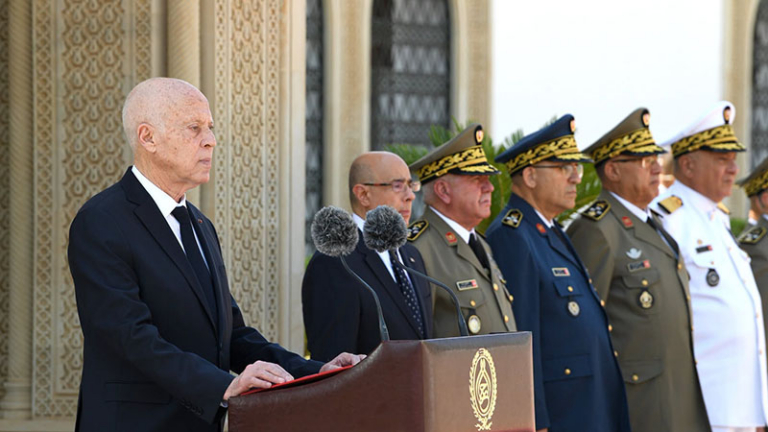
Featured image credit: Tunisian Presidency via Facebook